MORE than a century ago an English ship carried a cargo of ungovernable Indians from the Island of St. Vincent to the coast of Honduras. The emigrants were not all full-blooded Indians. The blood of the African race, with whom they had been compelled to labor, had been mingled with their own. Intermarriages between negro and Indian had produced a race with thick lips and woolly hair, who had all the cunning of the Indian without his filthy habits. This mixed race has spread itself along the coast of Honduras; and from a few hundred individuals, has grown to an equal number of villages—always near water; for the Carib is an amphibious creature.
Upon approaching one of their towns, we see a long line of canoes drawn up on the beach, high above the breakers, and the shining black bodies of children sporting in the surf. As our boat runs in on one of the waves, half a dozen villagers dart from the shade of the cocoanut-trees, grasp the rail of the boat, and draw us far up on the sand.
Beautiful bodies these Caribs have, erect and muscular. “Once,” they say, “before polygamy came among us, there were many giants.” Even now they are a large people. Unconfined at foot or waist, the women are almost as powerful as the men, and accomplish more work. A group of these women marching along the beach with baskets and pails upon their heads, is a sight worth seeing, they are so erect, and their step is so elastic. The children go entirely naked; but of late years, men and women, when visiting the Spanish towns, put on Hondurasian dress. About their work in the native villages, the Carib women wear a sleeveless white cotton garment, reaching a trifle below the knee. The men wear cotton trousers and a straw hat when at work, unless they are in the water.
Though polygamy is practised among the people, the family ties are held more sacred than they are among some other classes of Central Americans. With the exception of the better classes, the Caribs are the most cleanly and industrious people in Honduras. In many respects they are certainly superior to the common Spanish and Indian mixtures, from which the soldiers and petty officials of the republic are drawn.
When a young Carib reaches maturity, he enters the forest, clears an acre or two of ground, and brings in the leaves of the cohune palm,—a tree closely resembling the cocoanut palm,—and spreads them out to dry. Poles are also brought, besides quantities of wild cane. The frame of his house is constructed without nails, wild vines, with which the Central American forests abound, being used in lashing the poles together. The steep roof is covered with thatch made from the cohune leaves, and our “Compy” (a word having among the Caribs much the same meaning as “John” has in America when spoken in reference to the Chinese) prepares for the “raising.” A keg of rum has been smuggled in from Belize; and there is no lack of willing help to empty the keg, and to plaster the basketwork sides and floor of the new home with red clay. Children are allowed a share in the work; for no trowels are used, the mud being thrown on out of the hand, and then smoothed down with the same tool. The doors and window shutters are hewed from cedar, a few wooden bowls are chipped out of mahogany, and a basket-like device is made to assist the young wife in carrying wood, cocoanuts, and wee Caribs. At last all is ready, and wife number one comes in possession of the home and plantation.
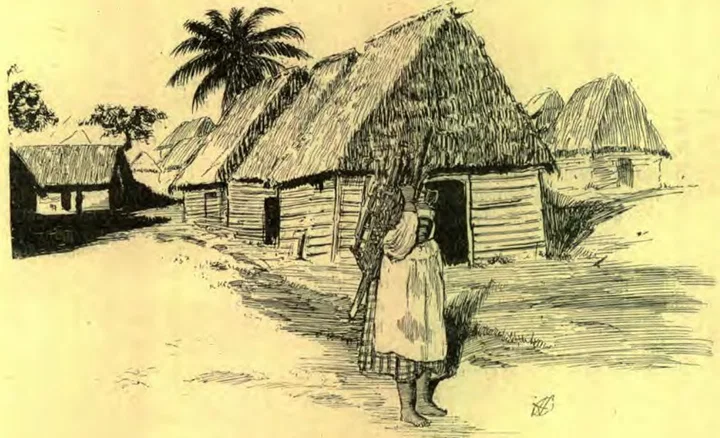
The young husband no longer gives thought, much less labor, to the plantation that he has cleared. The woman plants the cassava, sweet potatoes, yams, and ginger, makes the cassava bread in great cakes three feet in diameter, prepares the fish soup, and keeps the house tidy. “Compy” goes off with the mahogany-cutters to new scenes and conquests.
The Caribs are great wood-choppers. They use a long-handled ax that in their hands is very effective. Often the tree that is desired for lumber has long spurs at the base, and the Carib has to build a scaffold to raise him above them. Immense trees are chopped down in this way, then squared with a broadax, and floated to the mouth of the river, where they are put on board ships bound for England or the United States.
Those who have lived with the Caribs tell us that the women speak a separate language among themselves, besides being able to converse with their husbands and sons in the Carib tongue. This strange custom is accounted for by the following legend: Centuries ago the women of the Caribs were massacred in war, and the bereaved husbands took vengeance by slaying the males of a neighboring tribe, sparing the lives of the women. In time these women became reconciled to their new homes, but never gave up their old language when conversing among themselves. Thus there is a women’s language among them to-day.
Naturally, the Caribs are black; but a sort of skin disease, which begins with an itching, and ends with a deadening and whitening of the skin, is making them a spotted people. A person afflicted with this disease suffers little, except in appearance. The contrast is shocking at first sight, and the foreigner avoids it as he would leprosy. Some have called the disease a mild form of leprosy, but resident physicians class it with eczema.
The young Caribs do as little Americans do,—imitate their parents,—diving in the surf, paddling tiny boats, and fishing. Bright fellows they are, too, who are glad to learn of better things. Already they are asking for a school to be started among them. Let us work and pray to the end that the gospel as it is known to us may be preached to them.
HERBERT OWEN.