ONE RAINY DAY

3%

Review and Herald Publishing Company · Battle Creek, Mich. · Oct 18, 1900

FromThe Youth’s Instructor, Vol. 48, No. 41.

Read the full edition

ONE RAINY DAY

Drip, drippity-drip, fell the raindrops from the gray skies outside the window; and, deary me, drip, drippity-drip, fell the teardrops from a pair of gray eyes inside the window. Just as if that would help any! But it was such a serious matter. For days Ida had looked forward to this morning,—her birthday morning,—for she had been promised a long ride with papa and mama, to visit a dear aunt in the city. And when she awoke, the first thought in her mind was the visit, and the first sound in her ears was the rain. She was so disappointed that she could not eat her breakfast; and now, at ten o’clock, it was raining harder than ever, both indoors and out; for papa had said that if it should stop by ten o’clock, they might still go.
Unable to bear the sight of the falling rain any longer, Ida threw herself down on the sofa, and hid her face in the cushions. Mama, who had tried in vain to comfort her little girl, or interest her in some work, was glad to see her lie down; for she was sure that something would soon happen to comfort, if not to interest, her. What happened proved to be interesting, too; for in a few minutes the rain stopped falling, and Ida put on her hat, and went out in the garden. The sun was very hot, and all the flowers hung their heads feebly. She went around to the east side of the house, where the pansy-beds were, and found all the dear little flower-faces drooping sadly.
“Dear Pansies,” said she, “why do you droop so this bright morning?”
“O Little Ida!” said they, “it is too bright; the sun is too hot. If it would only rain a little, we would hold up our faces again.”
She went into the corn-field: the long blades were hanging limply from their stalks, and some of them looked a little yellow.
“Good Corn,” said she, “why do you not stand up straight and green, as you did a while ago?”
“We need rain,” said the Corn. “Our roots are drying out; and if it does not soon rain, we shall die.”
Then Ida went out on the road; and there she met the old white duck and her nine little yellow ducklings, moping along, and quacking mournfully.
“Ducky,” said Ida, “why don’t you take your little ones to the pond this fine, bright morning?”
“Pond?” said the Duck, “alas! there is no pond any longer. We have been so long without rain that the place where the pond was is now only a dry hollow. Quack! quack! I wish it would rain!”
And all the little Ducks said, “Peep! peep! we wish it would rain!”
“Well, I know there is water in the brook, anyway,” said Ida, and away she went down the road to the bridge. She could hardly believe her eyes—the brook was dry! “Oh, oh! I wonder what has become of all the little fishes!”
Then she heard a little splash, and looking down, she saw a tiny pool under the bridge, and in it one little fish.
“All my brothers and sisters are gone,” he said. “When the water began to get low, they started down to the river. They begged me to go, too; but I loved the brook and the bridge: and I said, ‘Surely it will rain soon;’ so I stayed. And now I am ready to die for lack of water. Oh, I hope it will rain soon.”
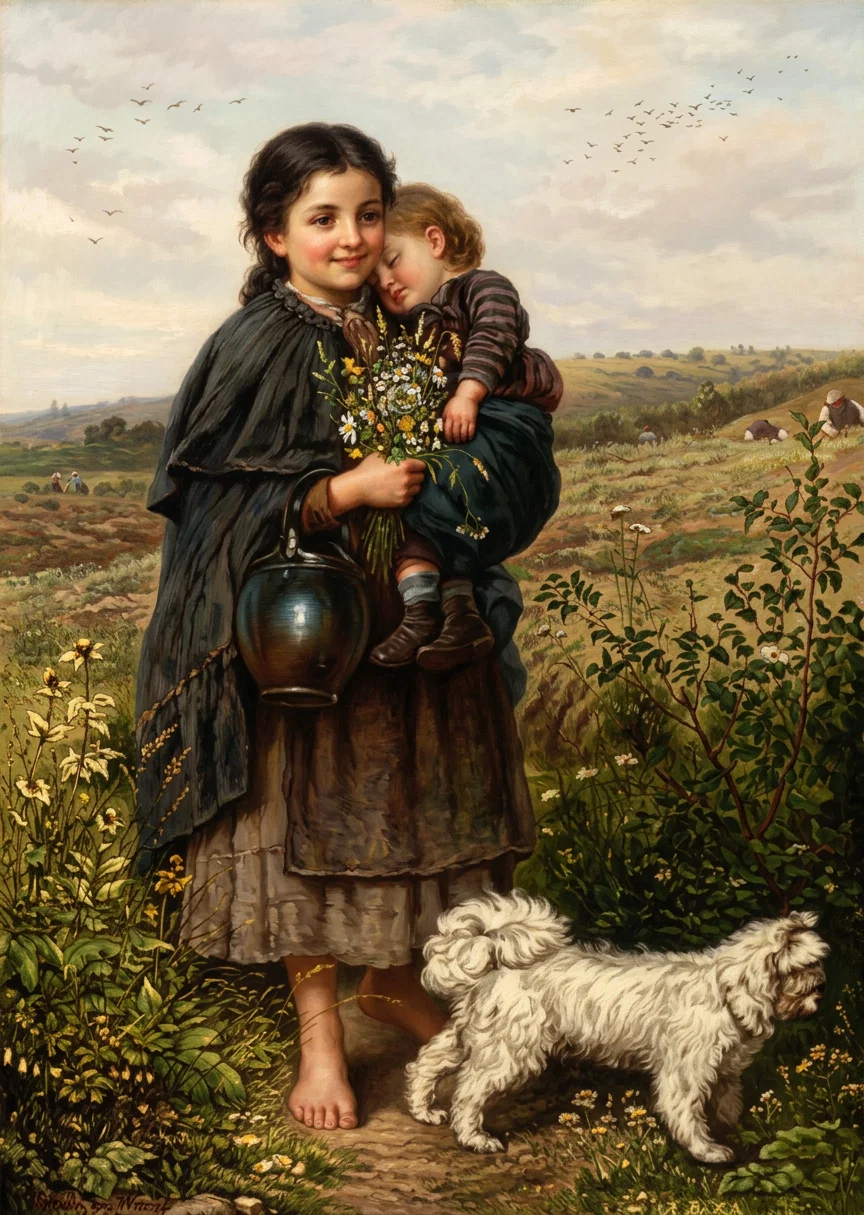
BAREHEAD, ALTHOUGH THE SUN WAS WARMRestored with AI
BAREHEAD, ALTHOUGH THE SUN WAS WARM
“I hope so, too,” said Ida. “Now I will go to the big mill-pond; for there is always plenty of water there.”
Yes, there was water in the mill-pond; but the miller was standing idly in his door.
“Good morning, Mr. Miller,” said she; “why are you not grinding wheat this beautiful morning?”
“Ah, Little Girl!” he replied, “there is not enough water in the pond to turn my wheel, so I am not able to grind. If it does not rain soon, I shall have to give up my mill and go away.”
“I am very sorry, sir,” said Ida; “I hope it will soon rain.” And then, she did not just know how it happened, she was at the river, many miles away. There she saw a fine ship, not moving swiftly along, but standing quite still.
“Fair Ship,” said she, “why are you standing idly here? Have you nothing to do?”
“Dear Little Girl,” answered the Ship, “I am full of wheat and corn and flour. Kind men and women in the city sent me out, laden with food, for the poor people in a land where there is famine for lack of rain. But the summer has been dry, and the river is so low that I am stranded on a sandbar.”
“Oh, dear!” cried Ida, “I gave the money from my ‘Do-without Box’ to help buy bread for them. I wish it would rain! I wish it would rain!”
Then, all at once, she was back on the sofa, and heard the “drip, drippity-drip” of the rain.
“Oh, I am so glad it is raining!” she cried. And jumping up, she climbed on mama’s lap, and told her all about it. “I’m sorry I was so cross about the rain this morning; I did not think how much it was needed,” she exclaimed.
“Well, dear, I’m sorry you did not get your ride; but we needed the rain very much, and we can have our pleasure another day.”
After dinner Ida busied herself with the pretty presents she had received, but which she had felt too mournful to look at in the morning. She was so busy and happy that she did not notice that the rain had ceased falling until she heard wheels on the driveway. Running to the window, she saw papa in the buggy, waiting to take mama and herself for a drive. In a few minutes they were ready; and as she went out, she could not help noticing how fresh and green everything looked. Peeping around the corner of the house, she saw all the little pansy-faces raised happily to her own.
“I’m so glad it rained,” she said as she climbed into the buggy. Over in the corn-field the beautiful green leaves sparkled in the sun. And the old duck and her little ones were all diving, swimming, and quacking in the pond. As Ida and her parents crossed the bridge, a beautiful trout sprang from the water, and Ida was glad to notice that the brook was higher than it had been for some weeks.
“It must have rained hard all night in the hills,” said papa; “yesterday the brook was dry.”
They heard the miller whistling cheerily as they passed the mill; the pond was rising rapidly, and by to-morrow the wheel would be running again.
When it was nearly sundown, they turned toward home. Ida sat very still; and at last papa said, “A penny for your thoughts, dearie.”
“I was just wondering if my ship had got clear of the sandbar yet.”
“Your ship? What ship?” asked papa.
Then Ida had to tell the story all over again. Papa smiled, and patted her cheek when she had finished.
After all, it was a very happy little girl who ended the day by repeating the verse mama gave her to learn: “He . . . sendeth rain on the just and on the unjust.” AUNT BETTY.