WHICH GOT AHEAD?

3%

Review and Herald Publishing Company · Battle Creek, Mich. · Oct 25, 1900

FromThe Youth’s Instructor, Vol. 48, No. 42.

Read the full edition

WHICH GOT AHEAD?

The bell had rung twice, very loudly; and Mrs. Stimson, who happened to be up in the garret looking over rags, hurried down to the door, thinking it must be something very important. For a moment she did not see any one at all, and she looked about in surprise. Then a voice spoke close beside her, and Mrs. Stimson jumped.
“Would you like to have all the weeds pulled out of your lawn?” the voice said, and another sweeter voice added, “It will cost but ten cents.”
There were really two persons at Mrs. Stimson’s door, but they were so small that at first she had looked right over their heads. Mrs. Stimson smiled, and glanced at her lawn, where the weeds had got a good start. Then she looked at the boys.
“It needs weeding badly enough,” she said, “but it’s quite a good deal of work. Don’t you think you’ll get tired before it’s done?”
“No’m,” said both voices at once, and the boys set to work without delay. Mrs. Stimson watched them smilingly a moment before she went back to her rags. George had often pulled weeds before. Willy never had. He fluttered from one to another like a big butterfly. When he hurt his hands, he looked at the red marks on the soft palms, and said, “Ow!” But in spite of this he was enjoying himself. His face was bright with smiles, and the little curls on his head bobbed about as if they liked it too. For several weeks Willy had been saving his money for something that was a secret. George would have liked to know what that was, but he was too proud to ask any questions.
A strange feeling was creeping into George’s heart as he worked. He said to himself that he was very foolish to ask Willy to come along. “I can work twice as fast as he can,” thought George, which was quite true. “I might have done it all myself, and got ten cents instead of five.” George was saving his money to buy a hat and ball. There was no secret about that.
“Aren’t you tired, Willy?” he said, by and by. “Because you’d better not work any more if it’s too hard.”
“I like to get tired,” said Willy, raising his flushed little face, and smiling bravely.
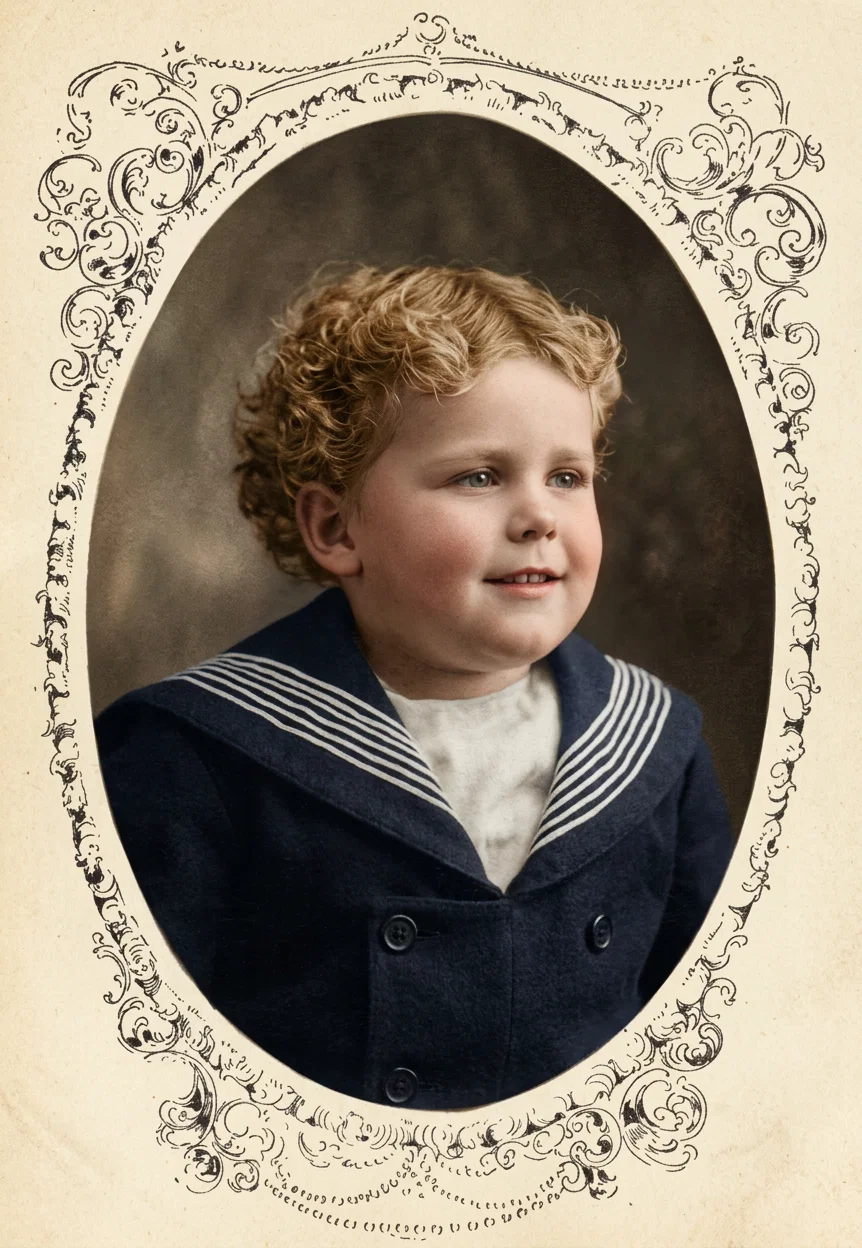
“AND THIS LITTLE LAD’S IS LIKE IT — PRINCE OF THE ROYAL BLOOD”Restored with AI
“AND THIS LITTLE LAD’S IS LIKE IT — PRINCE OF THE ROYAL BLOOD”
“Five cents isn’t much, anyway. You’ve got such a lot of money in your bank I shouldn’t think you’d care for any more,” said George, who had not learned that the more money people have, the more they want, as a general thing.
“I want five cents more,” and Willy smiled happily, “and then I am going to buy something. But it’s a secret.”
George looked cross. He was getting tired of Willy’s secrets and of Willy himself. And then such a mean, unmanly thought whispered to his heart that he would not have listened if he had stopped to think. But as other people do sometimes, he spoke without thinking.
“Say, Willy, if we had a rake, we could work a lot faster.”
“I could get our rake, but it’s an awful long way to my house. Maybe the lady that lives here has got one.”
“I don’t believe she has,” answered George, quickly. “You’d better go home for yours. You needn’t hurry, you know, ’cause it’s so hot.”
After Willy had gone, George worked very fast. His face grew flushed, from stooping, and he breathed fast, as if he had been running. Altogether he felt very uncomfortable, and he said to himself that it was because he was hot and tired.
When he rang the bell again, Mrs. Stimson brought her pocketbook to the door. “Oh, the other boy went home, did he?” she said.
“Yes’m,” answered George. His voice dropped down into a whisper.
“I thought he’d get tired and give up,” said Mrs. Stimson. “He’s such a little fellow.” Then she dropped a shining dime into George’s hand, and he hurried away, almost forgetting to say, “Thank you.”
People usually can find excuses for their own wrong-doing. George found a great many for what he had done. He told himself that Willy had worked only a little while, and that very likely he got to playing when he went for the rake, and never came back at all. Mrs. Stimson must have thought he deserved all the money, or why had she given him a dime? But after he went to bed, he found himself thinking of Willy’s happy face as he pulled up the weeds, and of his smile as he started away to get the rake. What could he think except that his friend was a cheat?
George’s father and mother had gone to a lecture that evening; and when they returned, about ten o’clock, they were surprised to find George sitting on the stairs, dressed and waiting for them.
“I want to go over to Willy’s,” he said, and his voice sounded as if he had been crying.
“To Willy’s! at this time of night!” his mother exclaimed, and his father asked, gravely, “What is the trouble, my boy?”
George explained, though it was not easy to tell the story; and before he had finished, his father had taken up his hat again. “You are right, George,” he said. “This should be settled to-night. You must not wait even till morning.”
Willy’s father and mother had gone to the lecture, too, and they had barely reached home when George and his father came. Willy’s mother seemed to understand George’s errand almost before he spoke it.
“Oh, yes, that five cents,” she said. “I told Willy you would bring it over either to-night or to-morrow morning. Thank you very much.” And George’s cheeks burned over her thanks.
It was still worse next day when Willy made his appearance with a long, queerly shaped package in his arms.
“It’s for you,” he explained, joyfully. “Because I didn’t have any money when it was your birthday.”
It was the longed-for hat and ball. George gasped as if some one had struck him. Then he pushed the gift away, and looked at Willy.
“I never meant to bring you that five cents yesterday,” he said. “And I sent you away on purpose. I was trying to get ahead of you. I meant to cheat.” There was a choke in his voice. He felt as if he hated himself.
“But I want you to have it,” pleaded Willy, in distress. “I’ve been saving my money for so long. And you won’t ever try to cheat anybody again.”
“Well, I guess not,” George answered. “I’ve had enough of that.” And he meant every word. That was the last time he ever tried to get the better of people by unfair means. But more and more, as the years go by, he practices the way Willy taught him,—the way of kindness and love.—Selected.