LEMONCITO TO JUTIGALPA

8%

Review and Herald Publishing Company · Battle Creek, Mich. · Nov 1, 1900

FromThe Youth’s Instructor, Vol. 48, No. 43.

Read the full edition

LEMONCITO TO JUTIGALPA

There is a trail from Lemoncito to Bonito, and thence to Jutigalpa; but our route took us to the Bay Islands of Honduras, and, touching the coast again at Truxillo, we started inland to find the trail before mentioned. Those long days in the saddle, under the tropical sun, and the longer nights, were more interesting to us than their narration can ever be to any one else.
The faithful mules had borne their burdens patiently, and the last steep mountain ridge was almost over, when man and beast, by common consent, stopped to rest. “Machaw! moola! moola!” failed this time to urge the pack-train up the sky-scraping trail that we followed in its alternate turnings from right to left over the mountains. One of the young mules refused to go farther with his burden of two hundred pounds, and sank into the ditch, making a complete blockade. The guide told us that it was the same mule that had insisted on running with his load in the morning,—such is the folly of youth.
The mozos loosed the rawhide cords, and laid the two bundles beside the trail. Our saddle-mules fell to eating the grass that was close by their heads on either side; for the winter torrents had cut the bridle-path so deep that oftentimes we could not see over the sides of it, even when mounted. At this place we could see over the banks and beyond the deep-cut valley, where in the distance the green of the mountains appeared almost blue, and blended with the sky.
“Machaw! machaw! moola! bruton!” The mules snatched a final mouthful, and began to grunt in time with their labored footsteps; and the lad with the conch-shell trumpet joined in with a sweeter part, that echoed far among the hills. We were off.
Beyond the crest a little way the caravan stopped at the door of a hut. Señor Francisco dismounted, and, folding his yellow umbrella, declared that he could go no farther, as he would have to send a mule back for the cargo left behind. It was not yet three o’clock, and our mules were in good spirits; the hut was small, and some of its inmates were suffering with native fever. Therefore we took one of the men, and rode on.
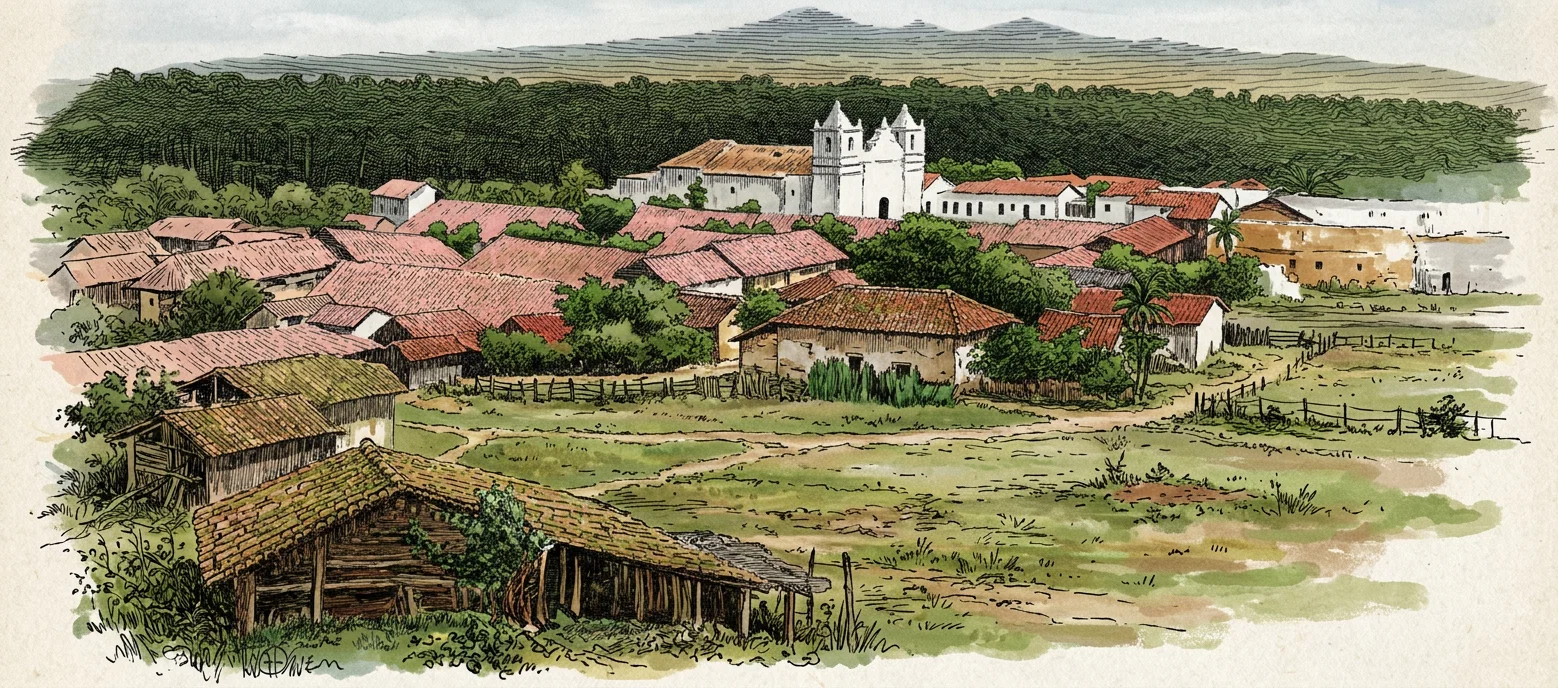
Over the tops of the pines, four thousand feet below, we could see a patch of faded pink, nestling close to the hills. This, the guide told us, was Juticalpa.Restored with AI
Over the tops of the pines, four thousand feet below, we could see a patch of faded pink, nestling close to the hills. This, the guide told us, was Juticalpa.
The trail began a gentle descent as we wound around a ridge; and we saw, far below us, the plains of Olancho. Eastward, there was nothing to break the horizon: the view was such as one obtains in the foothills of our own Rockies. Over the tops of the pines, four thousand feet below, we could see a patch of faded pink nestling close to the hills. This, the guide told us, was Jutigalpa, the capital of the department of Olancho. To the south stretched a flat expanse of green, broken by lighter patches of the same close to the hills. This, the guide told us, was to discern the houses of the cattlemen. The descent was made rapidly, when we turned off on a south-bound ridge, and zigzagged down a path that we hoped never to be compelled to climb. The mules kept their footing, but sometimes the leaps they made seemed leaps to death. The saddle-girths were strong, not a buckle nor stitch gave way, or, even with the beasts on their feet, we should have followed the stones, that, started by their hoofs, sometimes went bounding down the mountain-side.
From the grass-covered ridges we descended rapidly through the pine belt, where the sweet scent of myrrh mingled with that of the evergreens, and, two hours later, found ourselves among the dense forest growth of the valley. The river was not spanned by any bridge,—few of the rivers of Honduras are. The mules plunged in, and picked their way among the boulders, the water coming to the stirrups, and, in mid-stream, to the saddle-girths. Then came a smart climb up the opposite bank to the Camino Real, one of the best cart-roads in the country, though seldom fit for a cart. Three centuries of neglect have taken away nearly all the good qualities of this road, if it ever had any; but it was better than none,—far better, indeed, than the path we had followed for twenty days.
It was not yet dusk when we rode into the city of Jutigalpa. The first houses we saw were the mud-walled huts of the country, but these were displaced by the more substantial adobe walls in the better parts of the town. The sound of the mules’ feet, though unshod, on the cobblestone pavement attracted the attention of Spanish-Indian faces in windows screened by wooden gratings. Many a kindly greeting made us feel that we were among friends, as indeed we were.
Señora Garcia, to whom we carried a note of introduction, led us to her guest-chamber, and ordered tortillas prepared. A large door opening on the street let in light and the glances of passers-by, who stopped in small groups to show their interest in the strangers. Mrs. Owen and the baby were of special interest. Few North American women, and fewer North American babies, ever visit this “Sleepy Hollow” of Central America. The children were especially expressive in their admiration of the little white traveler. Some of these children were selling sweetmeats, others were leading donkeys laden with water. Barefooted, and for the most part happy, these children of Olancho will always be remembered with pleasure. They have inherited the Spanish courtesy, and many of them are really helpful to their parents, bringing water from the river for cooking, and wood for the clay stoves. Some of the older boys are intrusted with the care of an ox-team and cart, and encouraged to take upon themselves other responsibilities.
These children are taught some things, though very imperfectly, about God and heaven; and each night they repeat the prayers taught them by their mothers. But there is small comfort for them in what they learn of Jesus; for they do not learn so much about him as about his mother, and even that does not give them hope, or help them to lead better lives.
H. A. OWEN.