An excellent way to practice is to make an original drawing from an object, using a good example of pen-and-ink work that some artist has applied to a similar object, copying the technique, but not the drawing. Or else draw the object with an entirely different technique, endeavoring to get as true an effect as possible.
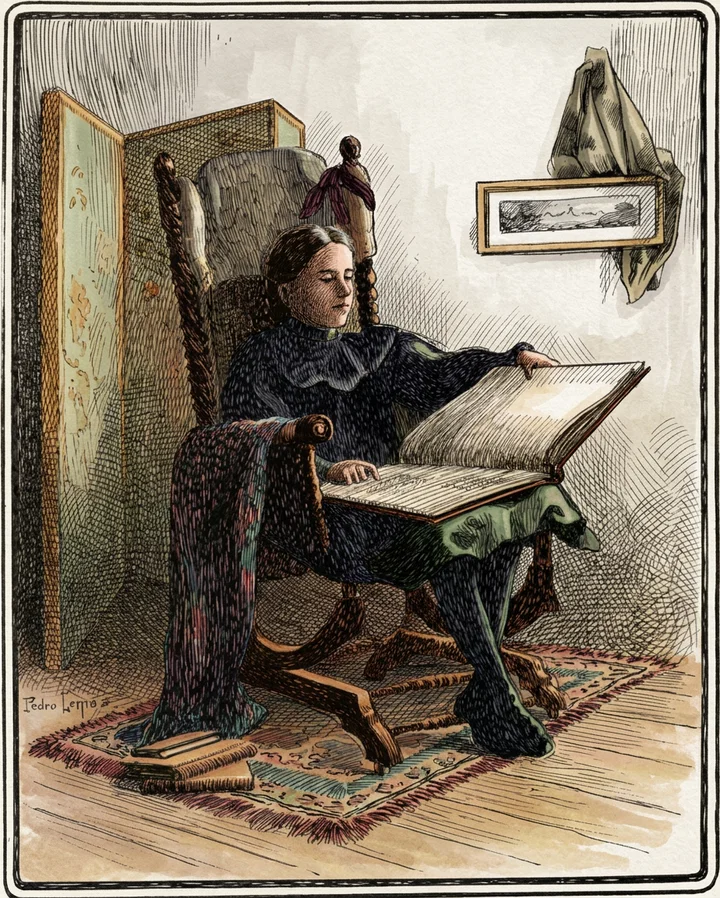
You will observe that some artists use a combination of the three methods explained in the last lesson. In the accompanying illustration you will see how crosshatching has been used in the background, while in the lighter portions of the background an entirely different technique has been used than in the figure. The student will understand that he is not bound to confine himself to one method of technique throughout a picture.
Make your lines strong, full, and vigorous, but not too heavy; let each line stand for something. Freedom in sketching is an artistic quality that beginners will do well to put into their work; but this must not be carried to an extreme. Students should be “carefully careless” after they have gained freedom in handling the pen; but at the beginning, when they must imitate technique, they should be more exact.
Do not fill your work with meaningless dots and dashes, hoping they will lend artistic grace to your drawing; they will not. Learn to draw objects as simply, and with as few lines, as possible.
An artist once remarked that two persons were necessary to the successful painting of a picture,—one to do the work, and the other to stand over him with a club, and tell him when to stop. It is highly important to stop at the right place; many an otherwise good picture has been spoiled by overwork. A pen-picture, of all others, especially if intended for publication, should be simple, as too much detail will interfere with a clear reproduction.
At first it is best to confine yourself to easy and simple subjects. Be careful not to attempt anything beyond you. As we study, and develop our powers of observation, our artistic sense deepens, and there come into our work, qualities that can never be attained by endeavoring to represent that which we are unprepared to grasp. Do not bother yourself too much about any special kind of technique. Try to avoid thinking about your lines as lines, otherwise than to keep them open. Think, instead, of the subject you wish to represent. When you write, you do not stop to consider how you may shape your letters; you select, almost unconsciously, the words from your vocabulary, and the fewest with which you can best express your thoughts. Select from the many lines of an object just those that will best suggest its character.
Make your lines in whatever direction will best express the subject before you. Try experiments; take the lines horizontally, vertically,—in whatever direction will best represent the surface or texture with which you are dealing. Never put in your picture all that you see in an object or scene. The mission of art is to “represent nature, not to imitate her.” Only that which is necessary to complete the idea, to finish the impression received, should bep. 356 drawn. I once heard an excellent artist remark that “it takes as much knowledge to know what to omit from a picture as to know what to put in.”
The student will find that this is true. Many persons think that the picture that is filled with detail, that shows that a large amount of work has been expended upon it, is a greater work of art than some simpler drawing; but one who has a trained eye will criticize such pictures as unnatural. A picture should record only the impression of a scene. Just as it tires us to hear needless detail in a description, so the eye is wearied by seeing the same in a picture. We admire the orator or writer who expresses great thoughts in few words. The best authors sum up their descriptions in a few well-chosen, strong sentences; likewise, the best pictures are those that describe their subjects in the fewest lines and with the least detail.
“In art tell the truth, but not the whole truth.”
PEDRO LEMOS.