LESSON 4 — PHOTOGRAPHS

8%

Review and Herald Publishing Company · Battle Creek, Mich. · Nov 22, 1900

FromThe Youth’s Instructor, Vol. 48, No. 46.

Read the full edition

LESSON 4 — PHOTOGRAPHS

Much help may be received from photographs in the study of pen-work, as one often has access to excellent photographs of walls, trees, etc., water ruffled by the wind and many other effects, which might be difficult to obtain outdoors at the desired time. Careful pen-studies of these will be of great value to the student.
When photographs are used in illustrating, they are reproduced by what is known as the “half-tone” process. Unless the photograph is clear and distinct, the reproduction is not a success. A pen-drawing is generally made if this is the case.
Restored with AI
The student will be tempted, in drawing from a photograph, to put in his drawing all that he sees in the photograph; but he should endeavor to omit all the many small, uninteresting details, which detract from the principal objects of interest.
One of the main things to keep in mind when working from a photograph is that you must look at it, and study it, rather than copy it. Artists claim, and rightly too, that a photograph is not a true representation of nature as seen by the human eye. In it the relative values of color are not preserved. Blue is non-photographical; and as this color enters into nearly all colors of nature, the reader can readily understand how the relative values are not preserved. A dark-blue can be photographed; but it is the black, red, or whatever color is used in making the blue darker, which is photographed: pure blue can not be photographed. Thus while half-tones printed in black ink may be again reproduced, those printed in blue are useless for this purpose.
Just as a flower seen under a microscope is not the image of a flower as seen by the naked eye, so a photograph, of a street scene for instance, brings out hundreds of details, such as bricks, arches, the grain in wood, etc., which the usual pedestrian never notices; while a clever sketch, in which these details are absent, and the essential characteristics, which the eye takes in, are preserved, is a truer representation of what is seen by the human eye. The great charm of a sketch, if successful, is that it gives only what is desired.
When drawing from a photograph, forget that it is a photograph; endeavor to place yourself in the camera’s place, and think how such a scene would have impressed you, and how you would have rendered it with only pen or pencil to record your impressions.
Have you ever come by chance upon a scene that you have never looked upon before, which at first appears charming, but which seems to lose its beauty the more you look at it, or when viewed a second time? It is the detail which is seen after the first glance, that tires the eye, and causes the scene to lose its charm.
It is this first glance, preserved on canvas or paper, that makes a good picture, often more charming than the original. Thus we learn that all unessential details should be omitted when drawing from a photograph, and the main motive preserved.
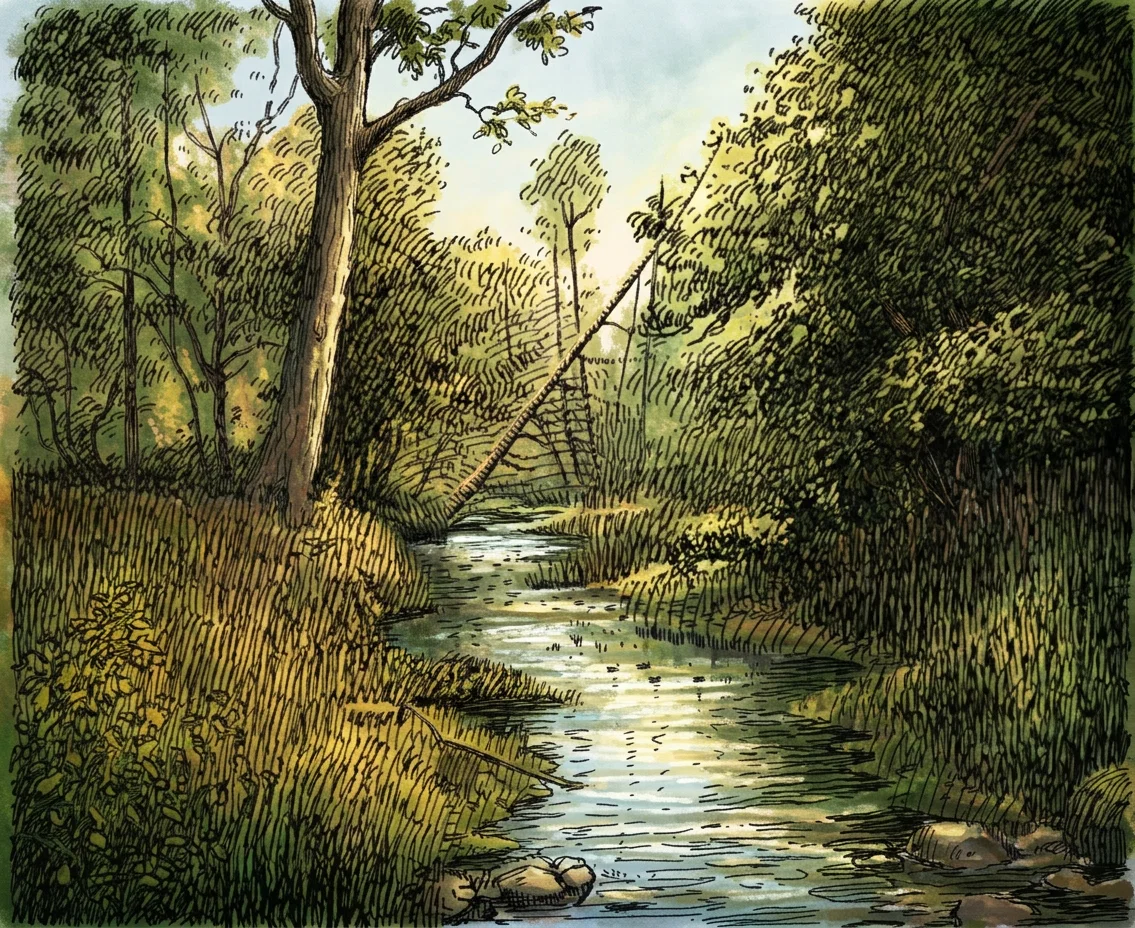
Accompanying this lesson is a reproduction from a photograph, and a pen-drawing made from the reproduction. By comparing the two, the student will see what detail has been omitted.
PEDRO LEMOS.