LESSON 6 — COMPOSITION

6%

Review and Herald Publishing Company · Battle Creek, Mich. · Dec 13, 1900

FromThe Youth’s Instructor, Vol. 48, No. 49.

Read the full edition
LESSON 6 — COMPOSITION
In sketching from nature everything depends on the choice of subject, or what artists call “motive.” The motive is whatever in the subject appeals to the sketcher by its beauty or picturesqueness.
Composition in art is the arrangement of the objects in a subject so they will appear artistic and natural. A landscape is well composed when the trees, distances, and foreground represent masses well weighted and pleasant to the eye.
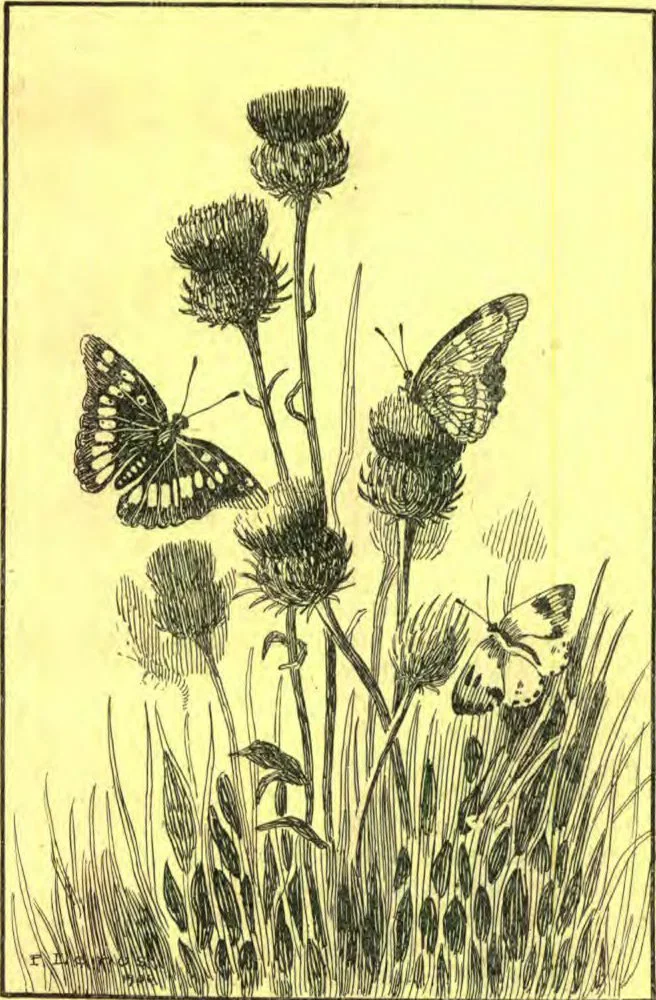
FLOWERS NEED TO BE PLAINLY OUTLINED
It is said that selection is composition, and in nature drawing this is so; for the position of a tree or other principal object in a good picture, so drawn that its relations are correct with the proportions of the picture, is the result of the selection of a suitable point of view.
The student should endeavor to be personal in his selection. To be original in one’s technique is much less possible than individuality in choice of subject. for nature is inexhaustible. Do not select certain views because some favorite artist has done so, nor look for certain subjects because some one else has drawn them. Record your own impressions in your own way.
Select a point of view that will not place the main objects in the scene to one side, or in the corner of your drawing, unless there is some secondary object or group of objects which can be drawn at the opposite side or corner, and so balance the picture. If the composition of the picture is unequally balanced, there will be some part that will look bare, and the whole will have an unfinished appearance.
Draw only what impresses you. A good practice is to draw from memory, at the end of the day, some object or scene that has impressed you; or, after you have studied some object, to make a memory sketch, and then compare it with the original object, and see how faithfully you have represented it. This practice will greatly advance your power of observation. Much of the difficulty experienced by students in making a successful composition is easily avoidable. Let your picture have only a few objects,—those that your eye takes in at the first glance. Do not attempt bird’s-eye views.
These suggestions do not apply to pen-work alone, but should be followed when working with any other medium.
When working with ink, the composition should first be sketched in outline with pencil, as plainly yet lightly as possible, as it must be rubbed out after the drawing is finished, and much rubbing will spoil the surface, and gray the ink. The composition may be made on another piece of paper, and when you are satisfied with it, traced on your bristol-board, before you go to work with your pen. As correct an outline as possible should be drawn; for without a good outline, all character in the drawing is lost.
Outline and light and shade can be learned only by actual studies from nature.
One artist has said: “Whoever can make a good pen-drawing without a careful preliminary pencil sketch of more or less importance, may set himself up for a genius, and be congratulated on his ability to avoid much work. I know a study by Fortuny of a man draped, in which may be seen not only the nude figure, but the anatomy as well, drawn in pencil, which has never been erased.”
Flowers especially need to be plainly outlined; but care should be taken not to put all the detail into the drawing that is seen in the flower. When drawing flowers and plants, the student is tempted to indicate each vein and petal; but unless he is studying the construction of the flower or plant, and wishes to make an exact copy of the specimen, no more should be put in it than is necessary, although he will understand that more detail may be allowed in sketching flowers than in sketching a scene or a figure.
Students are sometimes at a loss to know how to make pen-drawings from a sunset, as the colors and shades are constantly varying. By making a rapid pencil sketch, indicating the lights and shadows roughly, and memorizing the scene as nearly as possible, the student can make a pen-drawing from his “notes,” and will secure much better results than by attempting to make a drawing first.
Many artists compose scenes, just as a musician composes songs. They make sketches of objects or subjects which they wish to introduce in their composition, and to these they refer for outline and character. The student will find this a good method, but he should be careful not to place by a stream or lake a tree that never grows near water, nor to commit other mistakes of like nature.
PEDRO LEMOS.