“Hello, boys! What’s your hurry?” You may trust boys for seeing a joke, under the soberest manner. Sam and Irvine looked at each other a little sheepishly, and giggled. They were, in fact, lagging along like snails.
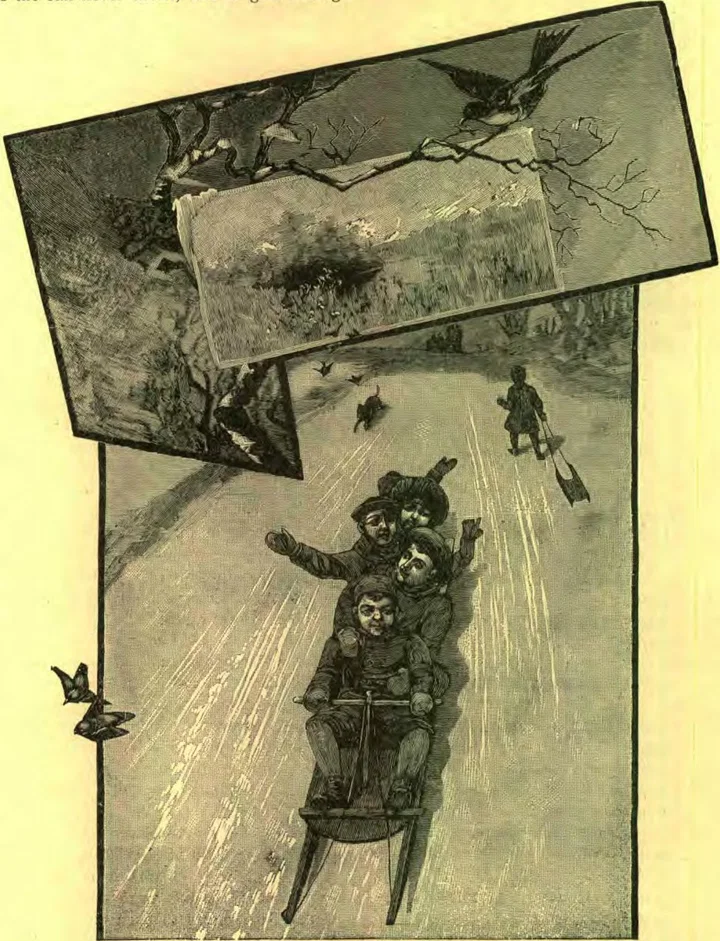
It was one of the very first spring days; there were a few patches of snow left in back yards where the sun never shone, and no green things had yet poked their noses up from the cold, wet earth; but the robins had come, and our boys had seen the flash of a bluebird’s wing that very morning. The sunshine was as sweet as distilled honey and dew, and a kittenish little breeze seemed to be saying, “Stay, and have a frolic with me.”
“You must be going to a picnic,” continued Mr. Pilson, seeing that the boys took kindly to the joke, “from the pace you have on.”
“Much picnic we’re goin’ to!” grumbled Sam. “Much!”
“You wouldn’t call it a picnic, Mr. Pilson,” protested Irvine, “if you had to sit at an old desk all day, and sweat over lessons.”
“Oh, school, is it?” said the farmer, in pretended innocence. “Well, I don’t have benches nor desks at my school; sometimes I wish I had.”
“Where is your school?” asked the boys, suspiciously, alert for another joke.
“Don’t you know where my schoolhouse is? You pass it every day of your lives.”
“What time does your school take up?”
“Take up? Why, it never lets out! It’s in all the time.”
“You’re playing truant then, Mr. Pilson,” said Sam, grinning. “I wouldn’t a’ thought it of you!”
The farmer laughed out big and loud. “Maybe I am, and maybe not,” he said. “I’m sort o’ waitin’ for some new books now. But if you boys don’t mend your hold on the road, you’ll have a lesson to learn that won’t be out of books, or I’m mistaken.”
Sam and Irvine glanced at the sun-clock, like the country boys they were, and set out on a trot, reaching the yellow schoolhouse by the roadside just in time to make a rush with the rest for seats, at the clang of the bell.
I don’t know how they pulled through lessons that lovely day, with whispers coming in at every open window of the delights outside. But the longest hours pass, even when they are clogged at every step with sums in arithmetic, and exercises in grammar, and mysterious events in United States history. At last four o’clock struck, and the steps that had dragged so slowly in the morning now danced on tiptoe, never two aground at one time, and oftenest both in the air!
This time it was their turn to be jocular:p. 390
“Hello, Mr. Pilson! your new books come yet?”
The farmer was ready for them; he left his harrow in the soft earth, and came over to the fence; as he came, he stooped, and took something out from under a bush in the fence-corner. It was a large glass jar, none of your half-gallon contrivances, fit only for jam, but a big, clear jar, that would hold two gallons at least.
Inside, secured by a thick perforated paper securely tied over the wide mouth, was a velvety black butterfly. He had bright yellow spots on his four wings, a double row of them, and on the hind wings some silvery blue spots besides; these hind wings had a funny little tail hanging from each.
“Oh, oh! who ever heard of a butterfly in March!” cried Sam.
Mr. Pilson looked pleased. “So,” he said, “you are a schoolmate of mine?”
“Sir?”
“Certainly you are. How else did you know that my Papilio Asterias was not to be found in March?”
“I don’t know anything about your papho steery, but any boy with two eyes knows that he doesn’t find beauties like that till the flowers come.”
“That’s so,” said the farmer, “it’s like another lesson in my class; a higher lesson, of which my great Teacher says a wayfaring man though a fool need not err therein.”
The boys almost forgot the butterfly, in trying to make out just what this queer farmer meant; for they had a glimmering.
“I see you have guessed my conundrum,” said Mr. Pilson; “my school is God’s big, green world; he gives me new books like this pretty Papilio constantly, but they are only new editions, you understand, of old works.”
Sam and Irvine chuckled; they saw through it now.
“Where did you get him, Mr. Pilson?” they asked.
“Why can’t you call a gentleman by his name?” asked the farmer, frowning; “didn’t I introduce him to you?” And not a word more would he say till both boys had learned the butterfly’s family name. Then, when they knew him for a Papilio Asterias, Mr. Pilson told with glee how he had found three caterpillars on a wild carrot plant last September; how he had brought them home, put them in this handsome jar, and fed them with fresh leaves until one day all three of them had tied themselves up in a curious fashion at the side of the jar, dropped off their outer skins, and left themselves in a chrysalid state,—pale, ugly, knobby things, that looked as if no life belonged to them.
Six months had passed, and here was Sir Papilio in his new body, ready to live his new life; far more beautiful, and free, and active than in the old days, when he was a dull caterpillar, knowing and seeing nothing but a little patch of earth under his wild carrot plant.
The boys were charmed with Mr. Pilson’s beautiful schoolbook; and still happier when he gave them each one of the brown chrysalises that had not yet opened their doors, from which they might see for themselves the dainty and gorgeous creatures come forth.
And you may be sure that this wise old schoolboy did not let these little preparatory pupils get away without telling them about the beautiful new bodies to be given to God’s children, “as it pleaseth him,” when they come up out of their grave chrysalises.—Elizabeth Preston Allen.