Revelation 9; “Thoughts on the Revelation,” Pages 469-487
(December 30 to January 5)
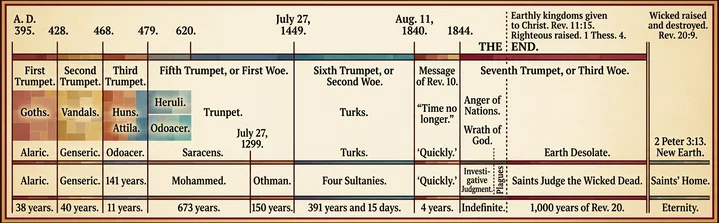
THE first four of the seven trumpets were fulfilled in the hordes of barbarians that poured down upon Western Rome. The church had become corrupt. The Lord represented their condition by the black horse in the third seal. The church at this time not only received the barbarians, but also accepted their pagan ceremonies, and incorporated them with the truth; from this combination the papacy arose during the sounding of the fourth trumpet.
Persia.—The Persia of Media and Persia, which was represented by the “breast and arms of silver,” the “bear,” and the “ram” of Daniel 2, 7, and 8, had passed off the stage of action many centuries before Mohammedanism arose. The Persia referred to as withstanding the rise of Mohammedanism is the restored Persian Empire, which came into power during the first part of the third century, and contended with the Romans for some time. It is the seventh of the kingdoms whose history is given in the “Seven Great Monarchies,” by Rawlinson.
Mohammedanism.—Mohammed was a false prophet who arose in the seventh century. The rise of his religion is commonly dated from 622 A. D., when the prophet fled from Mecca. This date is called the Hegira, by Mohammedans, who reckon from that date as the Jews reckon from creation, and Christians from the birth of Christ. For a little over five hundred years the Mohammedans were ruled by caliphs, but did not form an organized government. Mohammedanism spread very rapidly over Western Asia and Northern Africa, and penetrated into Europe.
The Mohammedans made strong settlements in Spain. For a brief sketch of their influence in Spain, read Chapter IV in “The Peril of the Republic.” The Mohammedans believe in the true God, but regard Jesus as a prophet of less power than Mohammed. Near the close of the thirteenth century the Mohammedans were organized, and a government was established, with Othman at the head. This was the beginning of the Ottoman Empire. The head of this government has ever been the high priest of this religion, holding the highest spiritual as well as secular authority in the nation.
Five Months.—Constantinople was the capital of Eastern Rome. This government is often called the “Greek Empire” to distinguish it from Western Rome, whose headquarters were at the old city of Rome. Eastern Rome, or the “Greek Empire,” was the eastern “third part” of the three divisions into which the Roman Empire was divided after the death of Constantine, in 337 A. D. After the Mohammedans were organized, and “had a king over them,” they began an attack upon the Eastern, or Greek, Empire, July 27, 1299. For one hundred and fifty years they continued to torment and harass the Greek Empire; nevertheless Greek independence continued until 1449 A. D.
The Second Woe.—The papacy was still busy with her bloody work; with an iron hand she was wringing the life blood from the very heart of the church. But God had not forgotten his people. Prior to this he had allowed the Mohammedans to torment the apostate church; but now from the horns of that glorious altar before the throne of God came a voice, saying to the sixth angel, “Loose the four angels which are bound in the great River Euphrates.” There were four principal sultanates of the Ottoman Empire,—Aleppo, Iconium, Damascus, and Bagdad,—situated in the region of the Euphrates. They had been held in check by the Lord; but now, like dogs let loose upon the prey, they soon captured Constantinople, and established their power on the ruins of the Eastern Empire. The same power that had restrained them also set a limit to their freedom. They were loosed for an hour (fifteen days), a day, a month, and a year. Prophetic time reckons a day for a year, which would make this period equal three hundred and ninety-one years and fifteen days. This period ended the eleventh of August, 1840, on which day was sounded the death-knell of Turkish supremacy.
The Seventh Trumpet.—The seventh trumpet, or third woe, is not mentioned in this chapter; but it came “quickly,” four years after the close of the sixth trumpet. It began sounding in 1844, and will continue to sound until Satan and all the wicked are forever destroyed, and woe and sorrow are eternally banished from the universe of God.