When we look over our country, dotted with villages and cities, and listen to the shrill whistle of the iron horse, the noisy whir of machinery, the puffing of engines, and the thousand and one other tokens of our busy, restless civilization, it is hard to realize that there was ever a time when, instead of the whistling train and the belching chimneys of our active industry, the scream of the prowling panther rang through the forests, and the curling smoke of the red man's wigwam was the only sign of human habitation. Yet this state of things existed in many parts of the United States only a comparatively short time ago.
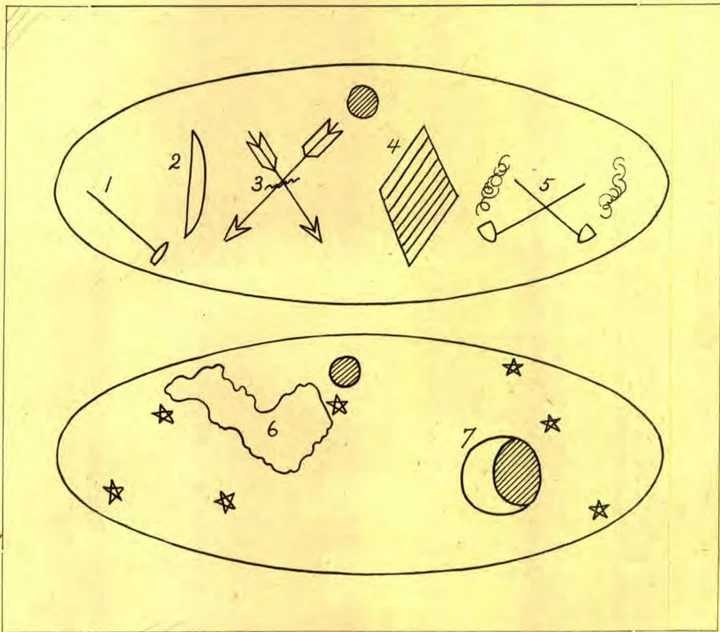
The accompanying pictures are exact representations of the two sides of a stone found on the farm of J. V. Avery, in Conway, Livingston County, Mich., in 1898. The rude pictures seem to have been carved upon it as a record of some important public event. As Fig. 1 represents a weapon as it is being thrown to the ground, and Figs. 2 and 3, a bow with tied arrows pointing downward, while Fig. 5 is a plain representation of the calumet, or pipe of peace, with ascending smoke, it is reasonable to suppose that the whole is intended as a record of a contract of peace between two contending tribes. Fig. 4 is an emblem commonly engraved upon the calumet. The owner of this remarkable stone has also a piece of an ancient calumet, with the same figure upon its bowl. The representation of the moon in eclipse (7) and the stars, together with the cloud (6), engraved on the opposite side of the stone, is probably intended to represent the date when this important war ceased.
Many other interesting relics have been found upon this farm. The owner one day plowed up the bleached and crumbling skull and whitened bones of some dusky inhabitant of the country, who paid the debt of nature many, many years ago.
I remember gazing with a sort of awe upon the dried and withered mummy of a South American woman, which had been unearthed by relic-hunters. She was in a squatting position, and had buried herself alive—so read the paper pinned upon the glass case where she sat in state. The attendant said this was customary among a certain tribe. The dry, grizzly hair was still braided in tiny braids, and hung—or rather, was plastered—close to the cheeks, which resembled dry, baked clay.
As I looked upon this sad and almost repulsive sight, it was hard for me to realize that this poor form of clay had once been a living, breathing, perhaps beautiful woman; that she, too, had known hope and fear, joy and sorrow; and I said: “Oh, how fleeting are the joys and sorrows, the sweet and the bitter, the sunshine and the shadows, of earth!”
Think of the time when the wonderful prophecy of Isa. 26:19 shall be fulfilled: “Thy dead men shall live, together with my dead body shall they arise. Awake and sing, ye that dwell in dust: for thy dew is as the dew of herbs, and the earth shall cast out the dead.”
MRS. L. D. AVERY-STUTTLE.