TEGUCIGALPA TO THE SEA

7%

Review and Herald Publishing Company · Battle Creek, Michigan · Feb 7, 1901

FromThe Youth’s Instructor, Vol. 49, No. 6.

Read the full edition

TEGUCIGALPA TO THE SEA

The markets of the capital city are crowded in the early part of the day. Heaps of oranges, plums, pineapples, alligator pears; bread in the form of light rolls, unleavened biscuit, cheese-rolls (resembling doughnuts in form), sweet cakes; candies, sugar in brown cakes (suggesting our own maple product); white Spanish butter and cheese; sweet and Irish potatoes, pumpkins, yucca, rice, beans, and the ever-present tortillas,—all these crowd the quarters. Then come stalls devoted to cloth, red, purple, yellow, and green predominating in the gaudy array. At one stand, pictures of the saints were on sale; at another, native-made shoes, sandals, and belts. Earthenware for the kitchen was the specialty of another. Baskets, rope, and straw hats may be added to the list. All this is only a beginning; for, hidden away under the things seen, are the staples, which need no advertising,—corn in sacks, hides, etc.
Each heap of goods is attended by a woman of dark skin, deep-set eyes, high cheek-bones, and black, shining hair,—not that all look alike, but these are some of the characteristics of this race. There are no more faces that are ugly than would be seen in a like gathering in the United States; neither, it must be confessed, do we see the “beauties” that are popularly credited to the common people of this country. The erect carriage of these women with water-jars on their heads, and unrestrained ankles and waists, is to be admired. Children love the market, and many of them grow up there, their sticky hands and faces attesting to the sweetness of their mothers’ confections.
At the market, too, the soldiers buy their dinners. Pots of soup, beans, and meat are ranged along the outside of the market shed, and their attendants hand out these supplies, at trifling cost, in carefully measured ladlefuls, while the soldiers chat and eat.
A grand old stone bridge connects Tegucigalpa with Comayaguela, a suburb of the capital, though having its own city government.
Travelers have been reminded of Jerusalem by this city among the hills. Its churches are all Catholic, and the feast-days in honor of the saints are the great days of the country. The women attend mass in the early morning; the men gamble, and in the afternoon race ponies on the plain of Comayagua. The drinking of the day continues far into the night, and the strains from guitars and accordions are accompanied with the sound of dancing feet upon the tile floors. The Hondurasian house is well adapted to the dance; for its one large room contains only a few chairs, boxes, and light bed forms, which are easily removed.
The journey from the capital to the coast took us through Comayagua, the ancient capital, a city of ruined churches, and silent, grass-grown streets. The plain of Comayagua has in the past supported a large population; to-day it is a cactus-grown wilderness, shrinking under the rays of a burning sun.
At the crest of the mountain several villages could be seen in the haze of the valley below, and the sandy trails that connected them did not appear long; but once in the valley, with the burning sand underfoot and the scorching sun above, the shambling growth of guavas and cactus on either side seemed unbroken, the distances lengthened, and the leagues traveled that afternoon were the longest of the journey.
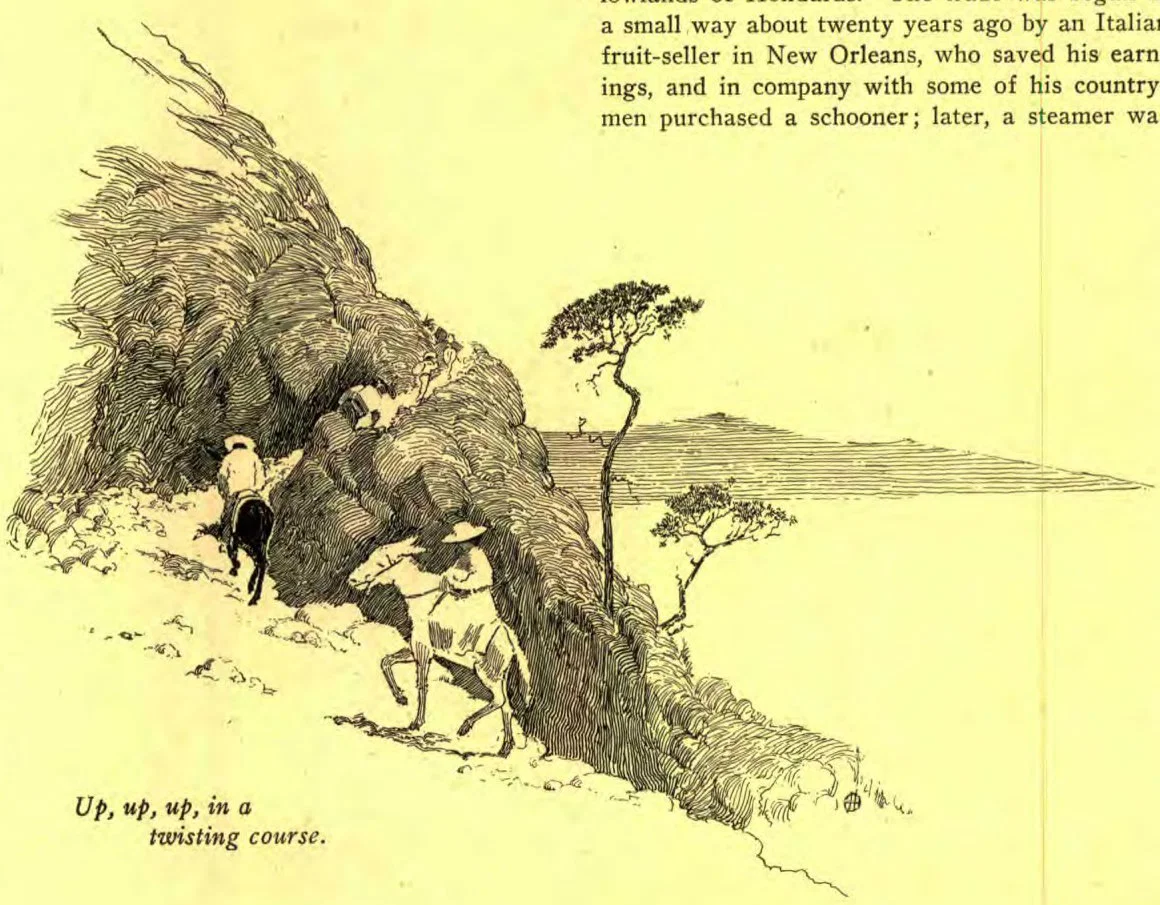
Up, up, up, in a twisting course.
A cross of wood kept upright by a heap of stones, marked the place where the road left the valley, and began the ascent of the mountains again. Some withered pine boughs lay at the foot of the cross,—a token left by pilgrims to the recent feasts at Comayagua.
Up, up, up, in a twisting course, until guavas and cactus gave way to pine and myrrh; then down again, across rivers swollen with the first winter rains, through the village of the Holy Cross and the town of St. Peter to the lowlands of the coast, where the mules waded knee-deep in ooze and tangled roots, and swarms of mosquitoes filled the air with a song in sharps, and parrots without number chatted an idiom of their own; where creeping vines ran riot, beautiful orchids grew from the knot-holes of trees, and every bog was made a special object of nature’s decoration,—this was the way home.
There is a railroad from Pemiento to the sea, a distance of sixty miles. On alternate days an engine of questionable repair, drawing a train of primitive coaches and freight-cars, starts for Puerto Cortez; the following day the return trip is made. The rails of this road have been woefully perverted from the parallel lines in which they were no doubt once laid. Weeds and grass grow in the road-bed, and overhead vine-laden branches sweep the tops of the cars. These things might be dangerous, but the speed of the train seldom reaches twelve miles an hour.
With all its failings the Honduras railroad is a wonderful thing for the country. After spending two years in a land that is two thousand years behind time, one discovers a keen appreciation for the conveniences of modern travel, even if those comforts are comparatively crude.
Quantities of bananas and coconuts are shipped to New Orleans and Mobile from the lowlands of Honduras. The trade was begun in a small way about twenty years ago by an Italian fruit-seller in New Orleans, who saved his earnings, and in company with some of his countrymen purchased a schooner; later, a steamer was put in, and to-day there is a considerable fleet of schooners and steamers in the trade.
The mainland of Honduras, with its Carib, Indian, and Spanish-Indian inhabitants, is practically an untouched field for Protestant missionary effort; but though the grain is scattered, and to the human eye this corner of the world seems to escape notice, the Lord of the harvest will send reapers even there. H. A. OWEN.