Many years ago some English sailors who had married Creole wives came to Bonacca, and settled upon the reefs that fringe its southern shore. Sheen Cay was more favorably situated than other reefs, being nearer the island and to a bountiful supply of fresh water, which, opposite the Cay, poured over the rocks into the sea.
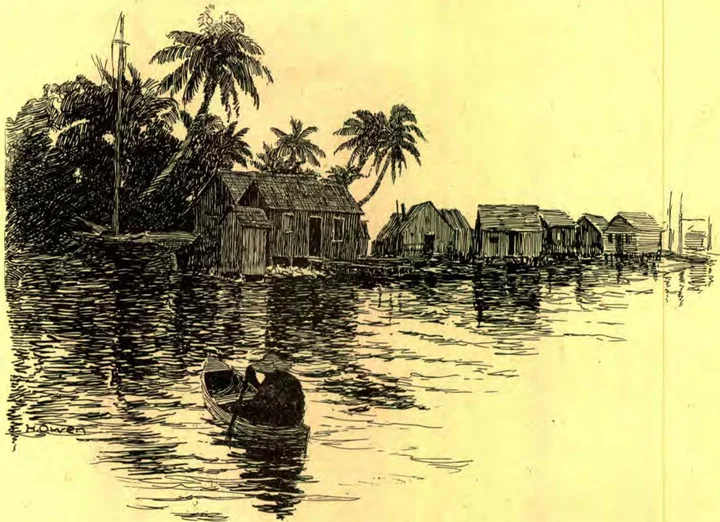
Plantations of bananas, plantain, and yucca were made on this island, and cocoanuts were planted in the flats near salt water. Children and grandchildren have built their homes around the old homestead. Strangers from Belize, Grand Cayman, and the coast have built over the shallow water that surrounds the reef until quite a community has grown up—a veritable modern Venice.
That first house, built by “Grandpa Haylock,” as every one calls him, is still standing. Its frame was of native pine. The upright siding of inch boards came from the States. Pillars of wood raise the floor three feet from the ground. The windows are closed in heavy weather with wooden shutters.
These early settlers of the Bay Islands could tell many thrilling tales of their experiences in the days gone by. They point to a large Carib canoe that is used now in carrying wood,—a use that is made of canoes about ready to go to pieces,—and tell how that was the largest boat Bonacca owned twenty years ago, and of storms encountered, in which the canoe would be half full of water, and the passengers save themselves by constant bailing, while every sea threatened to swamp them.
In those days, cattle ran wild in the hills, and the few families who lived on the reef were plentifully supplied with game and fish. Vessels came for fruit and cocoanuts, and left whisky and cloth. Money came easily; for the soil of the island yielded results with little labor, and fruit was in demand. The conditions of a prosperous lumber camp prevailed: there was plenty of fighting, boat-racing, and gambling.
The men of Savannah Bight,—a little Spanish community that had settled at the east end of the island,—becoming incensed for some cause against the Creoles on Sheen and Dog Cays, came down in their canoes one Sunday afternoon, and after drinking “plenty” at the Stanco, sallied out on the Creoles, whose men were mostly away at the time. The Creoles took refuge in one or two houses, and the women armed themselves with clubs. The Spaniards began chopping at the doors with their machetes. Shots were fired, one or two of the Spaniards being killed, and others badly bruised, before they retreated to the boats. This was “fun” that ended unpleasantly.
Their boat-races were more harmless, and must have been most exciting. The racing canoes were slender dugouts of graceful lines, carrying a cloud of sail. Each canoe was guided by one man, who sat on a weather-board, leaning far out to windward to balance the canoe, which tipped with the force of the wind until the water reached the gunwale, and fairly leaped from the crest of one wave to another.
We have vegetable oysters in the Northern States. At Bonacca, oysters grow on bushes.
Fringing the lagoons and bays, there are quantities of mangrove bushes—trees, some of them are. They send their shoots down from the branches, after the manner of the banyan tree; and on these shoots, which take root on the salt-water bottom, the young oysters fasten themselves when the tide is high. They grow to a considerable size, and are very convenient for gathering at low tide.
When the slave-trade began to languish because of the strict laws enforced against it in the United States and England, and before the present inhabitants came to Bonacca, a rendezvous for slavers was established in this island. Ship-loads of slaves were brought to this place, and recuperated sufficiently to market well in New Orleans. Here they could learn enough English to enhance their value one half.
Utilla, the westernmost island of the group of the Bay Islands, was a haven for pirates in the days of buccaneering. Silver-mounted swords, drinking-cups, stirrups of solid silver, and other relics have been found in caves on the island. Its harbor is excellent, and the town that stretches along its sandy beach in the shade of mango and cocoanut trees is the most thriving in the islands. It was at Utilla that we first met Elder F. J. Hutchins and the missionary schooner “Herald,” though we did not step foot on the boat until reaching Ceiba the next day.
The schooner appeared small from the deck of the steamer, but after more experience in the islands, her dimensions seemed relatively greater; for we soon left the region of steamers, and did not see anything larger than a two-masted schooner for months. Captain Hutchins has spent about nine years in the Caribbean Sea, cruising in all sorts of boats, and suffering many hardships in small crafts. Mrs. Hutchins has become quitep. 50 a navigator, and is as familiar with the chronometer and sextant as women ordinarily are with the needle and crochet-hook.
A good work has been done, and is still in progress, among the English-speaking people of the Bay Islands; but the great mass of the inhabitants of Central America speak Spanish, and are yet without the gospel. H. A. OWEN.