THE Junco is a bird that may be found in the north central States almost any day in winter, and along into the spring until about the first of May. In the spring, especially, you will find flocks of Juncoes feeding on the ground, always avoiding the sunny spots, and keeping well within the shadows of the trees.
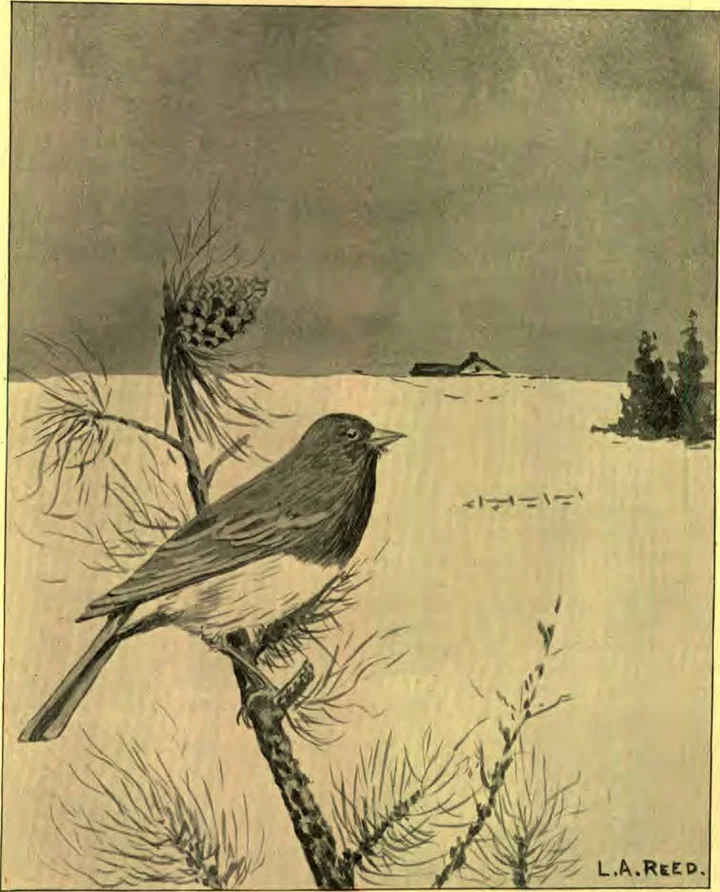
The upper parts, throat, and breast of the Junco are of a grayish slate-color, with the upper parts washed slightly with grayish-brown. One Junco, a resident of the mountains of Virginia and North and South Carolina, does not have this brownish wash upon the upper parts. Another, a Western species, has the back and sides browner. There are no wing-bars, but the two outer feathers of the tail are white; an abrupt line on the breast, where the gray ends, and the white begins, is one of the most striking marks on the bird. The bill is flesh-color.
The nest is made of grass, moss, and rootlets, and is lined with fine grasses and long hairs; it is always found on or near the ground. The eggs, usually four or five in a nest, are white or bluish-white, speckled, spotted, or blotched at the larger end with light-brown.
It is extremely difficult to catch the bird singing; nevertheless he has a very sweet and unpretentious song. The 'tsip is frequently heard, and is so characteristic that, once learned, it will always inform you of the bird's presence.
One of the characters in that excellent book of birds, “Citizen Bird,” relates the following interesting experience:—
“When I was a boy here at the farm, these white-vested Juncoes were my winter pets. A flock was always sure to come in October, and stay until the last of April, or even into May if the season was cold. One winter, when the snow came at Thanksgiving, and did not leave the ground until March, the birds had a hard time of it. The Robins and Bluebirds soon grew discouraged, and left, one by one. The Chickadees retreated to the shelter of some hemlock woods; and I thought the Winter Wrens were frozen into the woodpile, for I did not see any for weeks. The only cannibal birds that seemed to be about were a pair of cat owls, which spent most of the time in our hay-barn, where they paid for their lodgings by catching rats and mice.
“But my flock of Juncoes were determined to brave all weathers. First they ate the seeds of all the weeds and tall grasses that reached above the snow; then they cleaned the honeysuckles of their watery black berries. When these were nearly gone, I began to feed them every day with crumbs, and they soon grew very tame. At Christmas an ice-storm came, and after that the cold was bitter indeed. For two days I did not see my birds; but in the afternoon of the third day, when I was feeding the hens in the barn-yard, a party of feeble, half-starved Juncoes, hardly able to fly, settled down around me, and began to pick at the chicken food.”
“I knew at a glance that after a few hours’ more exposure, all the poor little birds would be dead. So I shut up the hens, opened the door of the straw-barn very wide, scattered a quantity of meal and cracked corn in a line on the floor, and crept behind the door to watch. First one bird hopped in and tasted the food; he found it very good, and evidently called his brothers, for in ap. 52 minute they all went in, and I closed the door upon them. And I slept better that night because I knew that my birds were comfortable.”
“They may go in once, but you will never catch them so again,” said my father, when he heard about it. I had an idea, however, that the birds trusted me; for though they flew out very gladly the next morning, they did not seem afraid.
“Sure enough, in the afternoon they came back again! I kept them at night in this way for several weeks, and one afternoon several Snowflakes came in with them. Later on, this same winter, five thin, starving Quails came to the barn-yard, and fed with the hens. I tried several times to lure or drive them into the barn with the Juncoes, but they would not go. Finally, one evening when I shut the chickens up, what did these Quails do but run into the hen-house with our good-natured Cochins, and remain as their guests until spring!
“I well remember how happy I was when grandmother gave me half a dollar, and told me to go over to the mill and buy a bag of grain sweepings for my ‘boarders;’ how angry I was with the miller when he said, ‘Those Quails’ll be good eatin’ when they’re fat;’ and how he laughed when I shouted, ‘It’s only cannibals that eat up their visitors!’”
In the winter and early spring the Junco travels in flocks of considerable size. He is most often seen by the roadsides; but in severe weather, hunger makes him more bold, and he feeds about barns, or even dwellings. It is only in the spring, just before he leaves us for the colder north, that we catch anything of his song. L. A. REED.