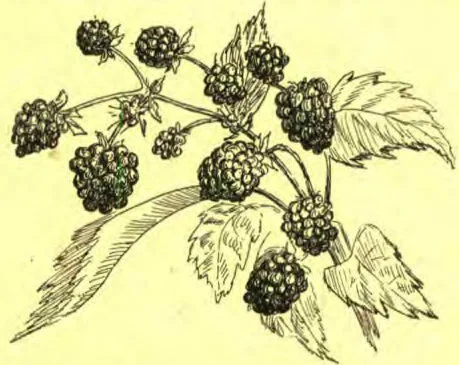
We have seen that, when ripe, fruits in their natural state are made conspicuous by their color, which contrasts strongly with the color of the foliage. But before the fruit was ripe, and ready for the seed sowing, it was practically of the same color as the foliage, and so almost indistinguishable from it. Thus the fruit is prevented from being taken before the seeds have matured.
When the fruit is ripe, birds and other creatures are attracted not only by the conspicuous color, but by the pleasant food that they find stored in the pulp. This food is the price that the tree pays to the birds and to man for their work in sowing the seeds contained in the fruit.
But not until the seeds are ready to be separated from the plant do the fruits become thus pleasant to the taste.
Before the seeds are matured and ready to be scattered, the fruit is decidedly unpleasant to the taste, and, indeed, contains alkaloids and glucosides that are positively poisonous to animals. By this protection the fruit is left on the tree until the seeds are ready to be separated from the parent plant. Some of these poisonous alkaloids are well known, being, unfortunately, often used as medicines, as, for instance, morphine, nicotine, atropine, and strychnine.
“Glucosides, of which more than a hundred are already known, have a use very similar to that of the alkaloids. Saponin is poisonous to man and animals; amygdalin splits up into the poisonous prussic acid, oil of bitter almonds, and sugar; and many others behave in exactly the same way. Tannin has an extremely bitter taste, and therefore protects branches, cortex, and fruits from being eaten.”
Thus the Creator has provided that the fruit shall not be taken from the tree until it shall be of some use to the tree by the scattering of its seeds. Later, the alkaloids and glucosides are altered, “perhaps under the influence of the acids, which are present in large quantities in unripe fruits, and their place taken by sugars and other harmless materials. Thus what is at first unattractive, and even repulsive, becomes, on ripening, a nutritious food, much sought after by animals, which at the same time unconsciously disperse the seeds. In this connection the walnut is very instructive. Until the seed contained in the ‘nut’ (here really the stone of a drupaceous fruit) is ripe, the latter is surrounded by a fleshy investment rich in tannin. It is not known that at this stage the nuts are ever interfered with by nut-crackers or other animals. But on the ripening of the seed the fleshy envelope splits, and the nut becomes accessible.”
“In other cases it is not by acids or bitter stuffs that the seeds are protected, but by strong-scented or sticky substances, which are contained in the cells and passages of the fruit. Thus, in the scales of the cone of the arolla pine, quantities of resin are present until the seeds are ripe. If the cones are cut with a knife, this resin escapes, and can only be removed from the blade with the utmost difficulty. Were a nut-cracker to peck the scales at this stage to obtain the young seeds, its beak would get all besmirched with the resin.”
“The well-known ‘hips’ of roses, which ripen in the autumn, do not fall away from the plant, but remain attached. The seeds are contained in hard, tiny, nut-like fruits, which are inclosed in the fleshy and excavated receptacle. They are destined to be distributed by blackbirds, jackdaws, and other birds, which devour the hips for the nutriment contained in the fleshy investment; the little nuts, however, pass out undigested in some place more or less distant from the rose bush. While these birds, attracted by the colored fruits, are welcome guests, the case is quite the reverse as regards mice and other little rodents, which gnaw the nuts, and devour their contents, the seeds. But the rose-hips are well protected against these animals. The stems and branches, up which they must climb to reach the fruits, are provided with sharp prickles, with downwardly directed points, which give complete immunity against these animals. I have repeatedly, in the late autumn, when the mice desert the fields, and take up their winter quarters in the abodes of man, strewed the ground in my garden with rose-hips of an evening. Invariably, next morning, I found that they had been gnawed and demolished by mice, while those remaining in place on the plants were untouched.”
And if you did not know it before, you now learn one reason—I say one reason, for there are others—why there are thorns among the roses. You see that the thorns are a protection to the rose, keeping its seeds from being eaten by mice and other destructive animals. It is quite possible that if there were no thorns among the roses, there would soon, perhaps, be no roses. Are there unpleasant things in your life, like these thorns among the roses? Be patient, and even thankful, knowing that if God permits them, he has a purpose in so doing, and intends that they shall actually minister to your comfort and protection. If God so clothe the rose-bush and these other plants, which are here to-day, and to-morrow are gone forever, how much more will he not care for you?
L. A. REED.