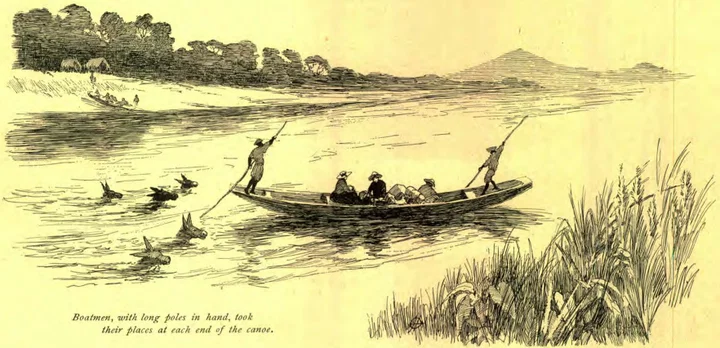
The caravan came to a sudden halt at the bank of a river. We alighted, and were led down to the water’s edge, where a long canoe awaited us. Saddles and packs were quickly stripped from the animals, and placed in the middle of the dugout, we finding seats on the packs. Half-naked boatmen, with long poles in hand, took their places at each end of the canoe, and we slid out into the current. The drivers urged the animals down the bank, and they followed us across, swimming with only their heads above water. At the landing-place, considerably down stream, they climbed to the grass-covered level, and stood grazing and dripping, their shiny coats reflecting the sunlight.
An hour’s rest in the shade of the boatmen’s hut, regaled with sugar-cane and muddy river-water, and entertained with the strains of a cheap accordion, and then at the call, “Listu!” we mounted, and rode until twilight.
The nights in the uplands of the country are cool, blankets being necessary to comfort. A heavy dew falls, and in the morning a fire is not objectionable. The tile roofs of the houses are of various tints, according to the quality of the clay in different sections of country; but the walls, when finished, are a uniform white. Sometimes the huts are more like playhouses for children than dwellings. Tiny doors made of a single cedar plank eighteen inches wide are common; and if there are windows, they are more tiny still, being as small as six by twelve inches, letting light into a room eight by ten feet square. But windows of any size are the exception, not the rule.
Every village we passed was situated by a stream of water, which serves as a public bath, also as a washing-place for the women. Little care is taken to obtain pure water for drinking and cooking purposes. The donkey water-carriers are driven into the streams either above or below a crowd of women, who are doing their week’s washing. This explained to us why the drinking-water had sometimes tasted soapy. Children attend the donkeys, and fill the leather or earthen water-bottles, using large gourds, or calabashes, as dippers.
In spite of warnings from the natives, we bathed in the streams after the heat of the day. These baths were a great treat. The soft rock formations had been scooped out in places by the action of the water, so that we found primitive bath-tubs of all descriptions. If you want a bath never to be forgotten, ride on the back of a mule to the valley of El Souce in Olancho, and inquire for the casa of Don Antonio Francisco. He or his good wife will take you by a path that leads from his door past the corral of split rails, and down a gentle slope of pasture. You will probably find women washing at a spring under some guava bushes at the right; and after leaving them a little way behind, you will begin to hear the fuss of a small stream as it jumps from one pool to another. There your guide will leave. You will forget, in the soothing of those waters, that there are fleas and jiggers in Honduras.
Near Tegucigalpa the paths that wind around the mountains are hewn from the soft rock, and though worn and washed for centuries, are still passable by the sure-footed mules. A cart is a useless encumbrance in this country, except in the larger towns.
The fertile flats along the course of a stream to which we descended later in the day were planted to corn. The time was late in September. The fields were well laid out, and the young corn was kept free from weeds. Men were at work in the fields with bill-hooked tools, which were unlike any agricultural implements used in the United States. We saw men plowing with oxen; the plow was of wood, with an iron point, and the plowman controlled it with a single handle.
Stone fences bordered the highway and separated the fields. At times we were reminded of New England, and then again a turn of the road would bring a cluster of native houses, a banana plantation, or a caravan of mules with rawhide pack-saddles—sights that would dispel our New England illusion abruptly. Once we crossed a stream on an iron bridge constructed by a North American firm; next time we forded it, and noticed that stepping-stones were provided for foot-passengers.
Caravans of mules and donkeys returning light from market, women with wooden trays on their heads, children carrying home unsold daintiesp. 34 from their parents’ stalls in the market, ox-teams with yokes lashed to their low-bent heads, and slow-moving carts, with clumsy wooden wheels,—all told us that we were entering the capital city.
At once we were there, a turn in the road bringing the city in sight. A Catholic school for boys was just ahead; and beyond, above the tops of the houses, rose the white walls of the churches and the government buildings. The streets were paved with cobblestone, and in the principal part of the town were narrow cement sidewalks, which made it much easier to get about than in Jutigalpa. Also greater crowds were here, more business, and an appearance of prosperity not found in the other cities visited.
President Serra seems to be much interested in the education of his people, and visits almost daily the school of mechanical arts that has been established near his palace. The native boys are quick to learn, and are turning out some very neat wood and metal work. Tramps who can not give an account of themselves are set to work upon the public roads, which are also an object of the president’s special care. Three miles of well-paved road are completed on the way to the Pacific coast town of Arna Pola, the seaport of the capital.
H. A. OWEN.