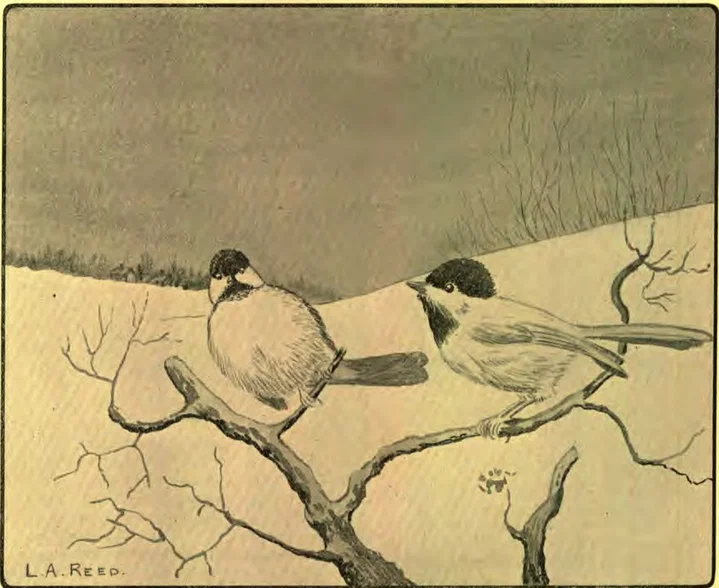
The Chickadee, one of the most interesting birds of winter, is very common everywhere in the Northern and Middle States, and is not confined to any special locality, being equally at home in the door-yard and in the depths of the woods. He has another name, Black-capped Titmouse, given him because of the black cap on his head. The name of Chickadee was bestowed on account of his familiar song. Chickadees are never silent, but are uttering their “chick-a-dee-dee,” “phee-bee,” or “tsee-deet” all day long. Some persons think the note “phee-bee” is the bird’s love call.
Chickadees are very tame. Dr. C. C. Abbott says he has often had them within arm’s length of his person. When thus near, they looked at him, he says, with a curious twist of the head, and expression of satisfaction, as much as to say, “I’m glad I’m not such a looking thing as that.”
Thoreau speaks as follows of their familiarity: “As I stood looking, I heard a smart ‘tche-day-day-day’ close to my ear, and looking up, saw four or five Chickadees, which had come to scrape acquaintance, hopping amid the alders within three or four feet of me. I had heard them farther off at first, and they had followed me along the hedge. They ‘day-dayed’ and lisped their faint notes alternately, and then, as if to make me think they had some other errand than to peer at me, they pecked the dead twigs,—the little top-heavy, black-crowned, volatile fellows.”
Professor Chapman relates that on two occasions Chickadees have flown down and perched upon his hand. “During the few seconds they remained there,” he says, “I became rigid with the emotion of this novel experience. It was a mark of confidence which seemed to initiate me into the ranks of woodland dwellers.”
A remarkable instance of the maternal devotion of a Chickadee is given by Dr. Brewer: “A Black-cap was seen to fly into a rotten stump near the woodside in Brookline. The stump was so much decayed that its top was readily broken off, and the nest exposed. The mother refused to leave until forcibly taken off by the hand, and twice returned to the nest when thus removed; and it was only by holding her in the hand that an opportunity was given to ascertain that there were seven young birds in her nest. She made no complaints, uttered no outcries, but resolutely and devotedly thrust herself between her nestlings and the seeming danger. When released, she immediately flew back to them, covered them under her sheltering wings, and looked up in the faces of her tormentors with a quiet and resolute courage that could not be surpassed.”
The Chickadee has an interesting way of answering when his call is skillfully imitated. Professor Chapman gives an excellent description of this habit:— “I never hear his voice in the woods without answering him. Soon he comes to me, mildly inquisitive at first, looking about for the friend or foe whose call has attracted him. In an unconcerned way he hops from limb to limb, whistling softly the while, picking an insect’s egg from beneath a leaf here, or larva from a crevice in the bark there, all the time performing acrobatic feats of which an accomplished gymnast might be proud. Finally his curiosity becomes aroused, he ceases feeding, and gives his entire attention to the discovery of the bird who so regularly replies to him. Hopping down to a limb within three feet of my head, he regards me with a puzzled intentness; his little black eyes twinkle with intelligence, he changes his call, and questions me with a series of ‘chick-a-dees,’ liquid gurgles, and odd chuckling notes, which it is beyond my power to answer; and finally, becoming discouraged, he refuses to renew our whistled conversation, and retreats to the woods.”
The Chickadee is one of the most useful of our winter visitors, as he helps greatly to prevent the ravages of several very injurious insects. He lives on grubs and on the eggs of moths hidden under the bark of trees, and is especially fond ofp. 36 the eggs of the cankerworm moth. One of the members of the Massachusetts State Board of Agriculture, Mr. Forbush, calculated that one Chickadee in one day would destroy five thousand five hundred and fifty eggs, and in the twenty-five days in which the cankerworm moths run or crawl up the trees, nearly one hundred and forty thousand eggs. He attracted a number of the birds to an infested orchard; and while other orchards in the neighborhood were seriously infested the next season, this particular orchard escaped with only a few worms.
Because of their practical value to man, no less than for their cheery companionship, the Chickadees should receive our loving and loyal protection. L. A. REED.