I am delighted to notice that many of our boys and girls have begun to study the birds. Some have written me to know whether anything interesting can be done in winter. I say, emphatically, Yes, indeed! especially as I notice that some say they have a good location, with pine and spruce woods near, and many sunny nooks and sheltered valleys. In regard to attracting the birds that come near the house, instead of giving you any directions I think I will tell you the story of the bird-box which we had last winter. Our piazza runs along beside the dining-room and kitchen, and then the barn makes an L with it, facing the orchard and maples. Our Bert put up the box on the corner of the barn opposite the piazza, where we could see it all the time. It was an empty grape-basket, with the handle cut off. Bert drove the nails through the bottom of the basket, leaving the top open toward us, so that we could see at any time if there were any birds in it. He left the heads of the nails sticking out, so that we could tie in the pieces of meat and suet; this proved a wise precaution.
It was the fifteenth of December, and the ground was well covered with snow. I scattered a handful of sunflower seeds in the box, mixed with some butternut and walnut meats, and tied two pieces of suet to the nails in the bottom of the box. I thought I had provided a very good banquet for the birds, but I did not think my invitation would be accepted quite as quickly as it was. But it must be that I was watched, for I had hardly got into the house before two Blue Jays shot into the box with a tremendous ki-yi-ing, and began to tear away the suet. They acted half starved. Perhaps they were; at any rate they gorged themselves, and left for the next comers little but a greasy string.
But, as it happened, the next visitors were not fond of suet anyway. They were a couple of Chickadees. They picked the nuts up daintily, sang their jolly chickadee-dee-dee, and nodded their tiny black caps toward us prettily. I took it that this was their way of expressing thanks.
It is not to be supposed that a newspaper circulates in the kingdom of the birds, but they all seemed to hear about our bird-box, and make it a visit. The Woodpeckers came, and they were suet-eaters, too. I could hardly get enough to keep the birds fed, they ate so ravenously. The Woodpeckers were noisy fellows, and no other bird would come to the box when they were there. If the Blue Jay came around when the Woodpecker was eating, he would sit on the tree, and talk very loud about what he was going to do, and make blood-curdling threats; but he kept away from the box.
Two little visitors who came to the box when the way was clear, gave us great delight. They were the white-breasted and the red-breasted Nuthatch. These little birds like to run about the trees, and it makes no more difference to them which side up they are than it does to a fly. The white-breasted Nuthatch has a good deal of curiosity in his make-up. If you come along quietly, he seems to be as anxious to see you as you are to see him; and it is very funny to see him stop, back downward, on the under side of a limb, and tilt his head toward you, as if he would say, “Can you do this?” The Nuthatches did not eat in the box, but took the pieces of nuts in their bills, flew to a tree, wedged the nuts into crevices in the bark, and then picked away at them. The red-breasted Nuthatch is tamer than the other species. Sometimes I would put a bit of nut in a chair on the piazza, and he would come and get it, and wedge it into a crack in the floor of the piazza and eat it there, to the great delight of the whole family.
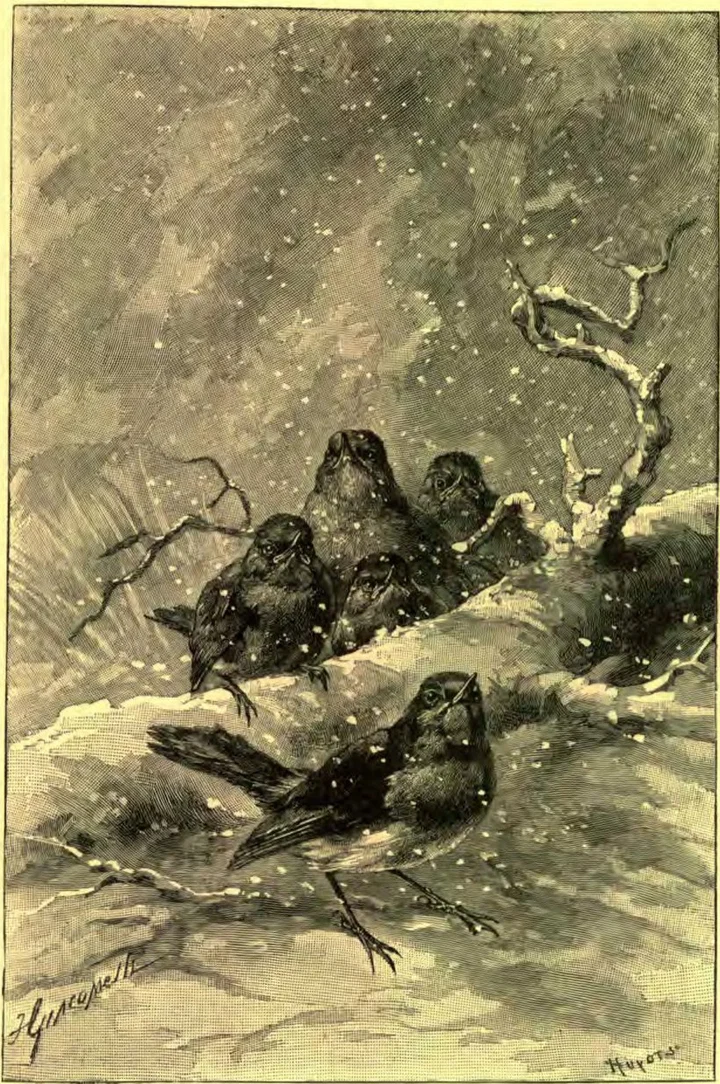
So the birds came to see us all through the winter, and on Christmas day we paid them a family visit. It was cold, but calm and bright, and we started out about nine o’clock through the orchard. We found eight of the birds ready to receive us, although the ungrateful Blue Jay sat in the top of a tall elm tree, and cried at the top of his voice, “Clear out, there! Skip, now!” But the Tree Sparrows and Nuthatches were glad to see us, and so were the Goldfinches—though it didn’t seem as if these yellowish-brown birds could be the same as the black-capped sprites of gold that undulated through the air in the summer, singing, “Per-chic-o-ree, per-chic-o-ree.” There was a small flock of Chickadees, too, and with them a solitary Junco, having his neat, slate-blue cape drawn closely across his shoulders above his white vest. Further up the mountain we found a flock of pine Grosbeaks feeding on the mountain-ash berries; and as they rarely come south of the Canada line, this was the most interesting experience of the day. Some of the Grosbeaks afterward came to the house. They would not go to the bird-box, but they ate pieces of apple from the piazza. They are very pretty when the sun brings out the rosy tints of their heads and necks.
But, after all, I think those who took the greatest pleasure in the bird-box were father and poor old Aunt Maria. Grandpa, who can imitate any sound there is in nature, from the peep of a chicken to the bray of a donkey, talked with all the birds that came, and I think they liked it. We would roll Aunt Maria up to the window in her wheel-chair, and she would sit there hour after hour watching the birds. Early in March, while the snow was yet deep, there came up from the south a warm, odorous day, to tell us that spring was coming. The window was open, and there was a Chickadee about, and we put nuts on the window-sill for him, as we had often done before, so that Aunt Maria could see him eat.
“Chickadee-dee-dee!” called grandpa.
“Chickadee-dee-dee!” answered the merry little fellow, and came to see what friend was calling him, and so found the nuts on the window-sill and began to eat them.
It was Ned who thought of it. He put some bits of nut in Aunt Maria’s hand as it lay on the arm of her chair. Pretty soon the Chickadee began to look around for more nuts, and saw those in Aunt Maria’s hand. He was a long time about it. He fluttered in and fluttered out, bowed and scraped and hopped about, but at last he alighted on the arm of Aunt Maria’s chair, and in a minute he began to pick at the nuts in her hand. Ned squirmed and swelled up almost to the bursting-point in his efforts to keep quiet, but dear old Aunt Maria’s face shone with joy.
So you see that the bird-box was a blessing to us as well as to the birds. Of course this isn’t the scientific side of bird study, but that will come later, as you get more acquainted with the birds themselves in their own haunts and homes.—John Melvin Hull, in Young People’s Weekly.