TWENTY-FIVE years ago a party of hunters were camping in the mountains of Oregon, southwest of Grant’s Pass, at a spot called The Lakes. One day while a member of this company was hunting in the dense forest about two miles from camp, his dog started a bear, and chased the animal down the steep side of a cañon until it disappeared in a hole near the bottom. The hunter, attracted to the spot by the barking of his dog, found that from this hole, at the bottom of a low, rocky cliff, issued a stream of clear, cold water. This in itself was of little consequence, for such places are common in the mountains; but as he approached, he was met by a strong, cold breeze, which told him plainly that the hole was the entrance to a large cave.
This man and others partially explored the cave; and a few years later another entrance was discovered several hundred yards higher up the side of the cañon. There are really two separate caves, quite distinct in character; but as they are connected by several winding passages, through which it is possible, with much crawling and still more climbing, to pass, they are usually known as one—“The Great Oregon Cave.”
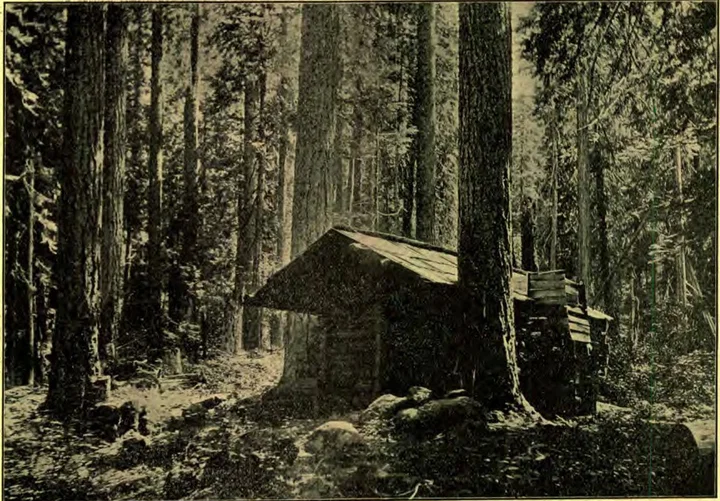
As the years passed, many persons visited the cave, and, returning, told such wonderful stories of its size and the beauty of its limestone formations, that it acquired considerable local fame. Then a San Francisco paper, more noted for sensationalism than veracity, sent a party of men to visit the cave, and write an account of their explorations. Wonderful reports they sent back, and the cave had a boom. A company was organized; and when they secured control of the cave, they began to build a road to it along the most feasible route. A substantial log cabin was put up for the guides; a rustic bridge was built across the cañon below the entrance to the cave; and in the cave itself passages were worked out, and ladders placed wherever it was necessary to make the most interesting points more easy of access. Then the company learned that the cave was not of sufficient interest to attract a paying number of tourists to a place so difficult of access. When the work was abandoned, the company left the cabin, the rustic bridge, the ladders, and a few bad debts to testify to what it had attempted.
Many exaggerated stories have been, and still are, told about the Oregon Cave. I have heard men claim that it extended seven miles underground; others assert that a four-horse coach could be driven four miles into the cave, and then turned around. One man, I remember, told me that it rivaled, if it did not outrank, the Mammoth Cave of Kentucky. To verify or disprove these rumors was for a long time my desire, but the opportunity did not come until early in August of last year.
From Grant’s Pass two roads lead to the cave, —one by the way of Williams Creek, the other through the village of Kirbyville. The reports as to the condition of the roads were very conflicting, but I finally decided to go by the Williams Creek route.
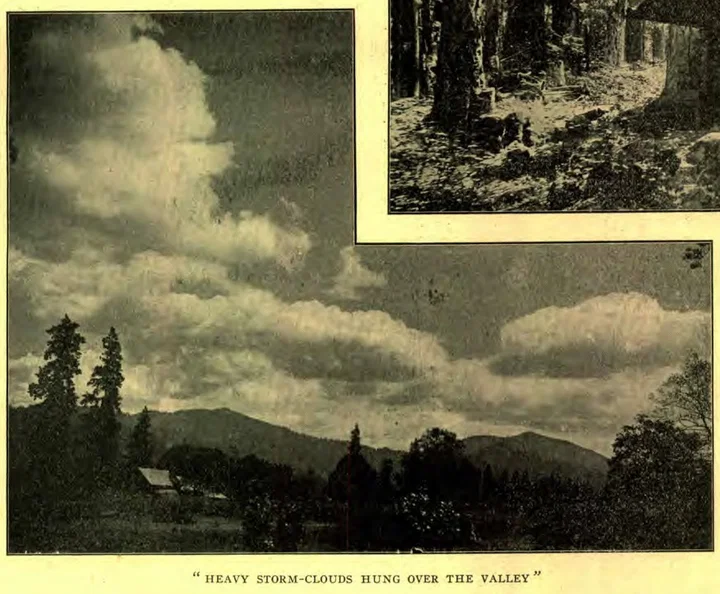
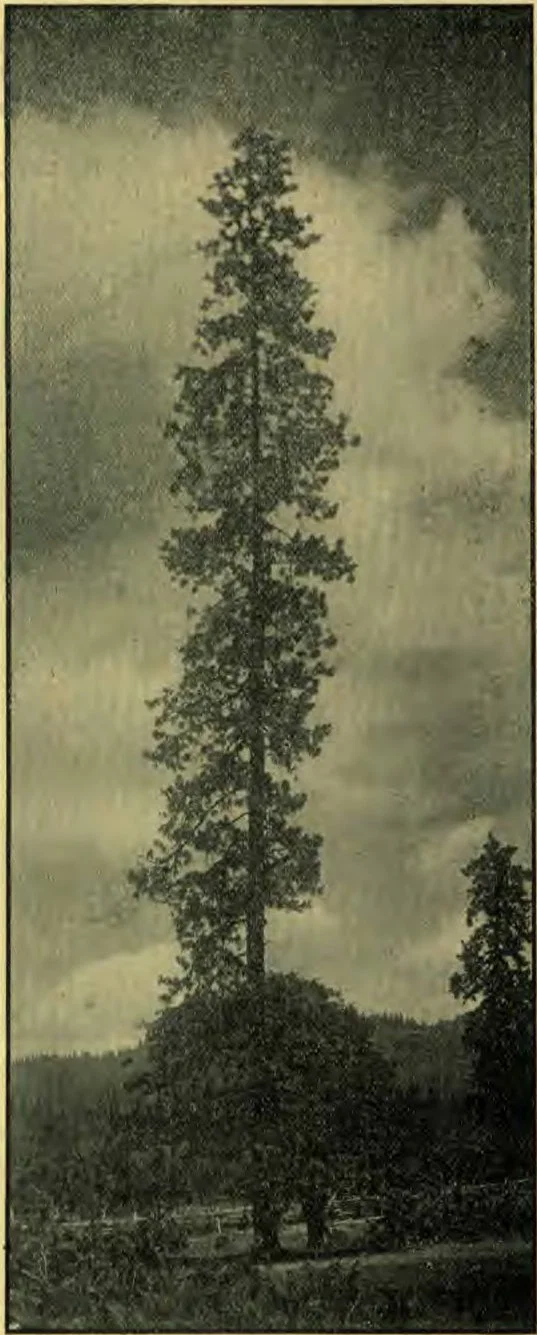
Early in the morning I started out with my camera and plates, a sleeping-bag, and sufficient provisions to last a week, on my wheel. It made rather a heavy load,—about seventy pounds,—but I found the roads tolerably good, and made fair progress up through the beautiful valley of Williams Creek. The hills, and in some places the valleys, were covered with dense forests of mixed timber. The tall and stately sugar-pine grew side by side with the sturdy oak. The madrona, with its smooth, red bark and bright-green leaves, grew in the shadow of the giant fir. Heavy storm-clouds hung over the valley that morning; but I had no fear of rain, for I knew that a shower would settle the smoke that obscured the view, and made it quite impossible to photograph the distant mountains. I could have found shelter under a fir-tree, and would have been willing to finish my journey in the mud for the sake of having a clear atmosphere.
At that season, rain is very uncommon in southern Oregon,—so rare, indeed, that the farmersp. 66 in Williams Creek Valley depend upon irrigating ditches to moisten their fields. In some places the water had broken from these ditches, and flooded the road. This was the only thing about the road that I could have wished changed, and it proved no serious obstacle; for I reached the head of the valley, twenty-six miles from Grant’s Pass, early in the afternoon.
At the last house on the road I had been told I would be able to get reliable information regarding the trail that led from that point to the cave. I was there told that the trail was excellent, and that in some places it would be possible to ride my wheel. I had intended to leave my wheel there, and carry my things on my back the remainder of the journey; but as I was assured that it would be much easier to push the wheel with its load, I concluded to take it on to the cave.
Expecting to reach the cave early the next day (it was only eleven miles), I camped there at the end of the road. That night I slept on a bed of fragrant fir boughs, lulled to rest by the music of a mountain stream.
Next morning I was not long in discovering that I had been grossly misinformed regarding that trail. It was simply a steady climb up, up, up—lifting the heavily loaded wheel up rocky steps, or over fallen trees; or carrying it through deep mud caused by numerous hillside springs; still higher and higher, up a seemingly interminable hill.
Shortly after noon I met a prospector, who gave me the only accurate information I had been able to get about the trail. I was nearly at the top of that divide, he told me; then I would have a short and not very steep descent to make. But he warned me that the next mountain was worse than the one I was on. When I reached it, I left the wheel beside a deserted cabin, and started up the mountain with my pack on my back. The mountain was steep, and the trail was rough; but my load was out of my way, and I did not mind the climb. There are no springs on that part of the trail, but there are several on the summit of the mountain, where there is quite a large open space, called “The Meadows” by some, and “Mud Flats” by others.
J. EDGAR ROSS.
- (To be continued.)