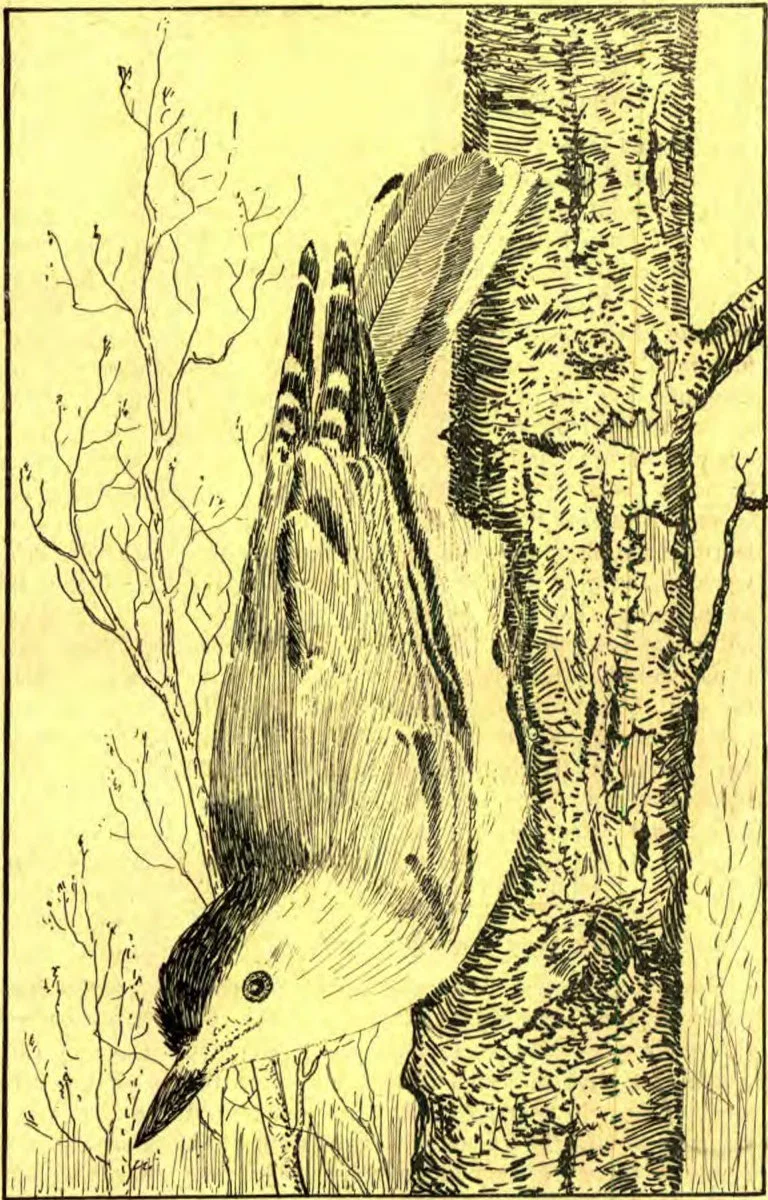
It is a cold day in early February as I write. The sleighing is fair, and the air sharp and tingling. A thin mist of clouds covers the sky, but both sky and earth are white with the exceeding brightness of a winter day. It seems like an inopportune time to observe birds; but as a brisk walk in the cold winter air acts as a tonic, shortly before dinner, armed with a field-glass, I set out.
WHITE-BREASTED NUTHATCH
A half-hour’s walk brought me to the outskirts of the city. Not a bird seemed to be about. I could not find even an English sparrow. I tramped about for a bit, and, discouraged, started for home. I think I had not gone ten paces when unusual bird-sounds brought me to an instant standstill.
Just over the fence to my left, along a hedge, was a flock of Slate-colored Juncos. They were very active, and apparently quite happy. In a tree almost over my head was a Nuthatch. This little creature had apparently a small nut in his beak, and was moving about on the side of the tree-trunk as if in search of something. First it came down the trunk toward me, head downward; and then, quickly turning about on the side of the tree, ascended as quickly as he had come down. He flew to another part of the tree, came down a limb head foremost, and then flew across the street to repeat the performance. At close intervals he uttered a creaking note sounding something like “Ink! ink!” Occasionally his tones were much louder, sounding then like “Yank! yank!”
Presently he found a crevice in the bark of the tree. Here he lodged the bit of food he had been carrying, and set about hammering it with his beak so fiercely it seemed he surely would drive his beak through his head. He was trying to earn his dinner. But he seemed to make no appreciable impression on the nut. At last, as if disgusted with the tree, and having had enough of my curiosity, he picked up his particle of food and flew away.
A Blue Jay was hammering at the top board of a fence near by, and a little farther away I heard the whistle of a Cardinal.
But to return to the subject of the Nuthatch. His peculiar habit of hammering, or hacking, nuts has given this bird the name of Nuthack, or Nuthatch. The word “hatch” of this compound word is another form of the Old English word “hack.” In the word “hatchet” we have the old form “hatch” preserved; and in the word “hash”—something hacked—we have another form of the word “hatch.”
In breaking open a nut, the Nuthatch holds it with his claws, or jams it into a crevice in the bark of some tree, and hammers it as I saw this one do to-day.
The Nuthatch seldom lights on the ground, but Mr. Torrey has observed it in this attitude. He says: “One is always glad to find a familiar bird playing a new rôle. . . . It may be assumed, therefore, that I felt peculiarly grateful to a white-bellied Nuthatch, when I discovered him hopping about on the ground, . . . a piece of humility such as I had never before detected any Nuthatch in the practice of. Indeed, this fellow looked so unlike himself, moving briskly through the grass with long, awkward leaps, that at first sight I failed to recognize him. He was occupied with turning over the dry leaves, one after another,—hunting for cocoons, or things of that sort, I suppose. Twice he found what he was in search of; but instead of handling the leaf on the ground, he flew with it to the trunk of an elm, wedged it into a crevice of the bark, and proceeded to hammer it sharply with his beak. . . . The sparrows were inclined to make game of my obliging little performer; but he would have none of their insolence, and repelled every approach in dashing style. In exactly three weeks from this time, and on the same hillside, I came upon another Nuthatch similarly employed; but before this one had turned up a leaf to his mind, the sparrows became literally too many for him, and he took flight,—to my no small disappointment.”
The Nuthatch is a permanent resident of the United States, but in summer, during the nesting68season, it stays close about home and is seldom seen. From now until the first of May is an excellent time to study this bird. During April you should also find the Brown Creeper and the Kinglets. These birds we will consider in the next two articles.