LOST IN OREGON CAVE

7%

Review and Herald Publishing Company · Battle Creek, Mich. · Mar 7, 1901

FromThe Youth’s Instructor, Vol. 49, No. 10.

Read the full edition

LOST IN OREGON CAVE

II
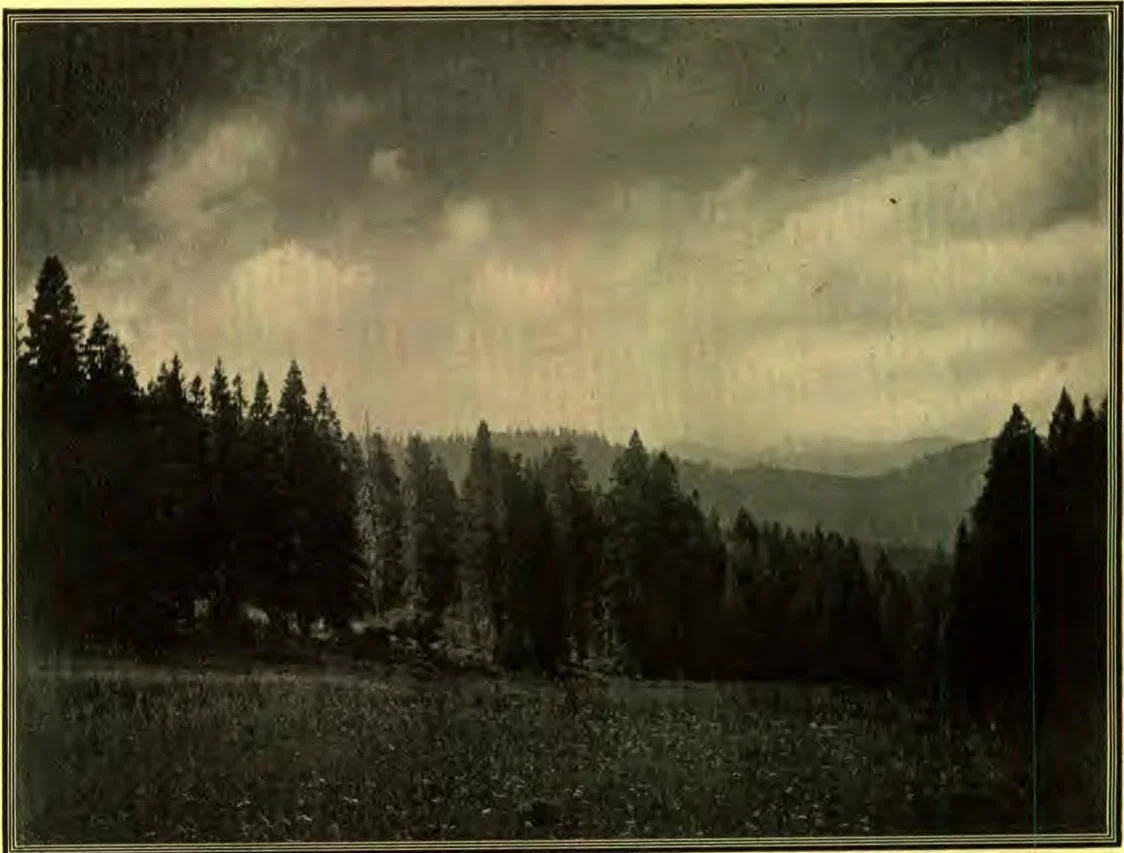
At The Meadows I found an old five-gallon oil-can, which I pressed into service as a camp-stove. On this I boiled water, and set some oatmeal cooking for my supper. Knowing that they would burn until my return, I filled the old can with pine knots, and started back after my wheel. It took longer to carry the unloaded wheel up the mountain than it had to transfer the heavy pack. It was nearly dark when I reached The Meadows again, and I saw that during my absence a herd of cattle had taken possession, upsetting the stove, knocking my kettle of oatmeal bottom up in the soil, and eating my salt. Fortunately, the kettle had a tight-fitting cover, and the oatmeal was fairly well cooked before the accident; so the loss of the salt was the only real damage.
It was late next morning when I started out, and I found that there were a confusing number of trails leading from The Meadows; but after a while I struck the right one, marked with a sign-board. I had to go down a steep hill for some distance, and the trail led through a patch of buck-brush so thick it would have been hard work to force a passage empty-handed. Of course with my heavily loaded wheel it was far more difficult. Had I been going up instead of down, it would have been well-nigh impossible. Once out of the brush, the trail led down the side of a deep cañon. After crossing the stream at the bottom, I came to the steepest part of the trail. It was so steep that it was hard to keep a foothold, and I simply had to lift the wheel up step by step. Fortunately, however, it was only a short distance to the top; and beyond that the trail was good until I reached the entrance to the cave. As it was Friday afternoon, I did not enter the cave that day, but pitched my camp, and began to prepare for the Sabbath.
THE MEADOWS
THE MEADOWS
I spent a somewhat dreary Sabbath in that cold, damp cañon. The sunshine seldom reaches the bottom of the cañon; for it runs from east to west, and its sides are covered with dense timber.
After the Sabbath I went into the lower cave, but found it disappointing. There were few of the peculiar limestone formations so common in the upper cave, and no chambers of any size. The passages are all extremely rough, and in the main passage there is always a strong cold breeze blowing outward. It is very cold and damp, and not of sufficient interest to repay one for the discomfort experienced in an extensive exploration. I took no picture in the lower cave, as I had been told that the upper one was far more interesting.
Bright and early on Sunday morning I started into the upper cave, taking my camera and tripod with me. It was not so cold nor so damp as in the lower cave, but some of the passages were very narrow, and so low that I was often compelled to go on hands and knees. I found it difficult to handle the camera and tripod, and at the same time protect my candle from the water that dripped from the stalactites above, and the wind that blew in the main passage. So I left the camera and tripod, and went on to explore the cave, and pick out the spots I wished to photograph.
I found a few fairly large chambers, though none were of sufficient size to justify the reports I had heard. In fact, none were large enough to give a respectable echo. In many places, stalactites of limestone hung like great icicles suspended from the ceiling. Other formations along the wall had the appearance of banks of soiled, drifted snow, with icicles along the bottom, a drop of water suspended at the tip of each. It is the constant dripping of water that causes the formation of these stalactites. A drop of water charged with lime trickles through some crack or crevice in the rocks, and clings for a moment to the lowest point it can reach. Before it drops, it deposits on that point a few particles of the lime it holds in solution. Another drop follows, and still another, each contributing its mite to the formation of the stalactite. As the years pass, this grows larger and larger until, unless broken off by some specimen hunter, it falls from its own weight, or reaches the stalagmite slowly rising from the ground to meet it. In the latter case the two unite, and as the water continues to trickle down, form a pillar that usually spreads out at the top and bottom like an old-fashioned hour-glass. I saw a number of these pillars, but only two or three were large enough to be conspicuous. Often these pillars continue to grow sidewise until they meet, when they unite, and form a wall that finally loses all resemblance to the original formation, and takes on many fantastic shapes.
I had crawled through wet and muddy passages, bumped my head on the sharp edges of broken stalactites, and covered my clothing with lime and clay and candle drippings, until I was tired of it all. My contempt for all caverns in general, and for the Oregon Cave in particular, increased at every step until I reached a large chamber near the end of the cave. It was the largest I had seen, and I afterward learned that it is the largest in the cave. I climbed over and around the great boulders that covered the floor to the end of the chamber, and there found a ladder that seemed to lead nowhere in particular. I discovered, however, that it led to one of the most beautiful chambers in the cave. There are two ladders above the first one, with much hard climbing between them; but when the explorer reaches the upper chamber, called Floral Hall, he feels amply repaid for his work.
It is so difficult to reach this chamber that few persons undertake the climb, and as a result not many of the formations have been marred by curio seekers. In the passages leading to Floral Hall are several large, dome-shaped stalagmites, that yield a musical, bell-like tone when lightly tapped with a stick or stone. The pitch of this tone varies with the height at which the hollow domes are struck, so that one can almost beat a tune upon them. Floral Hall is a rather small chamber; but it makes up for lack of size by the variety and rare beauty of its formations.
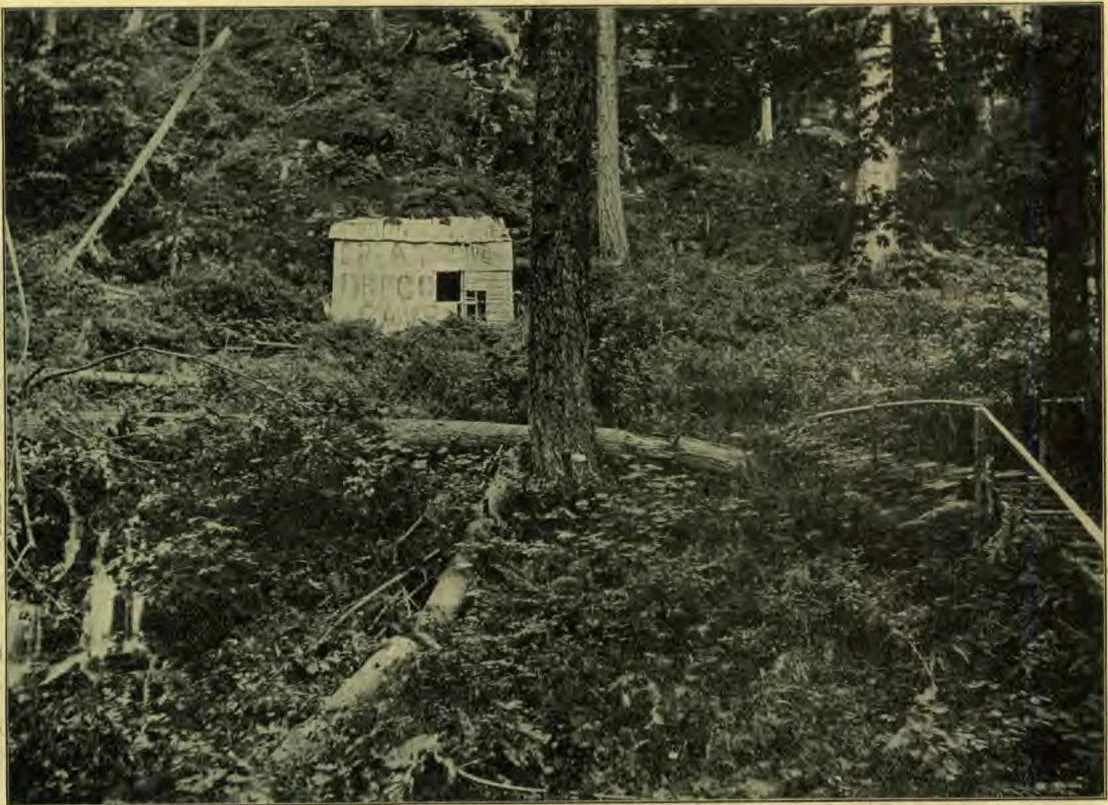
THE LOWER ENTRANCE TO OREGON CAVE
As I turned to retrace my steps, I thought that if I could only step from that chamber into the open air, and thus save another trip through those tortuous passages, the cave would leave a better impression on my mind than would otherwise be the case. When I descended the last ladder from Floral Hall, and found myself once more in the Ghost Chamber, I looked at my watch, and saw that the day was half gone. Concluding that I had seen enough of Oregon Cave, I started back, intending to get my camera, take a few flash-light pictures, and then bid the cave a permanent good-by. But I was not to be let off so easily.
J. EDGAR ROSS.
(Concluded next week.)