Ginseng, of which we hear so much since the trouble began in China, is the aromatic root of an herb of the genus Aralia, and in China is a very celebrated medicine. The Chinese view it in an almost sacred light, believing it to be a panacea for all the ills of the flesh, and that it will, in a majority of cases, revive and prolong life in the feeble and aged. European chemists and practitioners, however, have failed to find any valuable medicinal virtue in the plant.
Ginseng roots of the finest quality are found near Manchuria, in China, and are an imperial monopoly. The Korean ginseng comes next, and the American ranks third in value. Cultivated ginseng is not regarded by the Chinese as equal to the wild roots; but the demand so far exceeds the supply that the price rose in the United States from fifty-two cents a pound in 1858 to more than three dollars a pound in 1893. The value of the ginseng exported annually from this country now exceeds one million dollars.
The root of the plant forks near the surface of the ground into two prongs, and assumes much the shape and contour of a man. A great deal of its imagined value is due to its appearance; and the nearer the root resembles a human being, the more valuable it becomes. Native ginseng is in China worth its weight in silver, and often in gold. Skillful workmen manipulate the native root coming from Manchuria to increase its resemblance to the human body, and these pieces become priceless. The name “ginseng” means “man-plant,” and a root with limbs entire is supposed by the credulous Chinese to be at least two hundred years old, and is worth from two hundred and eighty to five hundred and sixty dollars.
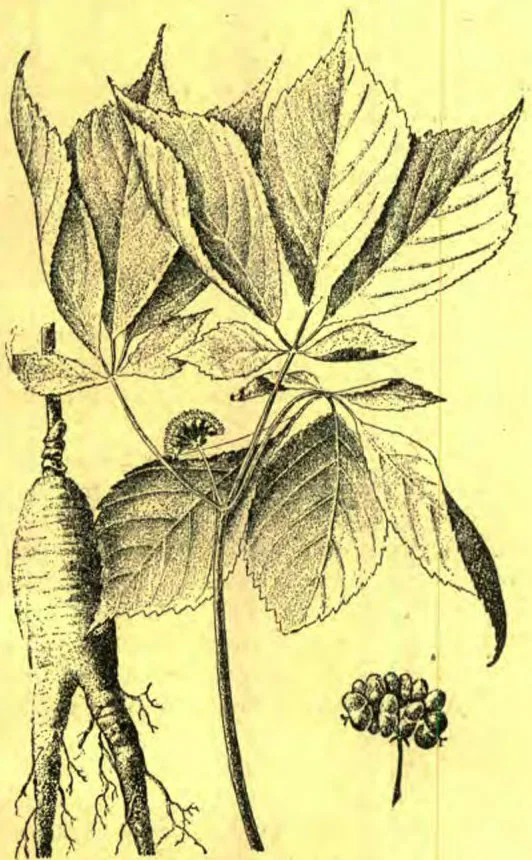
The root, when gathered, is thoroughly washed in several waters, and well scrubbed with a brush. It is then again washed and dried by steam; this gives it a white appearance. On drying, it becomes transparent. After washing and cleaning the roots, the natives lay them on sticks over the fumes of boiling millet, which imparts to them a golden-yellow hue, highly prized by the Chinese. The dried roots are carefully guarded against dust and dampness, else they rot or become wormy. To show how important the Chinese dealers in ginseng regard this, I quote from Lockhart’s description of his visit to a ginseng merchant:—
“Opening the outer box, the merchant removed several paper parcels, which appeared to fill the box. Under them, however, was a second box, or perhaps two small boxes, which, when taken out, showed the bottom of the large box and all the intervening space filled with more paper parcels. These parcels, he explained, contained quicklime, for the purpose of absorbing any moisture, and keeping the boxes quite dry, the lime being packed in paper for the sake of cleanliness. The smaller box, which held the ginseng, was lined with sheet-lead. The ginseng itself, inclosed in silk wrappers, was kept in little silk-covered boxes. Taking up a piece, he would dilate upon the merits of the drug, and the cures it had effected, at the same time requesting his visitor not to breathe upon nor handle it. The covering of the root, according to its quality, was silk, either embroidered or plain, cotton cloth, or paper.”
In China, ginseng is often given as a present to a friend, with a small, beautifully finished double kettle, in which the root is prepared. The inner kettle is made of silver, the only metal used in contact with the ginseng when cooking. The decoction is drunk as a tea. The root is often used pulverized, the dose being from sixty to eighty grains. W. S. CHAPMAN.