You should be on the lookout these days for the little Brown Creeper. It is possible to find him any day in winter; for he is a northern bird, breeding in summer-time from the northern limits of the United States far north into Canada; in the winter he may be found anywhere from Canada to the Gulf of Mexico. But from the middle of March to the last of April, the little creatures are on the move northward, traveling in such numbers that they may be seen almost any day, busy at work on the bark of some insect-ridden tree.
The story of the Brown Creeper can be told in a very few words,—he is unobtrusive, and very industrious.
He is unobtrusive because of two things. While he is with us, he never sings; and he is so nearly the color of the bark upon which he works that if he remained quiet, we should certainly pass him by unnoticed. But he does not remain quiet. Remember, his other characteristic is that of being very industrious. Some persons can hardly bear to watch the little fellow—he tires them with his unabating zeal.
My acquaintance with the bird was begun one day in March,—next to the last day in the month. I was out hunting birds with my field-glass. I had read more or less about this little bird, and recognized it the moment I saw it. I wrote in my note-book as follows: Saw a Brown Creeper on the trunk of a large maple, which allowed me to come very close, merely moving by a corkscrew movement around on the farther side of the trunk, but not stopping for a moment his picking at the bark. Used his bristle-ended tail frequently to brace himself, but often did not seem to need it. Even turned head downward on the bark for a fraction of a second, but never moved in that direction.
Keeping in mind the two characteristics of the Brown Creeper,—its unobtrusive ways and color, and its great industry,—let us see what others who have studied the bird have to say about it:—
“The facts in the case will doubtless show that the patient, plodding Brown Creeper is searching for the insects, eggs, and larvae which are hidden in crevices in the bark; but after watching him for several minutes, one becomes impressed with the thought that he has lost the only thing in the world he ever cared for, and that his one object in life is to find it. Ignoring you completely, with scarcely a pause, he winds his way, in a preoccupied, near-sighted manner, up a tree-trunk. Having finally reached the top of his spiral staircase, one might suppose he would rest long enough to survey his surroundings; but, like a bit of loosened bark, he drops off to the base of the nearest tree, and resumes his never-ending task. He has no time to waste in words; but occasionally, without stopping in his rounds, he utters a few squeaky notes, which are about as likely to attract attention as he is himself.”—Frank M. Chapman.
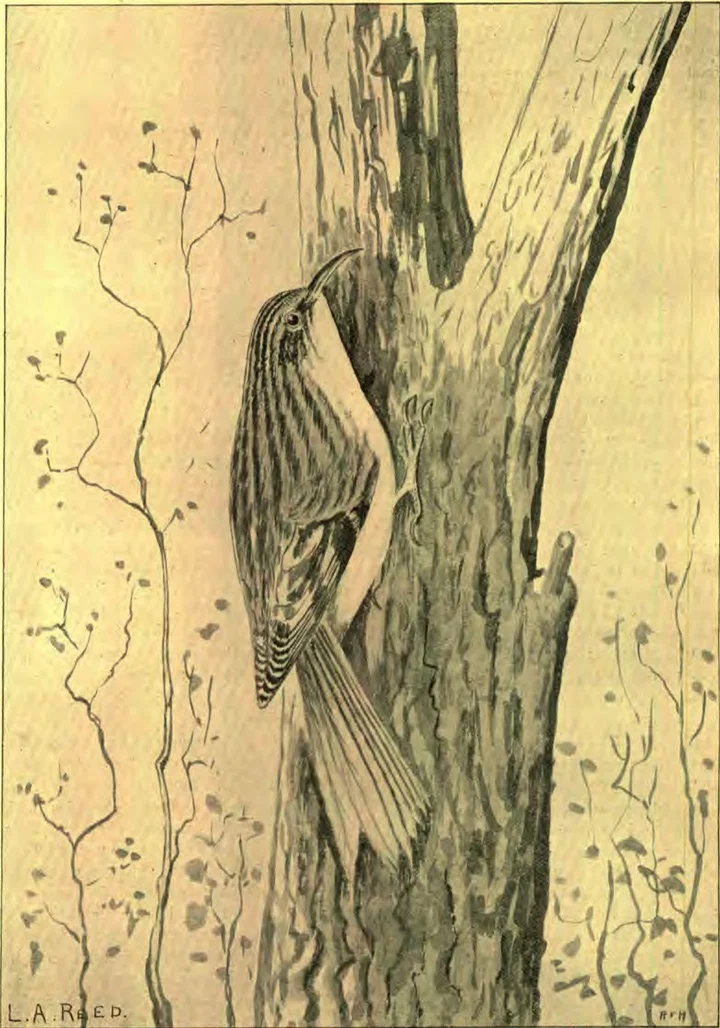
“An inoffensive but wearisome little fellow is a brown-clad denizen of all our woods in winter; . . . namely, the Brown Creeper, almost invariably seen on the trunks of trees whose bark is somewhat rough. He is a little over five inches long, white beneath, and finely marked with various shades of brown and white above. On first acquaintance he makes no particular impression other than that of being a neatly clad and busy little body; but in course of time he becomes really irritating to the feelings, from his exasperatingly conscientious but cold-blooded diligence, which makes you feel as if you ought to admire it on moral grounds; but you can not. The Brown Creeper is a virtuous drudge, without animation or variation. There is an air about him, as he silently climbs tree after tree, that makes his work seem as soulless as it is incessant. When you have seen him a minute, you have seen him a year; and seeing one is seeing a thousand.”
“He starts near the bottom of a tree, crawls up just about so fast and so far, and then flies to the bottom of another, only to repeat the program. By close application to business (and nothing but sickness can stop him), I find he can do a tree in just about fifty seconds, or seventy-two trees in an hour; and in the twenty-four hours (as far as I know, he works nights and every day in the week) seventeen hundred and twenty-eight trees. If he would only sing or chirp at his work, or flutter his wings, or turn his head occasionally, it would change the impression marvelously. Only now and then you hear a faint sip, that cheers neither himself nor the spectator, and has a drearily mechanical and conscientious sound. Every other bird I have seen will at times show joy or sorrow or fear by its manner of song, but the Creeper has only one aim and one ambition, and no time for sentiment. . . . It is nothing but climb, climb, climb, and never getting there.”—H. E. Parkhurst.
“As a tree-creeper we know the Brown Creeper, and as nothing else. If he ever happens elsewhere than on a tree-trunk, it must be by accident. I once found one that had evidently been blown into the room through an open window during a storm. Its effort to creep over the wall was not a success; and when it finally sank to the floor, its claws took such a hold upon the carpet that I could not dislodge it without injury. Any attempt to touch it was resented by vicious thrusts of its beak, which I found quite equal to piercing the skin.”—Dr. C. C. Abbott.
Those who have studied the bird in the nesting season describe the song of the little fellow as exquisitely pure and tender, now rising, now falling, and “dying away in an indescribably plaintive cadence, like the soft sigh of the wind among the pine boughs.” L. A. REED.