HENRY L. TRANSTROM

5%

Review and Herald Publishing Assn. · Takoma Park Station, Washington, D. C. · Jul 10, 1917

FromThe Youth’s Instructor, Vol. 65, No. 28.

Read the full edition

HENRY L. TRANSTROM

Alligators

HENRY L. TRANSTROM
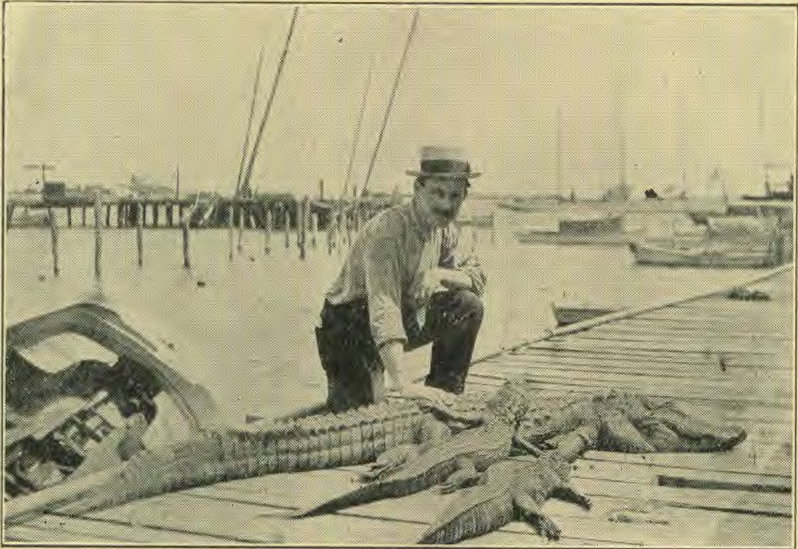
WHEN the really warm weather comes in the latter part of April or the first of May, the cold-blooded alligator leaves his den where he has been hibernating since the previous autumn, and chooses some pleasant spot on the river bank where he basks in the bright sunshine for several hours at a stretch. At first he ventures out for only an hour or two in the middle of the day, providing it is bright and warm; but he stays in altogether if the weather is cloudy. The first few weeks succeeding his long winter’s confinement are chiefly spent in sleeping in the sun; but as the hot days of summer approach, he becomes more active, and throwing off his sluggishness, makes excursions up and down the creeks in search of something to eat. He is very fond of pigs and dogs, but subsists chiefly upon sand crabs, shrimp, and other inhabitants of the water or the river banks. In capturing a pig of considerable size the alligator employs his long muscular tail to good advantage. In an apparently aimless manner he drifts noiselessly under the water alongside the bank on which the unsuspecting animal is walking, when without warning there is a sudden swish of the huge lizard’s tail, which, with unerring aim, usually knocks his prey off the bank into his gaping mouth. When he attacks unmanageably large hogs he pulls them down under the water and holds them there until they are drowned.
MR. TRANSTROM AND HIS ALLIGATORS
Alligators are plentiful in the lower Cape Fear region of North Carolina. Although these strange animals are not so numerous as they were a few years ago, they are rapidly increasing, because they are not hunted now as formerly. Besides, alligators are very prolific, a single batch of eggs numbering thirty or forty.
Fresh-water creeks and ponds are the favorite retreats of these reptiles, although in the very hot weather of middle summer, when the shallow water gets uncomfortably warm, they sometimes leave the creeks for the deeper and cooler waters of the Cape Fear River, which are made brackish by the tides that carry the salty sea water many miles upstream.
When spending a summer in the Cape Fear country at Southport, I had an exciting experience while hunting alligators. Although it is possible to shoot them in the daytime, one cannot usually approach within good shooting range, for they have such tenacity of life that unless the brain is almost completely shot out they will show signs of life. When they are angry, alligators seem to pay not the slightest attention to a rifle bullet passing through some parts of their bodies. At night one can approach them so close that a fatal shot is absolutely certain.
Not knowing the methods used to capture or shoot alligators, I hired to go with me two young men who had acquired a local reputation for skill in this kind of hunting. One was really the hunter, while the other was a boatman who could propel his little rowboat with the deftness of an Indian in a birch-bark canoe.
We started on our hunt rather late in the evening. After an hour’s ride in a small motor boat up the Cape Fear River, we arrived at a point where three fresh-water creeks empty into the Cape Fear. Two of these tributaries are rather large, the Elizabeth and the Dutchman’s, but the third, Dosher’s Creek, is much smaller. As there had been considerable traffic on the Elizabeth, our guide decided we would try our luck on Dutchman’s Creek. This creek is about two hundred feet wide at its mouth, slowly narrowing upstream, and the water was perhaps ten feet deep to within a short distance from the banks, which are almost perpendicular. The banks were covered with a dense growth of long marsh grass, and at high tide would be submerged, leaving only the coarse grass to show the shore outline.
On our way out from Southport, the moon was visible in the west, but by the time we reached the delta of the three creeks an impenetrably black cloud obscured it, and the night became so dark that as we sped on our way I noticed a peculiar phenomenon. There seemed to be directly ahead of us a cloudy wall of inky blackness, into which we were in danger of crashing. This optical illusion got on my nerves, but the young hunter paid not the slightest attention to it, guiding the launch safely and surely with the almost uncanny intuition of an Indian. As I was kept busy taking care of a small rowboat which we had in tow, my attention was taken from the black wall illusion to the brilliant phosphorescent glow coming from the disturbed water in the wake of our boats.
Everything was now favorable for the hunt, the water being smooth and the night dark, so our guide made ready for locating the prey. He took out of his pocket an old-style bull’s-eye lantern which he had filled with lard oil, and lighted it. Fastening it to the front of his cap in such a way that the lantern’s ray would always be thrown in the direction of his vision, he stood up in the prow of the launch so as to direct the steering of the boat by the hardly visible motions of his arms, much as a brakeman does on a train.
The launch was run up the middle of Dutchman’s Creek, while for a few minutes he cast the ray of his bull’s-eye first along one shore and then along the other. We continued for some time in this fashion, while our guide kept intently peering back and forth over the water, especially near the shores, when, without making a sound, he signaled the boat to stop, all the while keeping the ray of light focused upon one spot near the shore to our left. He told us he could see a “gator,” as these creatures are called in the South. So, after anchoring the launch, we all got into the rowboat, taking a shotgun and ammunition with us, as well as a quantity of strong rope.
After our leader had again located our prospective victim, we silently made our way toward him,—silently, I say, for the boatman did not row us, but instead we were propelled forward with a rotary motion of one oar held in the water at the stern of our boat. By standing very close to the guide, I could see both eyes of the “gator” stand out like living coals of fire, although we were about a hundred feet from him. Hardly disturbing the water, our boat neared the two gleaming eyes, until we had approached within fifteen feet of them. I handed the gun to the guide, who signaled the boatman to cease sculling and allow the momentum to carry the boat the rest of the way. By this force the little vessel moved slowly, like a shadow, closer to the charmed reptile lying in our path. Not one instant did our leader allow the light to leave the eyes of the alligator. If he had, we should have had all our trouble for nothing. The “gator” would have sunk as soon as he could distinguish the boat, which he could not do with the glare of the lantern in his eyes.
The prow of the boat approached within three feet and a little to the left of the “gator,” when there was a flash and a report, followed by a terrible churning of the water for a moment by the wounded alligator. Shortly the splashing subsided, and then our guide reached over the side of the boat, and with a firm grasp attempted to pull the creature on board; but it required the aid of the boatman and myself to get the monster over the gunwales and into the bottom, where we securely bound him with a strong rope. Upon examination we found he measured nine feet in length and weighed about two hundred pounds. His brains had been partially blown out by the one load of buckshot fired directly between his eyes. It was fortunate for us that the shot took fatal effect, for a wounded alligator is a terrible foe.
Depositing the body on the shore, and carefully shooting it again to be sure life was extinct, we made our way back to the launch and went in search of more game. I carried the gun for the rest of the hunt, as the guide shot the first victim simply to show me how it was done. It was not long before we spotted another “gator,” and rowed up to it the same way as we did the first one. I was all excitement, so that when the time came for me to shoot, my heart was beating like a trip hammer; but taking careful aim, I fired. The gun did not go off! I pulled on the trigger until my finger ached, but it refused to strike. The boat ran so close to the scaly creature that I could have touched it with my hand, but the gun would not go off, and, when our guide could no longer focus the light in his eyes because of his nearness, the alligator, without making a ripple, sank from our sight.
Upon examining the gun, I found that I had set the safety catch so that it could not discharge. It was not long until we spotted another prospective victim, but as I did not understand the working of safety hammerless shotguns, I once more spared the life of a saurian! Although it is rather unusual, this last animal within a short time came up not many yards from where he had sunk, and allowed us to charm him again. Not wishing to repeat my past performances, I thought I would shoot at the reptile before we got very close, that I might have more time to alter the adjustment of the gun in case it would not go off, so I fired at a distance of twenty feet. This time the gun responded, and I had shot my first alligator! It measured five feet in length.
A little later I shot another about eight feet long, but he sank to the bottom before we could get to him. We could reach his body with an oar pushed down in the water as far as it would go, but were unable to raise him with it. Alligators sink within a few seconds after being shot, so great skill and quickness are required to get a wounded “gator” into a boat.
Not getting sight of any more game in Dutchman’s Creek, we returned to its mouth, stopping on the way to pick up our nine-foot prize where we had left it. Then we went up Elizabeth Creek a mile or two, where I added one more five-foot trophy to my record. We returned to Southport at four in the morning, feeling well repaid for our efforts.