NITROGEN is a gaseous element, the chemical opposite of oxygen. Oxygen has strong affinities; nitrogen is characterized by extreme inactivity. It can only be made to enter into chemical union with other substances by “specially devised and circuitous processes.” “Oxygen is found almost everywhere; nitrogen exists only in the air, and in comparatively few compounds. Oxygen illustrates chemical activity; nitrogen, chemical inertia. Oxygen sustains life; nitrogen has no physiological effect when inhaled, though it is a constituent of many animal tissues.”
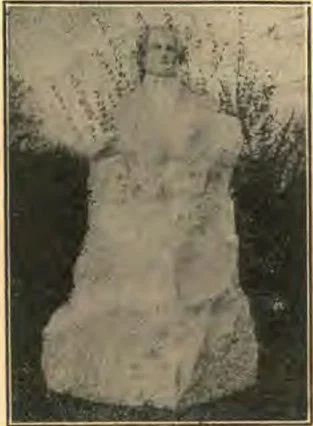
PARIS MONUMENT TO
HORACE WELLS
Nitrogen occurs free in the atmosphere, making about four fifths of the volume of air. Its chief office in the air is to dilute the oxygen, thereby lessening its activities. It is not chemically combined with the oxygen, only mixed; so the oxygen can easily be separated from the nitrogen for respiration and combustion.
Nitrogen, like hydrogen and oxygen, is colorless, odorless, and tasteless. It has been reduced to a liquid, and to a snow-like solid. It has no poisonous properties, neither will it burn or support combustion. The wisdom of having such an associate for oxygen in the atmosphere is evident. It is difficult enough to extinguish fires at the present time. If nitrogen aided ever so little in the work of combustion, it would, from its abundance, greatly increase the difficulty.
Nitrogen, meaning niter producer, was given its name because of its being an important constituent of saltpeter (KNO₂), often called niter. As nitrogen is so abundant in the air, the best method of obtaining it is to remove the oxygen from the air. Mr. Williams in his chemistry gives the following experiment for collecting nitrogen:—
“Cover a large, flat cork with a coating of plaster of Paris and float it upon a pan or basin of water. A small iron saucer serves well instead of the cork. Put upon it a small piece of phosphorus and ignite. Quickly place over the burning phosphorus a large, wide-mouthed jar. Notice that the water gradually rises in the jar to take the place of the consumed oxygen, and that in a few minutes the white fumes are absorbed by the water. Owing to the expansion caused by the heat, some bubbles of air almost always escape in the early part of the experiment.”
This experiment should be performed only under the supervision of an experienced teacher, as phosphorus is highly poisonous and inflammable.
Nitrogen is an important element in organic nature. All forms of life, animal or vegetable, contain a large proportion of it. The peculiar odor of burning hair and horn is due to the presence of nitrogen in those substances. Nitrogen, hydrogen, oxygen, and carbon are pre-eminently the organic elements. But neither plants nor animals ordinarily use the free nitrogen from the air. They get it from nitrogen compounds. We water plants sometimes with weak ammonia water. The plants break up the ammonia, which contains nitrogen, and use that element in their tissues. About one million five hundred thousand tons of sodium nitrate (NaNO₃) are exported yearly from the northern part of Chile, where immense deposits of it occur. Nearly all of this is used as a fertilizer, in order to furnish nitrogen to crops. Economists, recognizing that this supply is not inexhaustible, some claiming that in less than thirty years it will be exhausted, have partially solved the problem by discovering a way to utilize the nitrogen of the air. With the aid of the electric arc, some of the nitrogen and oxygen of the air are induced to unite, forming nitric oxide, which in its turn is readily converted into nitric acid or nitrates. A successful plant for carrying on this operation on a large scale has been set up in Norway, and is now turning out large quantities of nitrate of lime for fertilizing purposes, which is capable of replacing the natural nitrate of Chile.
“Recent investigations by Jamieson, in Scotland, and Zemplen and Roth, in Hungary, indicate that forest trees may, through the natural functions of their foliage, be able to perform the feat which science has only within the past few years placed within the reach of human accomplishment, of extracting free nitrogen from the atmosphere. Professor Henry, of Nancy, was the first to point out that forest soils are enriched in nitrogen by the decay of leaves. The later investigators have found nitrogen in the trichomes of many species of forest trees, and they believe that they have excluded every possible source of this nitrogen other than the atmosphere.”
Compounds of Nitrogen
While nitrogen is inert at ordinary temperatures, it can be made under certain conditions to combine with hydrogen, oxygen, chlorine, bromine, sodium, and some other elements. The principal explosives, as powder, dynamite, guncotton, and nitroglycerine, owe their activity to the presence of nitrogen in them, it making compounds unstable,—a necessary characteristic of explosives.8
Perhaps the most common or best-known compound of nitrogen is ammonium hydroxide (NH₄OH), or ammonia, as it is commonly called. That term more properly, however, belongs to the gas. Ammonium water consists of ammonia gas (NH₃) dissolved in water. It is thought the gas acts chemically upon the water, making the unstable compound NH₄OH, from which the gas readily escapes.
Ammonia was formerly prepared by the dry distillation of hair, hoofs, hides, and horns; for this reason it was called hartshorn, and its solution, spirits of hartshorn. At the present time ammonia is made in large quantities as a by-product during the manufacture of illuminating gas from coal. Since coal is of vegetable origin, it is natural to look to it for nitrogen compounds. The decomposition or decay of all vegetable or animal matter gives free ammonia to the air.
Ammonia gas is easily converted by cold or pressure, or by both together, into a colorless liquid. This liquid produces great cold when it evaporates, and is largely employed for cooling and for the production of artificial ice, for which purpose it has almost completely displaced other substances in practical work. The manufacture of ice, then, is a simple matter; if the liquid ammonia is allowed to evaporate near vessels of water, the heat required to cause the evaporation is drawn from the water, so the water is frozen.
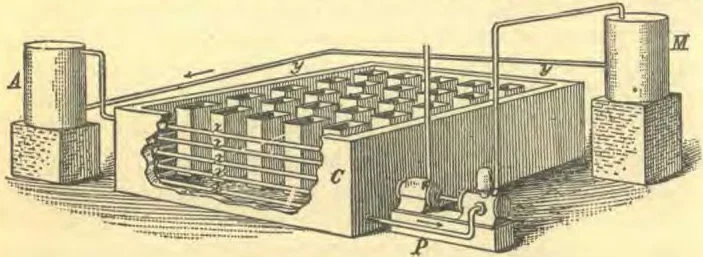
MODERN ICE PLANT
“A is a tank filled with liquid ammonia. C is a rectangular vat, filled with strong salt water, through which are coiled a series of pipes, x x, that connect with A. Through the top of this vat are let down oblong galvanized iron boxes, containing the fresh water to be frozen. P is a steam-pump, which is continually exhausting the pipes and keeping up a rapid evaporation in A. This evaporation lowers the temperature of the salt water in C below the freezing-point of pure water, and in from thirty-six to sixty hours the ice is ready to be drawn from the boxes.”
Just as a drop of ether or benzine placed on the hand in evaporating draws heat from the hand, and causes it to feel cold.
Inorganic compounds are classed as bases, acids, and salts. Litmus paper, which may be obtained from a druggist, is used to test the nature of substances. In general, blue litmus is turned red by an acid, and is unaffected by either a base or a salt; red litmus paper is turned blue by a base, and is unaffected by an acid or a salt. A solution of cochineal, orange itself, will turn violet on the addition of a base, like ammonia. An acid will restore the orange color. Ammonia will turn red litmus paper blue, so it is a base, one of the strong bases called alkalies. It will, therefore, neutralize an acid. For this reason it is used in cases of accidents when acids are spilled upon the clothes or flesh. “But should the acid be received in the face, it is best to wash it off quickly with much water, then with a weak solution of ammonia, and finally, without rubbing, to cover the injured parts with sweet-oil.”
A friend of mine recently purchased a gray mohair skirt. Almost the first time it was worn she completely ruined the front width, as she thought, by getting lemon juice on it. Some one suggested to her that she put ammonia water on the spots from which the lemon juice had taken out the color. This she did, and then washed out the ammonium salt with clear, cold water, and found the skirt was restored to its original condition. If she had spilled nitric acid on the skirt, the ammonia would have deepened the spots instead of restoring them, though it might have kept the acid from decomposing the cloth.
Ammonia is much used for cleansing purposes and for softening, or “breaking,” water. In a medicinal way it is used as a restorative in cases of fainting, and overdoses of chloroform and other anesthetics. Smelling-salts reveal the presence of ammonia.
Nitrogen makes five compounds with oxygen. Perhaps the most interesting one is nitrous oxide (N₂O). This is a colorless gas, with a faint odor and sweetish taste. It will support combustion almost as well as oxygen. “When nitrous oxide is diluted with oxygen and inhaled, it produces a kind of intoxication, generally accompanied by a disposition to immoderate laughter, hence it is called laughing-gas. When the gas is breathed pure, it produces temporary unconsciousness and insensibility to pain. It has been used by dentists for the painless extraction of teeth. It should be used with caution; for if it is inhaled too long a time, it produces suffocation and death.”
“A monument was recently unveiled in Paris, in honor of the American surgeon and dentist, Horace Wells, the discoverer of nitrous oxide. Although its properties had been made known as early as the year 1800, Wells was the first to employ it in dentistry. He made a visit to Paris, where he communicated his discovery to the French medical societies.”
Nitric acid (HNO₃) is, as shown by the formula, a combination of hydrogen, oxygen, and nitrogen, and is one of three common acids so important in the arts and in commerce. It has been known for hundreds of years. Considerable quantities of it are employed in the manufacture of the explosives nitroglycerine and guncotton. Smokeless gunpowders, most of which are mixtures containing the foregoing explosives, have increased the demand for nitric acid. It is also used in etching copper and steel plate, also swords and razors, much as hydrofluoric acid is used in etching glass. It acts an important part in the making of the beautiful and varied coal-tar colors, or aniline dyes, which is one of the most fascinating of industries.
A simple test for nitric acid is that it turns the skin yellow. It has the same effect upon vegetable fibers.