MOST of the world's extracts and essences come from Europe, our own total production probably not exceeding one twelfth that of one little town in France. Grasse, in southern France, is the center of the perfume industry. It is a city of lovely flowers, and during the larger part of the year the air is heavy with fragrance. Nice and Cannes, neighboring cities of Grasse, are her rivals in giving the sweets of the flowers to the world.
Not all our perfumes come from flowers. Leaves, wood, bark, gum, seeds, buds, and fruits of various plants yield perfume. Some plants produce more than one distinct perfume. The orange yields three.— fruit, flower, and wood each producing a different odor. Even some animals, as the civet cat, musk deer, whale, and beaver, yield some of the most important perfumes.
The animal perfumes are very strong and persistent. A grain of musk will distinctly scent millions of cubic feet of air without any appreciable loss of weight, and its scent is not only more penetrating but more persistent than any other known substance. The animal perfumes serve chiefly to hold the vegetable odors in solution. The most valued musk comes from China, though some is imported from Russia. Artificial musk is now manufactured as a coal-tar product.
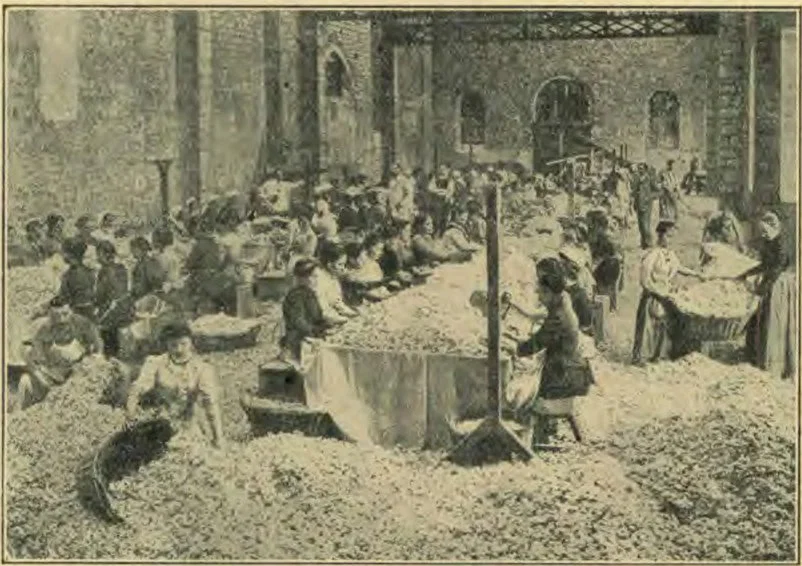
SEPARATING THE PETALS FROM THE PISTILS OF ROSES
Castor, or castoreum, is the name of a perfume taken from the beaver, while ambergris is that from the sperm whale. Ambergris is a solid, fatty substance of a dull-gray color found in the abdomen of the whale. As much as one hundred pounds of ambergris has been taken from one animal. It is usually found floating on the surface of the ocean, or cast upon the shore in regions frequented by whales, sometimes in masses of from sixty to two hundred and twenty-five pounds in weight. Ambergris was once used in medicine, but now its use is confined almost wholly to perfumes and flavoring materials.
Process of Distillation
There are four processes of extraction of the perfume from the flower,— distillation, enfleurage, maceration, and expression. By the first process the flower petals, buds, or seeds yielding sweet odors are put into a still with water, and the mixture distilled, or boiled, the fragrant oil or principle passing out through the steam. It is then carried to a receiver containing water. Here it rises to the top, and can be poured out or siphoned off. The water retains a certain portion of the essential oil. It is used over and over again, or sold as rose water, jasmine water, etc.
Process of Enfleurage
The process of enfleurage requires a wooden frame two to three inches deep having a glass bottom. The glass is covered with a layer of refined lard or beef suet, about one fourth of an inch thick. On this is placed a layer of flower petals or buds. The frames are placed one above the other and left from ten to seventy hours, according to the species of flower used. After this layer of flower petals is removed, the grease is scratched up and a new layer of the same kind of flower is sprinkled on the fresh surface. This is repeated until the grease has absorbed a large quantity of perfume. The grease, or pomade, is then scraped off and sold to perfume manufacturers, who melt it or treat it with alcohol or rectified spirit of wine for a month at summer heat. Essences of tuberose, rose, orange, and violet are obtained in this way. Much of the perfume extracted in Grasse is treated in New York and other large cities.
Sometimes a piece of wire netting is used in place of glass for the wooden frames, and on this is laid a piece of felt saturated with pure olive oil. The flower petals are sprinkled upon this greasy felt and left for many hours.
Process of Maceration
Orange and rose petals are usually treated by the process of maceration. In this the flower leaves are thrown into large iron kettles of melted lard surrounded by boiling water, and left for from twelve to twenty-four hours. The petals are then strained out and fresh ones put in. This process is repeated until the lard, or pomade, is highly perfumed.
Process of Expression
Expression, or squeezing, is suitable only in cases where the plant is abundantly supplied with essential oils, as in lemons, citrons, oranges, and limes. In such cases the rind is pared off, and the parings placed in a canvas bag and squeezed in a screw or hydraulic press. The oils so obtained are then separated from the water with which they are mixed, by a tap funnel and filtered.
Thus we see that perfumes are obtained by boiling, the odors passing off with the steam; by allowing the odors to be absorbed by cold or hot grease; or by pressure.
Sensitiveness of Essences
One writer, in speaking of the sanitary care acquired in the perfume industry, says: “One’s first impression on stepping inside the cool, airy buildings is astonishment at the cleanliness of everything. The whole place is quite as spotless, and perhaps even more so, than a food factory. It is explained that all kinds of essences are extremely sensitive. Anything that would cause the slightest smell must not be tolerated. All the workers are expected to observe the9strict rules of the factory in this respect; instant dismissal would follow the smoking of a cigarette.”
Quantity of Flowers Used
We can hardly comprehend the quantity of flower petals demanded by this industry. It is said that forty-five pounds of rose petals, and a rose petal is not very heavy, are required for one three-hundred-and-fiftieth of a pound of attar of roses. The total weight of flowers gathered annually at Grasse alone is estimated to be ten or twelve billion pounds. The factory flowers at Grasse are always heaped with flower petals, for it is estimated that 3,300,000 pounds of roses, 4,500,000 pounds of orange flowers, 700,000 to 900,000 pounds of violets, 1,320,000 pounds of tuberoses, together with thousands of pounds of other varieties, are used annually by the Grassois.
The work of the perfume industry is wholesome as well as pleasant, for it is claimed that two thirds of the people of Grasse live to be seventy years of age. But this simple folk have competitors in their work. Before the war, German scientists, by blending and combining chemicals, were manufacturing in large quantities perfumes that almost perfectly simulated the products coming from the factories at Grasse. We shall hope, for the sentiment connected with the beauty and sweetness of the natural product if for no other reason, that the real product will never be displaced by the artificial. F. D. C.