Second Talk on Daniel Eight
CARLYLE B. HAYNES
When Donald Hunter came into the big tent on the baseball lot on Monday night, he saw the same charts on the platform that Brother Harris had used the night before, and he remembered the preacher had said that on Monday night he would continue the explanation of the wonderful prophecy of the eighth chapter of Daniel. He was very eager to understand the rest of this prophecy.
Elder Harris first reviewed briefly the talk of the preceding night. He pointed to the charts, and said that, as previously stated, the ram was a symbol of Medo-Persia, the goat a symbol of Greece, and the little horn of Rome. After reading Dan. 8:13, 14, he said:
“Whenever time is found in connection with symbolic prophecy, the time itself is symbolic. In prophecies of this kind we are given a divine rule of reckoning. This rule is in Eze. 4:6, and reads, ‘I have appointed thee each day for a year.’ “Hence every day mentioned in this prophecy represents a year. Therefore, a certain work, called the cleansing of the sanctuary, is to be done at the end of a long period of twenty-three hundred years.”
The minister read Dan. 8:15, 16, where the angel Gabriel was commanded to make Daniel understand the vision, and then continued:
“In response to this command, Gabriel immediately begins to instruct Daniel in the meaning of the vision. He explains the ram, the goat, and the little horn in verses 20-25, and then refers to the twenty-three hundred years. Verse 26. This chapter closes with the statement that the vision was not understood.
“Plainly it was the prophecy of the 2300 days which Daniel did not understand, for the angel had very carefully explained the symbols of the ram, the goat, and the horn. Since Daniel did not understand the vision, it is clear that the commission to make him understand had not yet been fulfilled, and hence we shall certainly expect Gabriel to return and carry out this unfulfilled duty.
“In the ninth chapter we find Daniel, by study and prayer, seeking for light and information. In response to Daniel’s prayer, Gabriel returns to make him understand the 2300 days. The angel now says, ‘Therefore understand the matter, and consider the vision.’ Dan. 9:20-23.
“In obedience to this command, Daniel considers the vision. He sees again the ram, the goat, and the horn, and recalls the explanation which had been given of them. But there is a part of the vision he does not understand, the 2300 days, at the end of which the sanctuary is to be cleansed. As he recalls this part of the vision, Gabriel begins right there to explain it, saying:
“‘Seventy weeks [of this 2300-day period] are determined [or cut off] upon thy people and upon thy holy city, to finish the transgression, and to make an end of sins, and to make reconciliation for iniquity, and to bring in everlasting righteousness, and to seal up the vision and prophecy, and to anoint the Most Holy.’ Dan. 9:24.
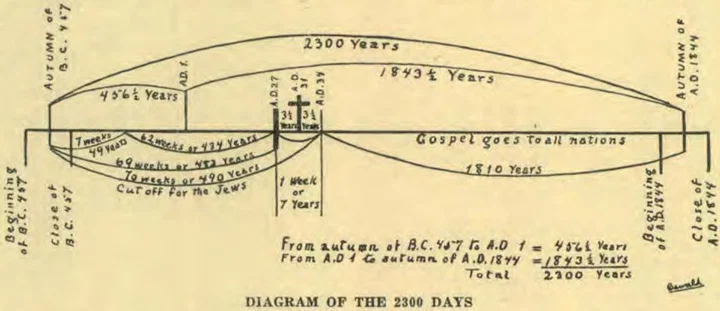
“This divides the 2300-day period into two parts, 70 weeks or 490 days, and the remainder, which would be 1810 days. As these days stand for years, we now have two periods, one of 490 years, the other of 1810 years, or 2300 years in all.
“The next verse gives the starting point of the entire period, and at the same time divides the first period of 490 years into three smaller periods. Read verse 25.
“Here we have the starting point of the 2300 years, and of the 490 years as well. It is to begin with some decree, or commandment, to restore and rebuild Jerusalem. From the time that decree is given it will be just 2300 years to the time when the sanctuary begins to be cleansed.
“The first period of 490 years is divided into three smaller periods: of seven weeks, or 49 years; of 62 weeks, or 434 years; and of one week, or seven years. The city of Jerusalem was to be rebuilt during the 49 years, the Messiah was to appear at the end of the 434 years, and the full end of the 490 years given to the Jewish people was to be reached at the end of the third period of one year. After this there would still remain the 1810 years of the full period of 2300, and at the end of this last period, the record says, ‘then shall the sanctuary be cleansed.’
“Now before we can find the end of any of these periods we must obtain the date when the whole period of 2300 years begins. And this, in the words of the angel, is at ‘the going forth of the commandment to restore and build Jerusalem.’ And this date is given,p. 13 with the very commandment, or decree, itself, in the seventh chapter of Ezra. The date given in the margin, 457 B. C., is the date which begins the 2300-year prophecy.
“With this date we have found a starting point. Forty-nine years from 457 B. C. brings us to the complete rebuilding of Jerusalem; 483 years, or ‘seven weeks, and threescore and two weeks,’ from 457 B. C., reaches to the appearance of the Messiah; 490 years from 457 B. C., reaches to the end of the time given to the Jewish people; and 2300 years from 457 B. C., reaches to the time of the cleansing of the sanctuary.”
By close attention Donald, though he was only a boy, found that he could understand the prophecy, but he made up his mind he would study it all over very carefully by again reading the book, “Thoughts on Daniel,” which his father had bought for him the previous night. Brother Harris continued:
“Four hundred and eighty-three years after 457 B. C., the Messiah was to appear to his people, the Jews. To what would this bring us? This period, 483 years, would reach from the first day of 457 B. C., to the last day of 26 A. D. Thus:
First day of 457 B. C. 483 Last day of 26 A. D.
“Now it is plain that if the decree did not go forth on the first day of 457 B. C., but some time later, that the 483 years would reach over into the year 27 A. D. The decree did take effect in the autumn of 457 B. C., and we are, therefore, brought over to the autumn of A. D. 27 as the ending point of the 483 years.
“Thus the prophecy points directly to the year 27 A. D. as the year for the appearance of the Messiah to his people. But was not Christ born before this year? — Yes, but notice carefully the wording of the prophecy, ‘Unto the Messiah the Prince.’ What is the meaning of the word ‘Messiah’? It is the same in the Hebrew language as ‘Christ’ is in the Greek. ‘Messiah’ means ‘the anointed One;’ and ‘Christ’ means ‘the anointed One.’ Hence we must locate the date of the anointing of Jesus of Nazareth.
“Jesus was anointed at his baptism. This we see by reading Matt. 3:13-17, and the date of this anointing is 27 A. D.
“Immediately after his baptism, Jesus was in the wilderness of temptation for forty days. We read that then ‘Jesus came into Galilee, preaching the gospel of the kingdom of God, and saying, The time is fulfilled, and the kingdom of God is at hand: repent ye, and believe the gospel.’ Mark 1:14, 15.
“Note the significance of this expression of Christ’s, ‘The time is fulfilled.’ At this point the 69 weeks, or 483 years, of the prophecy of Daniel ended. At this point the Messiah, the anointed One, was to appear to his people. And at this very point the Messiah did appear, being anointed at his baptism, and then coming and preaching, ‘The time is fulfilled.’ He called their attention to the very prophecy we are now studying, the very prophecy which proves his Messiahship.
“Continuing our study, we find there is one more week of the seventy which were given to the Jewish people. Sixty-nine weeks have brought us to 27 A. D. There is now another week of years, and adding this to 27 A. D., we are thus brought to the year 34 A. D., as the ending point of the seventy weeks, or 490 years.
“Now in the middle of this last week something takes place which is especially noted in the prophecy. ‘And he shall confirm the covenant with many for one week: and in the midst of the week he shall cause the sacrifice and the oblation to cease.’ Dan. 9:27.
“In the ‘midst’ of the final week of the seventy ‘the sacrifice and the oblation’ were to cease. This sacrificial system was all typical of Christ, the great Sacrifice, and when Christ died on the cross, during this week, type met antitype, and the typical system thus closed. This was shown by the veil of the temple being rent in twain at the time of the death of Christ. Matt. 27:51. However, during the entire week, from 27 to 34 A. D., the covenant was to be confirmed with the Jewish people.
“The full period of seventy weeks, or 490 years, given to the Jews expired in 34 A. D. At this point we find the prophecy being fulfilled by the official rejection of the gospel of Christ by the ruling body of the nation, the Sanhedrin, in their persecution of the disciples and the martyrdom of Stephen, and from this time onward the apostles turned to the Gentiles. At this time, too, the great apostle to the Gentiles, Paul, was converted.
“We have now completed our consideration of the first division of the 2300 years, that period given to the Jewish people, which was 490 years long. We have found this ending in the year 34 A. D. To this must now be added the 1810 years of the 2300 which still remain. And when this is added to 34 A. D., we are thus brought to 1844 A. D., as the grand terminal point of the entire period of the 2300-year prophecy. And the accuracy of this date cannot be successfully challenged, for it is based upon the central facts of the gospel of Christ, his baptism, ministry, and crucifixion.
“According to the prophecy, then, the sanctuary would be cleansed in 1844. With these facts clearly before us we are prepared to pass on to a consideration of what the sanctuary is, and what is meant by its cleansing.”
Donald found himself so interested in this prophecy that it was very hard to wait until the next night to hear it further explained. The following day he read it all over again in “Thoughts on Daniel,” and thus was much better prepared to understand what the speaker said the next evening.