THIS is a practical age, and the question that naturally comes to our minds is, Does it pay? Why all this fuss about birds? Wouldn’t it be time more profitably spent if we were to study how better to serve humanity?
The birds are man’s untiring employees, as well as being counted among his true friends and unsurpassed entertainers. The farm, the orchard, and the garden are their habitat. Their speech is a song.
Let’s take a single case as an example. According to the government reports, the American sparrow family, in 1910, saved the sum of $89,260,000 to the farmers in consuming weed seeds that cause great losses, as reliable figures show. Seventy-two thousand weed seeds have been found in the stomach of a single duck, which proves that a duck hunter is one of the enemies of humanity.
A few years ago the American hen was looked upon as a sort of consort for the farmer’s wife. Eggs furnished the pin money for the womenfolk. But today the chicken business totals more than $650,000,000 for meat and eggs, to say nothing of the by-products of feathers.
We fought a fierce political battle on the problem of gold, and yet that year there were $40,000,000 less gold produced than involved in the poultry business.
Eggs have gone up from two cents for a baker’s dozen of thirteen to one dollar for twelve. The latter price is often paid for specially selected eggs for high-class hotel, restaurant, and drug store trade, and fifty dollars a dozen for eggs for sitting purposes is not unusual, while a single hen is worth as much as a farm in Texas, and a married one, together with her family, often costs more than a city residence. Sonoma County, California, alone has produced more than 10,000,000 dozen eggs in one year.
Hens lay for us, but we have to provide feed for them, house them, and care for them as if they were prima donnas, for chickens and grand-opera singers are equally sensitive to the gentlest zephyrs, and both are temperamental.
Birds work for us so faithfully that every time a hen cackles or a rooster crows over the fact that they annually add $650,000,000 to our wealth, the little birds snicker te-hee and sing of their glorious work, accompanied by nature’s symphony orchestra, for they have saved us $1,000,000,000, and cost us little effort and less money for food and shelter.
Chicken shows are more numerous and more profitable than a circus. Why not have a bird show? We have our Arbor Day to plant trees; now what is needed is to make April 9 our national bird day.8
Bird farming is one of the great industries of the future. Just as fox farming has produced $16,000,000 profit in the last two years, so will the wild birds prove veritable Klondikes to the wise men of the near future.
As the new practice of medicine is based upon prevention rather than cure, the bird life of our community ought to be studied with care, for here are to be found the natural enemies of many disease-bearing insects. “Even the nighthawks,” says the Philadelphia Farm Journal, “are great sportsmen, and are such expert aeronauts that no winged insect is safe from them. They contribute greatly to the healthfulness of the section where they live, by disposing, in a most elective and hygienic manner, of several species of mosquitoes, among them the Anopheles, the transmitters of malaria. Nighthawks belong to the whippoorwill family, and subsist entirely upon winged insects, which they capture while gracefully sailing around at eventide.”
The common barn owl lives on rats, mice, beetles, shrews, gophers, and other undesirable squatters in the fields that are intended for corn, wheat, oats, and other food grain. So owl farms are not an iridescent dream.
The National Association of Audubon Societies is doing a wonderful work in the field of research, gathering the facts, and classifying them; and from this mass there is coming into use several new sciences, much useful, practical knowledge, and a greater love for nature. Its national headquarters are at 1974 Broadway, New York City, and a card to that address will bring much valuable information about this movement.
On Jan. 1, 1913, Mr. Wilmer Atkinson, editor of the Farm Journal of Philadelphia, organized the Liberty Bell Bird Club, with one member. On Feb. 1, 1915, the club had 300,000 members. Its sole object is to save the song and insectivorous birds, and it asks the cooperation of every bird lover.
The need of such a club is readily seen when the government reports are studied, and we find that ninety per cent of the bird life in this country has been destroyed, and that $1,000,000,000 a year is lost by the farmers and fruit growers through the ravages of insects.
We read with ever-refreshing interest the story of the plagues of Egypt that Pharaoh encountered thousands of years ago, quite forgetful of the fact that in one year the birds of Massachusetts alone consumed 21,000 bushels of insects.
The Liberty Bell Bird Club has brought the battle for birds before about 4,000 county superintendents of schools, 125,000 teachers, and has introduced bird study into more than 7,000 schools. There are no dues, no assessments, no fines, no fees, no expenses of any kind. All that is asked is valiant service for the birds.
Can we bring back the birds? The Saturday Evening Post some time ago devoted a half page to that very subject, describing how J. Warren Jacobs, of Waynesburg, Pennsylvania, conceived the notion that even departed birds would “come back” to their old haunts, in spite of steam whistles, quarry blasts, and the general racket of forge and factory, if given an intelligent welcome; so in 1896 he built a bird house, designed with a view of attracting martins. This mansion contained twenty rooms, and great was his delight when he discovered an old scout flying around on an investigation tour; and as he saw “to let” on every side, he was not long in deciding to move in.
He hastened away to lead his good mate to their new home. The next day Mrs. Martin inspected every room in the house while Mr. Martin sat on the chimney of his new home looking for neighbors; and in less than a week there were eight couples in Jacobsville, as the martins called it. At that time there were less than two dozen martins in Waynesburg. Last year 1,200 of them left there about the twenty-eighth of August for their flight south to the West Indies or to Central and South America.
On Sept. 17, 1908, 25,000 of these real aviators were gathered from all parts of Pennsylvania, West Virginia, Ohio, and States still farther north, and they halted for the night at New Martinsville, West Virginia, an Ohio River town about forty miles south of Wheeling, which if it wasn’t named in their honor deserved to be; at any rate they took the city. They had gathered for their flight south.
The martin is the friend of man as man is the friend of the martin. The noble red man of the forest was the first to build a rude house for him, and it was he who started the evolution that has changed the martin’s home from a hollow tree to a house built after all the modern plans of architecture.
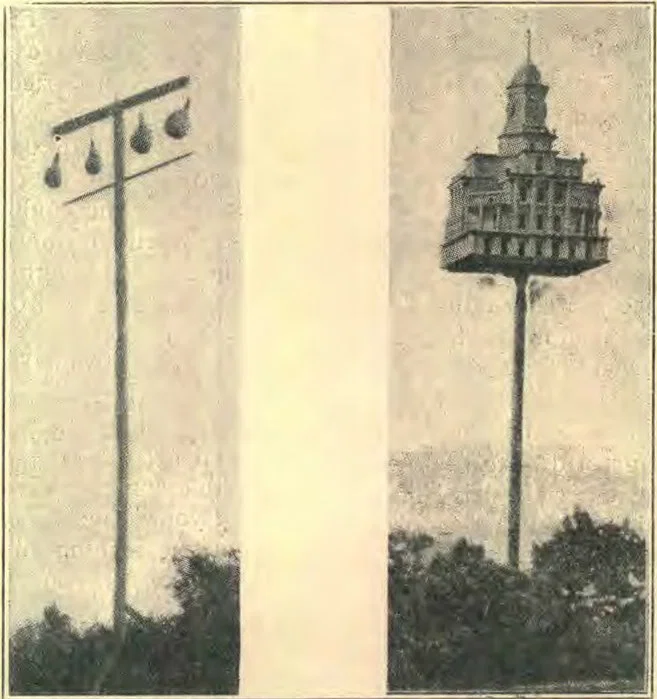
The pictures of the Jacobs martin house are worth studying. That prince of men, philanthropist, and friend of the race, at Detroit, Michigan, Henry Ford, the manufacturer, has ordered a dozen of these bird mansions for his home and factories. He knows the pleasure that the purple martin brings to those who watch its busy life. Wm. Rockefeller has six of them at his Bay Pond, New York, home. Mrs. Potter Palmer has one in Florida, where she migrates during the cold weather. Two thousand others have these bird mansions on their private property. City parks and public places are dotted with them. They are shipped to all parts of this country. Russia, before the war, was a constant buyer of purple-martin mansions.
Mr. Jacobs has a bird-house factory—his business is a profitable one. It is only in its infancy. There is a great future for the manufacturer of bird houses as a business.
Mr. Jacobs says: “The purple martin is today at the threshold of a stimulating and prosperous advance, which during the next few years will spread its progeny over territory where it has not been seen for years. A large amount of correspondence during the past few years shows a widespread desire and longing to reestablish the martin in communities from which the birds long ago departed.”
In Illinois we have a State law that compels the teaching of kindness to birds and animals in our public schools. We see the value of teaching the young that we are past the age of barbarity, and that we have learned a part of our lesson from the story of the buffalo.
Mr. Ford, the Automobile Manufacturer, and His Birds and Bird Mansions
When a man with as many diversified interests as those which daily confront Henry Ford, the much-written-about automobile builder, can take time from his many activities to give his personal attention to the better protection of song and insectivorous birds, it is time for most of us to give thought to this great economic problem. Mr. Ford has a farm of four thousand acres that is situated at Dearborn, Michigan, about ten miles9from Detroit. The Rogue River flows through it, and Mr. Ford has had it dammed to make a wider series of drinking places for the birds. He has placed about five hundred bird houses in this bird haven, and he finds no trouble in keeping his houses occupied.
He has many houses and feeding stations arranged, and the thick undergrowth, and the big roots from fallen trees, are all good shelters, but especially fine is an arrangement of rails and cornstalks. Fence rails, some distance apart, are laid on the ground, then a layer crosswise, and so on until a series of five or six rows is made. Around and on top of these rails are placed cornstalks until the rails are entirely covered. A better shelter can hardly be made. The birds work in through the stalks, and there is always plenty of dry and warm spaces between the rails. The water cannot get through, and food is thrown between the rails. Hundreds of birds can use these throughout the winter.
In the spring the shelters are burned, and new ones are built in the fall. These cornstalk shelters are from ten to thirty feet long.
It is a great sight to see the motor cars leaving Detroit for the Ford farm, loaded with food for the birds, and to follow them to the places where this food is placed so his little feathered friends can banquet on grain, seeds, suet, doughnuts, and hot cakes, and to hear their little twitters of delight and songs of thankful praise for these favors.
KIND OF HOUSE THE INDIAN BUILT. KIND MR. FORD BOUGHT. THESE HAVE SEVENTY-TWO ROOMS.
Their menu reads like this: Rolled oats, cracked wheat or cracked corn, hemp, millet, or sunflower seeds. Flapjacks are hung on the trees; doughnuts are put where they can be easily found to finish up a short-order lunch. Suet is provided in big quantities, and is placed in wire cages so it cannot be carried away in large pieces. The grains are placed on the trays in the feeding stations, in boxes, thrown under the cornstalk shelters, and, for shy birds, scattered on the ground under the feeding houses. The feeding is done daily, and the birds visit the stations in flocks, and eat up the supply clean.
A daily report shows the feeding stations were visited by 100 myrtle warblers, 110 song sparrows, 150 juncos, 41 white-throated and white-crowned sparrows, 98 tree sparrows, 204 goldfinches; also by many white-breasted nuthatches, downy woodpeckers, robins, and larks. Many other varieties are expected to stay there this coming winter.
Thousands of wild berry plants have been set out for the birds, and, for the ducks and shore birds, wild rice has been planted in the swamps. Many of these, like the mergansers, stay all winter.
Water is provided in winter. Mr. Ford has built a box with an electric heater, which keeps the water tepid. No bird suffers from thirst on the Ford farm.
The fifteen or more feeding stations are all securely built. The trays are at the top, so that the birds can eat in comfort. The rain and snow cannot reach the food.
The Ford farm is not a show place. There is not a caged bird on the farm. The farm is for the birds, and every effort is made to make it an ideal breeding place for them.
The birds have become very tame, and some are absolutely fearless. The wrens and woodpeckers build right up to Mr. Ford’s bungalow, and in a strip of ground thirty by two hundred feet, near the bungalow, there were found twenty-three nests of fifteen varieties of birds.
All the native birds of Michigan are on the farm, and many others. Prairie chickens, quails, and pheasants are there, and rapidly multiplying.
If you are interested in this story of Mr. Henry Ford’s bird farm, send a post card to the Ford Automobile Factory at Detroit, and ask for the literature that this great-hearted humanitarian has gathered, and he will mail it to you free of charge. I know, for I tried it.
Uncle Sam and the Birds
So important are the birds that the Agricultural Department of our national government has led in the research work that has wrought such wonders in recent years. The scientific information that is the basis of our bird knowledge, is largely due to the fostering care given to this great movement by those in authority.
The department has issued many valuable and practicable booklets, pamphlets, and bulletins that are accomplishing wonderful results. The general diffusion of practical ways of protecting the song and insectivorous birds is already felt as an economic factor.
The department has just completed the 1915 bird census, the most complete ever taken. It shows that the robin heads the list as the most numerous bird in America, with the English sparrow as second. In the Northwestern States there is an average of six pairs of robins for each farm of fifty-eight acres.
On each acre of farm land covered by the census there was an average of one pair of birds. The record of density came from Chevy Chase, Maryland, a suburb of the national capital, where one hundred and sixty-one pairs were found nesting on twenty-three acres. Thirty-four species of birds were represented.
The present bird population, it is pointed out, is much smaller than it ought to be, having in mind the fact that birds feed largely on insects. It would be a very easy matter to increase the number of birds to almost any desired figure, by more protection and better care.
“It is an interesting fact disclosed by the government census,” says the Christian Science Monitor, “that breeding birds prefer thickly inhabited centers of population to forests. This gives mankind a larger10responsibility for the preservation of bird life than it was before supposed to have. In other words, the census shows that the widespread belief that the human family and birds are in any sense antagonistic is not true.”
The department has issued a bulletin announcing the result of the census of 1915. It is very interesting, and is ready for distribution.
Our humane societies are aimed at the abuse of animals. They are great organizations, and do a great work. They are humanizing the human race, for no man can love his wife who is cruel to his horse; and if he is brutal to his dog, it’s a sure thing that the children know not the warmth of the tender heart of real love. The way to prevent cruelty is to teach the beauty of love and the power of kindness. An anti-cruelty society is a first step and a necessary one, but for permanent results we must circulate just such little eye openers as the book “Our Dooryard Friends,” with its philosophy, which might be termed the gospel of the larger love. There is only one gospel that every creature can understand, and that is the gospel of love.