G. W. CAVINESS
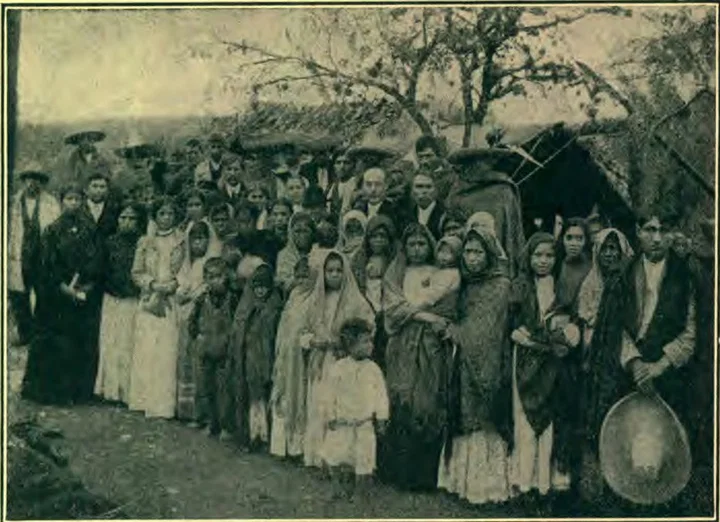
In order to understand the difficulties and conditions which confront the work in Mexico, it may be well to give a brief description of the people, together with their history. When Cortés discovered and conquered Mexico, some four hundred years ago, he found the people well advanced in many respects, having a civilization much superior to that of the Indians farther north. Of course they had a system of pagan worship, with its gods and goddesses, and some of their rites were vile and cruel.
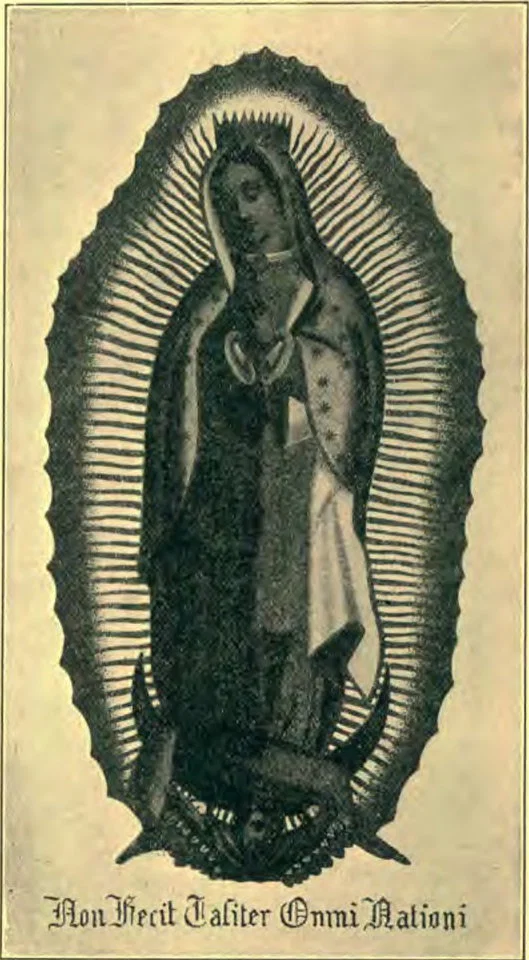
But the Roman Catholic Church, that has had control of them during all this time, has changed matters only in name in many things, and in some respects they are in a worse condition than before. In almost all the houses, and even in the huts and stores, one finds images, and candles or incense burning to them. The image most extensively used is that of Guadalupe, which for many takes the place of Mary, the mother of Christ.
The history of the worship of Guadalupe is as follows: An Indian passing a rocky hill near the city of Mexico, claimed to have seen the apparition of a virgin, who told him that a temple must be built on this particular spot, and that he should go to the bishop and tell him about it. The Indian went to the bishop as ordered, but received no encouragement. On returning by the place, the vision again appeared to him. When the Indian told the virgin of his failure to gain the support of the bishop, she told him to pluck some flowers that were growing there and carry them to the bishop. The flowers were miraculously produced on the bare and rocky spot, and the Indian, placing them in his blanket, set out to see the bishop again. This time, as he made his business known, he opened up his blanket to show the flowers, and behold the image of the virgin was painted on the blanket in indestructible colors. With this the bishop was convinced, the church was built, and the wonderful blanket was framed and hung up in it. Copies of the picture have been reproduced, and are now found in almost all the houses of Mexicans, and the Virgin Guadalupe has been made the patron saint of Mexico.
A few years ago, in order to give additional honor to their saint, the Church of Rome decided to crown her. Thirty thousand dollars was raised to purchase the crown, and as a literal crown could not very well be placed on the head of a picture, it was hung just in front of the top of her head. All the clergy of Mexico, with the archbishop, and visitors from other parts of the world, were present at the ceremony, thus sanctioning the fraud.
Many other stories of pretended miracles are disseminated by the priests in various parts of the country. Every one, even the most ignorant peon, knows that they are frauds, and he can have but little confidence in a church that is always seeking to advance her interests by means of such tricks. They are sometimes called “pious frauds,” and it is no wonder that nearly everybody looks upon the church and the priests as frauds, with but little piety. That the very poor and ignorant understand this, is clear from what an uneducated Indian told me. He had heard me speak about the vanity and uselessness of their saints and images, and so told me the following story:—
In a certain village there lived a shoemaker. In his yard there was a tree, under which he frequently sat while engaged in his occupation of mending shoes. A priest who often passed that way, sometimes stopping to chat with the man, noticed that this tree was of fine wood, and decided to buy it in order to make a saint. Having bought the tree, the priest had it cut down and the trunk of it taken to a wood carver and made into a saint, which he called St. Francis. The saint was set up in the church, and soon there were rumors of great miracles that it was performing,—healing the sick, lame, and blind. Meanwhile the shoemaker took the limbs of the tree and used them for firewood to cook his meals. One limb that was of considerable size, he decided to keep for use, and made a pig trough out of it. When he heard of the miracles of the new saint, he went to the church to see about it. Entering the church, with hat in hand, he stood before the image and looked him over carefully, then said: “Well, St. Francis, I haven’t forgotten you. We used to be companions in days gone by, but you have grown very great indeed, such wondrous things I hear of you. But, St. Francis, you must remember that you are a full brother to my pig trough.”
The priests, when they enter upon their office, take the vow of celibacy, but very few of them are true to their vows. While I was in a little village in thep. 4 southern part of the country, talking with some acquaintances, a woman passed by. One present said, “There goes the mother-in-law of the priest.” I asked them if the priests had mothers-in-law, and they said, “Yes, that is what we call them.” When a church is engaged in propagating “pious frauds” and her priests are untrue to their vows, how can the people have very much respect for religion? The church claims the right to celebrate marriage ceremonies, and the government has declared that only civil marriage is legal. The fact is that a large part of the people live together as they see fit, without respect to either church or government. For the church it is a question of dominating the people, and getting money out of them.
A servant girl whom I knew wished to get married. She asked the priest what it would cost. He said, “Twenty-two pesos.” The poor people can never get that much money together to pay for getting married, so they dispense with any ceremony in the matter.
When the church itself is connected with so many frauds, it is no wonder that fraud and dishonesty among the people prevail. I have been told that it is quite customary to search all the laborers on a job as they leave in order to prevent them from carrying away something. I have known such cases. When a building is to be erected, a wall is built about the lot on which it is to be built. Then the workmen as they leave for dinner and at the close of the day, have to pass through a door and be examined to see that they do not have some tool or something of value concealed about them. Anything, such as a hammer, hatchet, or saw, or a garment, can be carried to the pawn shops, which are plentiful, and disposed of for a few cents. In the city of Mexico there is one place called “the thieves’ market,” and almost anything that one can think of is there, and without doubt the greater part of this merchandise has been stolen.
In a country full of pious frauds and deceptions, wooden and painted saints, immorality and theft, the preaching of the gospel still has power to convert hearts and change the life and practice. It is indeed a blessed sight to see the saints thrown out of the houses and burned, and the law of God hung up in their place. This, in a word, is our work in Mexico. We have now companies and churches scattered from one end of the country to the other, the main centers being in the north at Monterey and Torreón, in the central part, at San Luis Potosi and Mexico City, and in the south on the Isthmus of Tehuantepec. There are also believers in Guadalajara in the west, and Tampico in the east. The change that takes place in these people when they accept the truth is very noticeable. They drop all such habits as the use of strong drink and tobacco, and become more industrious. They begin to clean up and live better, and to get in better conditions in every way, so that often their neighbors say, “I am going to be a Protestant so that I can get rich.” Of course they are not rich, but are so much different from their neighbors that in comparison they seem rich. Many of the poor people live in mud huts, without floors and with no furniture, except by chance a rude bench or a box. Their bill of fare is not very extensive either. I have frequently dined with them on corn cakes and beans, and for drink had cinnamon tea. Many of them sleep on the ground, wrapped up in a blanket, with only a straw mat under them. It certainly is good to see such conditions change for the better.
In one of our churches the brethren formerly had land, but they had lost nearly all of it. After receiving the truth, they began to buy back small portions of their property. The last time I was with them, it was in the time of roasting ears. With what pleasure the brethren invited me to accompany them to their little cornfields. There they roasted some corn, and we had a feast. On the way to their patches of corn, we passed other fields. On asking them, they would tell me the names of the owners, then they said: “A few years ago we would not have passed by others’ fields to go to our own, but would have taken corn wherever we could get it.” One can realize from this little incident something of the change that has taken place in them. One old man who had given up his saints, to whom he had been accustomed to pray, or rather repeat certain formal words without any particular meaning, said he did not know how to pray at all any more. He was shown the Lord’s Prayer, and as he had a Bible, he soon found many prayers in the Psalms, some of which he couldp. 5 make his own, and he could pray as well as anybody.
There certainly is a great joy in seeing the transformation wrought by the preaching of the message. The greater part of our brethren can read and write, although the per cent of the illiterate is about eighty. It is very evident that the Church of Rome has not tried to educate the people very much when such conditions prevail in this twentieth century. For over five years the country has been in revolution, and for more than two years it has not been possible to travel to any great extent, so we have not been able to visit our brethren. By letter, we learn that nearly all of them are faithful, and that in almost every place others are awaiting baptism. I have the names of about sixty that have asked for baptism, and there are more who with proper instruction will soon be ready to unite with us. None of them have been forced into the army.
A few families, because of politics, have been led astray, and one worker, a young Spaniard, who was laboring on the isthmus, left us last year for the Millennial Dawn delusion. This leaves us without a laborer among our Zapotecan Indians. There seems to be an excellent opening among this people who number more than five hundred thousand in all. This part of the country has been in comparative peace all through these troubled years, and even this year our canvassers have done well in that part of the field, one man selling nearly a thousand Mexican dollars’ worth of literature in the month of January. We are looking for a consecrated young man who understands Spanish to take up the work in that part of the vineyard. From Mexico City, where we united with the Red Cross in helping the poor, comes the report that many homes are now open to our Bible worker. We have but one in all that great city of a half-million inhabitants. She has many more openings than she can possibly fill. From Guadalajara, also, comes the word that a number there are anxious to study the Word of God. If once the country could have peace, there would be a wonderful opportunity in nearly every part. We should be prepared to enter with greater force and do the work rapidly when peace comes.
The few workers that we have are still at their posts, and the Lord is blessing their work. Our literature has been disseminated in many parts, and has been our principal evangelical agent. But when we think of fifteen millions of poor people, more than seventy-five per cent of whom can neither read nor write, and all that they have known of the gospel is what they have learned through the Catholic Church, which in Mexico appears to be one great fraud without much piety, we realize that a great work must be done, and we plead earnestly for laborers. We know that the gospel is the power of God unto salvation to them that believe. We have seen some of its proofs in poor benighted Mexico, and we firmly believe that from this dark land, so long held under the double curse of ignorance and superstition, a goodly number of faithful ones will yet come to sit down with us at the supper of the great King in the everlasting kingdom of our God.