THERE are some picturesque and graphic phrases in the Sintebele tongue. Sintebele is the name of the language spoken by the Matabeles. This giving of one name to the tribe and another name to the language is very common in Africa.
Talking with Brother George Hutchinson, at Somabula, I learned the name of the stone which is a part of every household outfit in native South Africa at least. More important even than the house is the grinding stone on which the women grind out the meal for the daily food. It is usually a flat stone, hollowed out by months or years of the grinding process. The smaller stone, smooth and flat, is the upper millstone, while the large slab below is the nether. Back and forth the small stone flies, and the corn or other grain is quickly turned to flour.
“What do they call the stone?” I asked Brother Hutchinson; for I had learned from him that many a pleasant surprise lay hidden to me in the vernacular phrase.
“They call it,” he said, “iitje logusila. Iitje means stone, and logusila means life. It is the ‘stone of life.’”
“Good!” I said; “that is a fine name! We call bread the staff of life, and surely the stone on which the meal is ground out should be the stone of life.”
When the kraal or village moves, the stones usually move along with it. I suppose the Matabele housewife gets to love the well-worn stone just as our housewives love the old paring knife, worn to the right shape by years of use. No new one could replace it.
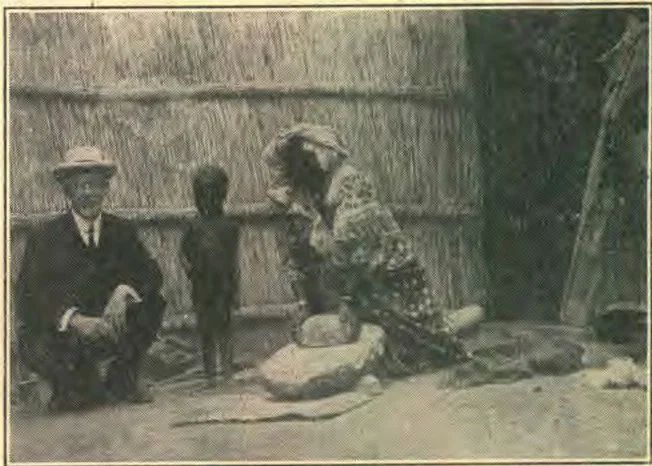
Yet in visiting a deserted kraal location near the Glendale Mission, in Mashonaland, one day, I saw an old grinding stone that had been left behind. Perhaps the hands that had ground out the meal for the bread of life upon it had long ceased their toil. Somehow the old forsaken “stone of life” seemed unworthily treated, to be left lying about among the rocks and rubbish.
The accompanying picture shows a woman grinding away for the daily bread. This scene is in Kolo,p. 6 Basutoland; and many will recognize the missionary included in the picture, as Elder W. B. White, president of the South African Union Conference.
W. A. SPICER.