DURING the dry season the two deep wells at our Solusi Mission station, in Bulawayo, Rhodesia, nearly dry up, and furnish only sufficient water for the two cottages. Some means had to be devised to get water for the school. For some years one of the farm wagons was used to draw water in tanks from a spring about half a mile away, but this necessitated unloading the wagon after each trip, taking a good deal of time. Finally, a two-hundred-gallon tank was made: some old wagon axletrees from Bulawayo, with blocks of wood bolted to them, formed the frame; and sections of a large log, bored out for the axletrees, furnished the wheels. This tank on wheels, with half a dozen yoke of oxen to supply the motive power, was named the “Solusi Water Express.” The most difficult step in the whole process was boring the holes in the solid wheels. We had no suitable auger, and boring into the end of the wood was difficult. Finally, we were obliged to resort to a small bit, and then burn the holes to the required shape and size to fit the axletrees. The wood being green made the job long and tedious. Nevertheless, in this far-off land, in a wilderness nearly forty miles from a town, we proved again the truth of the old saying, “Necessity is the mother of invention.”
Sometimes we read of traction engines used in morep. 5 favored countries to break the land, prepare the soil, sow the seed, and harvest the crops; and sometimes we even see pictures of these wonders. But so far we rely on our forty yoke of oxen, six mules, and my saddle horse, for motive power. We are slow, but sure.
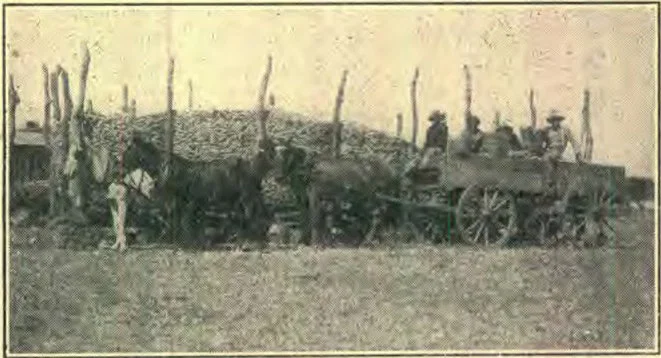
The four-mule team shown in the picture, is our mainstay for getting around “light;” when we have heavy hauling to do, the oxen are used. For “running over to Bulawayo” for supplies for the mission workers and goods for the “store,” which is operated on the mission property, and for visiting our outschools, this mule team is invaluable. When not on the trail these animals are used for general farm work, such as hauling corn from the fields. The corn is husked on the stalk, and drawn to the ingalonas, or cribs, and then stored until it is thoroughly dry, and ready for the market.
When we go for a trip to visit our outschools, we put some hay in the wagon, with our camping outfit, grain for the mules, and food and bedding for ourselves. Two native boys go with us to drive and care for the mules and look after the camp. We usually plan to be away for about two weeks, driving from one school to another, and staying a day or two at each. Here we look over the teacher’s work, and visit with and prescribe for the natives who flock to us with all sorts of ills. We must extract teeth, give treatments, do minor surgical work, and prescribe simple medicines for their ailments.
During a two weeks’ trip we often travel nearly two hundred miles, frequently camping in the open, beside a fire, sometimes sleeping on the hay in the wagon, and often on the ground, wrapped in our blankets. When we can, we call the natives together and preach to them, and sometimes show the stereopticon pictures. Mrs. Walston usually accompanies me on these trips.
Our friends often ask if we are not afraid of the wild animals and the snakes, which are so numerous here. To this we must answer No. The Lord is just as able to care for us in the wilds of Africa as anywhere else, and we trust him and fear not.
W. C. WALSTON.