The Zion City of the Mormons
By Ernest Lloyd
The city by the great Salt Lake interests one from the very minute of arrival. Lying beautiful and serene at the foot of the high, cool Wasatch Mountains, Salt Lake City is as refreshing, after a long ride over sagebrush country, as an oasis in the desert, which, in fact, it really is, thriving there in that vast sparsely developed country. It is a city of streets that are marvels of width and length. The average block is 660 feet long, and the width of the streets is 132 feet from property line to property line. Of particular admiration is the parking of the streets, especially where they are parked down the center with beautiful flower beds at each end. The residence streets are particularly beautiful, with their large brick houses and big velvety lawns.
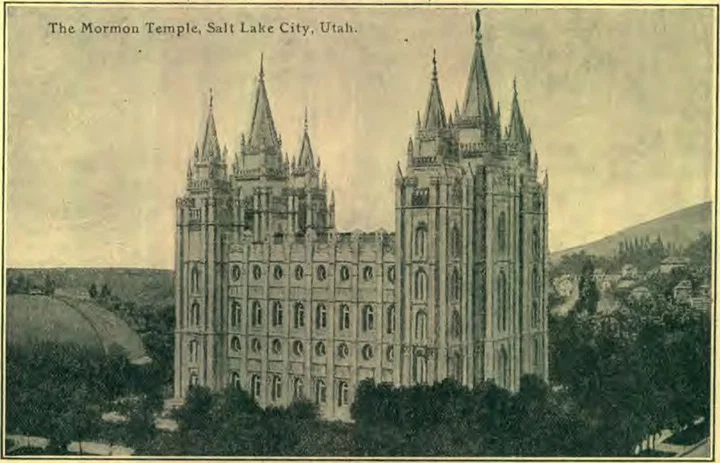
This city by the “inland sea” holds much that is of peculiar interest to the visitor. Historically the Mormon buildings come first, and the first place to which all visitors are taken is the temple grounds. Inside the surrounding wall is the magnificent Temple, an awe-inspiring structure which is to the Mormon what Solomon’s temple was to the Jew, a holy place, devoted to sacred ordinances. The cost of its construction was $4,000,000. It is not open to the public, nor is it used as a place for general worship. Within its walls the different rites of the Mormon priesthood and the ceremonies of baptism and marriage are celebrated.
The Mormon Tabernacle, which is just west of the Temple, is one of the architectural curios of the world. Its elliptical shape looks like a vast terrapin back, or half of a prodigious eggshell cut in two lengthwise. The interior presents the appearance of an oval arch without any center support, being one of the greatest self-supporting arches in America, and probably the largest in the world that is constructed wholly of wood. The bents of the roof are composed of a lattice truss and rest upon twenty-four pillars. The gallery, which extends around the building except at the west end, is 480 feet long and 30 feet wide. The entire building has a seating capacity of 10,000. It has twenty large doors, so that in case of emergency a great audience can make its exit within two or three minutes.
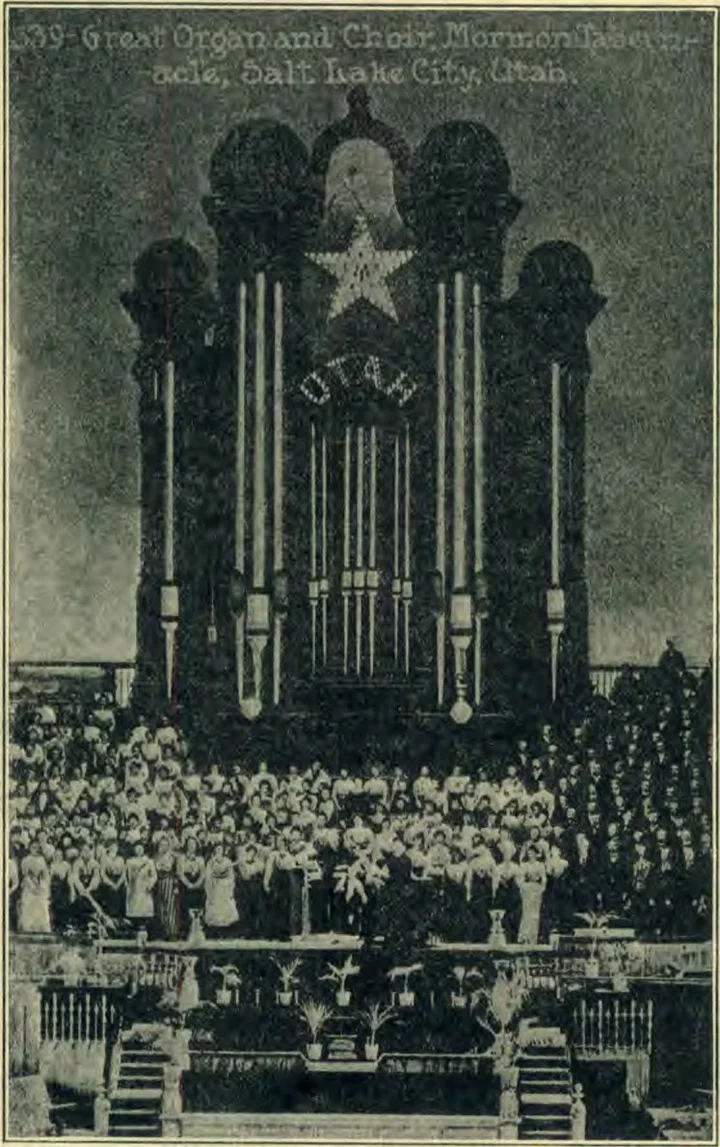
In the Tabernacle there is a wonderful, old melodious pipe organ, pronounced by some musical critics to be unequaled in variety of construction and the massing of tonal qualities. Always a wonderful instrument, it has kept pace with, adopted from time to time, the latest improvements in its line, and today is regarded by many as “the ne plus ultra in organ building.” “The organ was constructed over thirty years ago, entirely by Utah artisans and mostly from native materials. The front towers have an altitude of 58 feet, and the dimensions of the organ are 30 by 33 feet. It has 108 stops and accessories and contains a total of over 5,000 pipes, ranging in length from two inches to thirty-two feet. It is capable of 400 tonal qualities. It is orchestra, military band, choir, and organ combined; and, I am told, there is no color, shade, or tint of tone that cannot be reproduced by it. The action is half electric and half tubular pneumatic. The electric motor is ten horsepower. The two bellows weigh 5,000 pounds and the two reservoirs 38,000 pounds. Five thousand cubic feet of air can bep. 6 pumped into the bellows every minute. The organist sits 20 feet from the organ, facing the congregation, and the distance between him and the air valves is 65 feet; yet the pipes will respond 726 times a minute.”
The sea-gull monument always creates interest, and the story connected with it is very interesting. In 1848, when the city was less than a year old, and the pioneers were struggling with their first crops, there came a plague of crickets. The pests began to rapidly destroy all the vegetation in sight, and although the people fought them, the insects were too many for them and their hopes of a harvest were fading fast when a great flock of sea gulls came in from the Great Salt Lake and destroyed the crickets. The bird has ever since been held sacred by the Mormons, and the monument was erected in memory of the timely aid given by the birds.
When the outsider hears of Salt Lake City he usually thinks first of salt, and particularly the Great Salt Lake. The lake itself is a wonder, 80 miles long and 40 miles wide, with water 23-per-cent salt and so dense that a person can float in it with very little danger of sinking. Not far from the lake are the great salt beds presenting a remarkable sight. Round about in circling whiteness lies a shimmering expanse of salt ponds. The country for miles around the refineries is as level as a table top. Into these great ponds salt water is pumped to a depth of several inches. Sunshine is plentiful in Utah, and the process of evaporation is unhindered. The ponds are “skimmed”—much as one would skim a pan of milk. This process removes all foreign substances, and then the heavily laden salt water is sluiced into other ponds where the evaporation process is continued. When the water is entirely evaporated, a layer of salt is left. Then the process is repeated until a thick depth of salt in its natural state has been deposited over many acres of ponds. Some four to five months are required to secure the proper amount of salt deposits. Then the “harvesting” begins, and the processes of grinding, sorting, cleaning, weighing, and sacking the salt follow.
Just recently a potash factory has been established near the city. It is now shipping out great quantities of potash, so the country has no need to fear a shortage because Germany’s exportation of the article has stopped. In speaking of this new industry recently, a Salt Lake editor said: “Every little while the United States discovers Utah. When the country is in need of some mineral, it runs around in circles for a time, so to speak, and then is told to possess its soul in patience, as Utah has the article required. If the country wants anything very badly it has but to ask for it. We will wager it is somewhere in Utah.”
ERNEST LLOYD.