While still rolling over the waves of the briny deep the word was flashed to our party of forty-two on the steamship “China,” that a royal welcome awaited us on our stop at the Hawaiian Islands. As we were waiting outside the harbor for the boat’s pilot and inspection officer, we noticed a little launch beside our boat containing a little man with the word “Aloha” pinned across his coat. It meant but little to us then, but before the day was over we learned to appreciate the word almost as much as the word “home.” It is the Hawaiian word of greeting, and means “my love to you.” We discovered that all the members of our little company at Hawaii had adopted this pretty word for our welcome. And to further show their love to us we each were decked with orange-colored garlands.
A special car was waiting to take us through the streets of the beautiful city of Honolulu—and beautiful is but a weak word to tell of the beauties of this city of the deep. The streets on either side are shaded with palms and banyan trees, the foliage of which is luxuriant and dense.
Everything was so interesting that we felt as if the English language were bankrupt, and when we got through with adjectives we should have to start all over again. Our trip took us through the beautiful Manoa Valley and along Waikiki Beach. This is a beautiful beach, and many of us could not resist the call of the waves. We were interested here to see the surf riders. These are little narrow boats with a pole fastened on one side, which keeps the boat balanced on the waves. Long ago the Hawaiian people invented them.
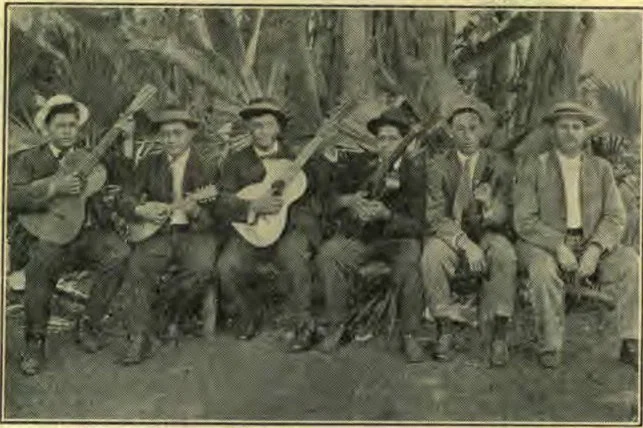
We were told to come to Kapiolani Park for lunch after our cooling recreation. Somebody said “baked beans would be served,” so no need to invite the Bostonians the second time. A bounteous lunch was served, and there were many delicacies which we had never before tasted. During lunch we were favored with beautiful music furnished by the Ukulele Sextet. We understand these musicians won the gold medal at the World’s Fair. Although we were not Hawaiians, we could appreciate the native songs, for they were beautifully rendered.
After lunch we listened to an inspiring address of welcome by Pastor F. H. Conway and a response by Elder R. C. Porter, after which all our party joined in the Chinese “pingan (peace), pingan.”
For the afternoon we were given our choice of many different trips, each party being furnished with a guide. Some chose to visit the famous aquarium containing the different species of sea life in the Pacific. Others went to visit the Bishop Museum, which contains a wonderful collection of island antiquities, feather cloaks, and the early weapons and utensils of the islanders. Another trip was planned for the executive building, which was formerly the queen’s palace. This building contains the throne room and many interesting relics. The shopping district proved to be an interesting place, for here one could see the Oriental markets and curio stores. No matter which trip was taken, each thought the one he had taken the most wonderful. Our “home on the water” left for Yokohama at four-thirty, and on their return to the boat the different groups had many interesting stories to tell.
Our boat sent a hurry call to tardy comers, and soon we were leaving the most beautiful place in the Pacific. As we weighed anchor, our Hawaiian friends bade us farewell with the new “Aloha” song, “Till Jesus Comes,” sung to the tune of their national hymn.
As one looked down into the water, a few bright-green looking forms could be distinguished. These were sharks. Farther out of the harbor porpoises were seen turning somersaults in the water around the boat. As we left Diamond Head in the distance, all felt satisfied that the day had been well spent, and appreciated land more than ever.
ELLA MAE BOWERS.
Shanghai, China.
HANKOW, CHINA, Oct. 6, 1916.
DEAR FRIENDS: While we were traveling from San Francisco to Shanghai it was our privilege to stop at Japan. When our ship cast anchor in the harbor of Yokohama, Elder De Vinney and others came out to meet us, and we gladly accepted their invitation to visit the mission, although the mission compound was thirty miles away. To reach it we had to ride on a street car and train. The electric car station was about a half mile from the wharf. Those of our party who did not care to walk rode in jinrikishas.p. 8
The streets are narrow, with narrow sidewalks on both sides. On each side of the street are Japanese shops. Such articles as wooden shoes, lacquer wares, sandals, parasols, kimonas, beautiful embroidery, dishes, and pictures are sold at these shops.
The youngest member of our party was a baby girl of three months. Her father carried her in a basket on his arm. This greatly interested the Japanese. Many would come up quietly, look at her, then go away smiling. It was evident that they thought this an odd way of carrying a baby; for they carry theirs on their backs.
After eating our lunch in the school chapel, we were shown through the building. Besides the chapel there were two classrooms. In the rear part of the building we found a kitchen, dining-room, and bathroom. These are used by the boys who attend the school. Their sleeping apartment is in the part over the school. The girls’ dormitory is a building across the street.
Another thing of interest which we visited was the printing office. The workmen, including the editor, are Japanese.
The Japanese roofs are thatched, made of grass, and are several inches thick. The house which we noticed in particular had one side open with the exception of a mat curtain, which can be raised or lowered as desired. The Japanese leave their sandals at the door.
The principal furniture in the dining-room was a round table. The Japanese sit on the floor. In the parlor was an organ, bookcase, desk, two chairs, and a few pictures.
The Japanese always have pleasant faces, are very polite, and the parents are fond of their children.
The Japanese dress interested us very much. The girls’ and women’s dresses are much like our kimonas, and a wide girdle is worn around the waist. The sleeves are long and have a long pocket in them. If a woman wears her hair in two coils in the back, it shows she is a maiden lady. If she wears her hair in one coil it shows she is married, and is subject to her husband. The men dress according to the class to which they belong.
All too soon the time passed, and we returned to our ship, the “China.” I trust you will remember this needy field in your prayers.
RACHEL PAYNE WHITE.