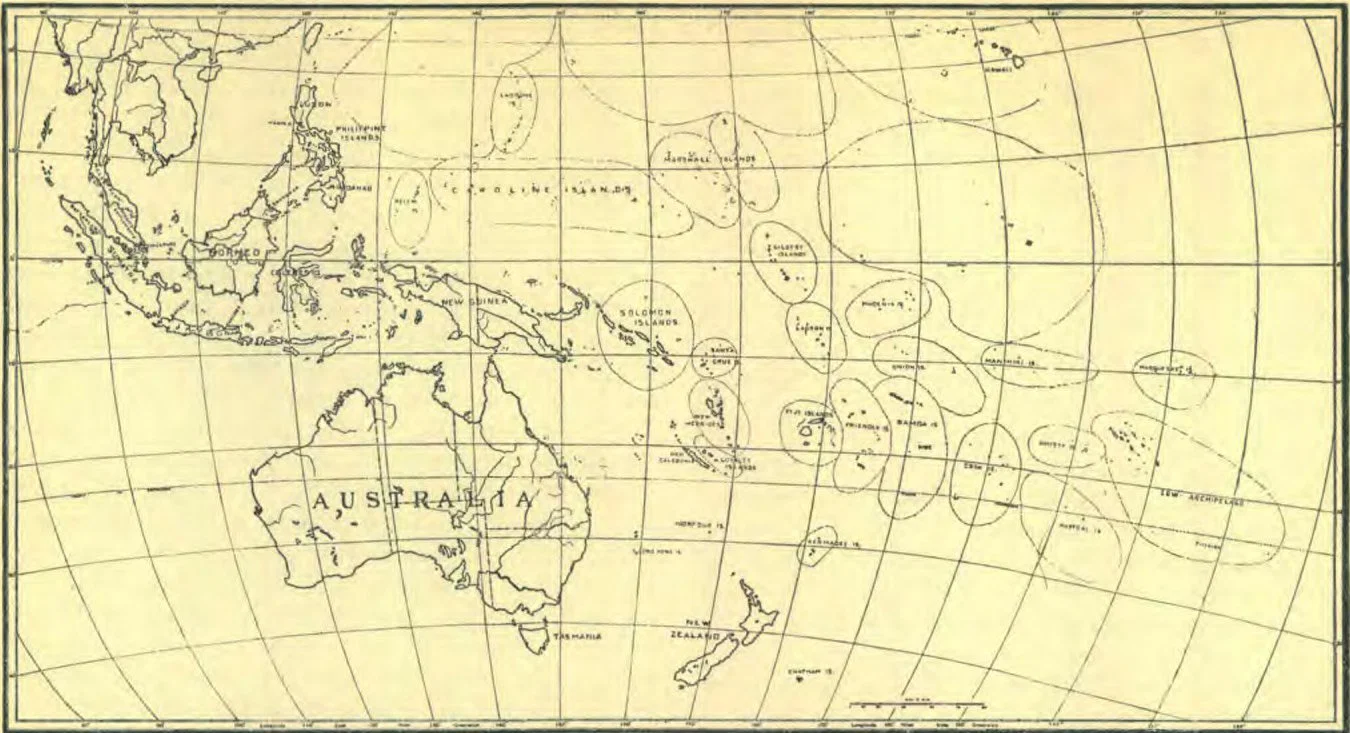
The South Pacific Islands Mission Field consists of three divisions,—Melanesia, Micronesia, and Polynesia. Melanesia takes in the western islands, those nearest to Australia. First in importance in this group is the large island of New Guinea, where the population is largely heathen. The western half is under Dutch rule, and is attached to the Malaysian Mission. The remainder is in the Australasian Union Conference mission field and marks its western boundary.
The Bismarck Archipelago consists of the Admiralty group, New Hanover, New Ireland, the Duke of York group, New Britain, and a chain of volcanic islands bordering the mainland. Most of the natives are savages, a race of totally naked cannibals. In places missionaries have exerted some influence over them. These islands, with a part of New Guinea, formerly belonged to Germany, but were captured by Australia early in the present war.
The British islands of New Guinea, though perhaps as numerous, are by no means as important as those formerly belonging to Germany. The Louisiade Archipelago, the D’Entrecasteaux, Trobiand, and Woodlark Islands, are the chief of them. The people in some parts are cannibals. Some of the natives have a strong admixture of Polynesian blood, and are well disposed.
The Solomon group consists of a double row of islands extending southeast from the Bismarck Archipelago for a distance of about seven hundred miles. It comprises seven chief islands. There are numbers of small islands as well. The people are mostly of the Papuan type, and are the most dangerous of all the natives of Melanesia. The islands are not thickly populated, but a different language is spoken in almost every one of them.
The Santa Cruz Islands lie about two hundred miles east of the southern islands of the Solomon group. None of them are large. The people are of Papuan origin, and apparently good-natured and well disposed, but not to be trusted.
The New Hebrides extend for a distance of over five hundred miles in a direction roughly north and south, midway between the Santa Cruz and Loyalty groups. There are about forty islands in the group, some of which are of considerable size. The natives of the north are for the most part of a friendly disposition, differing from those of the southern part of the group. The larger part of the people are of Papuan origin. Christian missions have been established in these islands, chiefly in the south, and in Aneityum the people are all professed Christians.
New Caledonia is the most southerly of the Melanesian islands. It is two hundred and fifty miles long and averages thirty-five miles in breadth. It is owned by the French, and is used by them as a penal settlement. The natives are a well-made race, with frizzly hair, dark skin, and pronounced features. They are divided into tribes, and the languages are numerous.
The Loyalty Islands consist of three principal islands. The population a few years ago was estimated at 10,000, but is said to have diminished. The people are the most civilized of any Melanesians, except perhaps those of Aneityum.
The Fiji Islands complete the Melanesian groups. These are divided into two great divisions, and consist of a large number of islands, of which a few are of considerable size. They have come under Christian influences.
Polynesia
The Tonga or Friendly Islands, the Samoan, Cook, and Society Islands all belong to this division, and have all been entered by the message.
Savage Island, or Niue, situated nearly midway between the Tongan and Samoan groups, is a small and very fertile island about nine miles long. The people are of mixed Samoan and Melanesian blood, and are now all nominal Christians. The population is about 5,000.
The little Tokelau or Union group consists of three small islands, inhabited by a Christianized people closely resembling the Samoans, and speaking an allied dialect.
The Ellice group consists of a number of low coral islands and atolls, arranged in nine clusters. The population numbers about 2,500, and almost all are Christians. All can read, and most can write. The inhabitants of Niue speak the language of the Gilbert Islands. All the others speak a Samoan dialect.
The Austral or Tubuai group is seldom visited. It consists of four chief volcanic islands. The population does not exceed 1,000.
The Paumota, Tuamotu, or Low Archipelago, forms a cluster of about eighty islands, about sixty of which are inhabited. They are scattered over a vast area, and have a population of less than 6,000 persons.
The Gambier Islands consist of five high volcanic islets inhabited by Roman Catholic converts, whose numbers were increased in 1879 by the immigration of the bulk of the inhabitants of Easter Island, 300 in number.
Pitcairn Island lies at the extreme southeastern limit of the Low Archipelago.
North of the Low Archipelago, and almost nine hundred miles from Tahiti, are the Marquesas, of which seven are inhabited. The population is estimated to be over 6,000. The aborigines are usually described as the very finest of all the South Sea islanders. Their complexion is of a pure, healthy yellow, with a soft, ruddy bloom on the cheeks. Few of them remain, however. About fifty years ago there were fewer than five hundred. The efforts of missionaries to evangelize this group were long fruitless, but recently the majority of the natives are said to have adopted the Roman Catholic religion. Nevertheless they still remain savages.
North of the Society group lie several widely scattered islets that are seldom visited. Caroline or Thornton Island, Manihiki, Penrhyn or Tongareva, and perhaps Suwarrow may be regarded as forming the Manihiki, or, as it is called by some, the Penrhyn group. North of these are Starbuck and Malden.
Another group of islets is the Phoenix group. Most of these are scantily populated. In most of these groups the people are nominally Christian.
Easter Island is far out in the mid-Pacific, 1,400 miles9beyond lonely Pitcairn. There are now about one hundred inhabitants, all Christians. This island marks the eastern boundary of this great mission field.
Micronesia
North of the equator, between New Guinea and the south coast of Japan, the great ocean is studded with countless little islands, which in consequence of their remarkably small size are collectively called Micronesia.
The Gilbert Archipelago consists of sixteen islands, nowhere more than twenty feet above the sea. There is no fern nor grass. A little taro is grown in trenches with great care. The food of the people is mostly procured from the sea, and ranges from the whale to the slug. The islands are thickly populated, the population of the whole group being estimated at 40,000. The natives are tall and stout, and appear to be a mixed race.
The Marshall Archipelago is arranged in two parallel chains, that to the east being known as the Radack group, and that to the west as the Ralik group. There are forty-six islands, and the population is estimated to be 10,000. The natives are decreasing rapidly in number.
The Caroline Islands occupy a vast area. The majority of the islands are low and coralline. The climate is very healthful, and where sufficient soil is found, fruits flourish. The people are believed to number about 30,000. They exhibit a considerable mixture of race and variation in color, from very dark copper in the west to almost a light brown in the eastern islands. Many are of unusually tall stature and strongly built.
The Pelew Islands consist of one large island and a few small ones. Their population is between 12,000 and 14,000. The people are smaller in stature and darker than those of the Caroline Islands. They are friendly in disposition, and intelligent.
The Ladrone or Mariana Islands extend in a chain about five hundred miles from north to south. The chain consists of seventeen islands, with a total population of a little over 10,000. The islands are peopled by Tagals and Visayans from the Philippines, with a few Caroline islanders, and numerous half-breeds, and also by the mixed descendants of natives of South American tribes. These islands are not often visited, being out of the regular trade routes. Guam, now in the possession of the United States, is a coaling station.
It will be seen, from this survey of the South Pacific islands mission field, that the giving of the warning message all through it is a difficult proposition. But in some way it must be done before the Lord comes in glory.