Who Are the Quitters?

5%

Review and Herald Publishing Assn. · Takoma Park Station, Washington, D. C. · Mar 7, 1916

FromThe Youth’s Instructor, Vol. 64, No. 10.

Read the full edition

Who Are the Quitters?

We hope to give enough evidence on the evil of tobacco using to prove that no boy should begin to use tobacco; and what will appear below could be multiplied many times. We will not cite the evidence from medical experts; nor will we consider the delinquency and degeneracy caused by cigarette smoking, or the growing hostility of business to the tobacco habit; but will only consider a few of the statistics gathered from the studies of superintendents, principals, and teachers in the public schools.
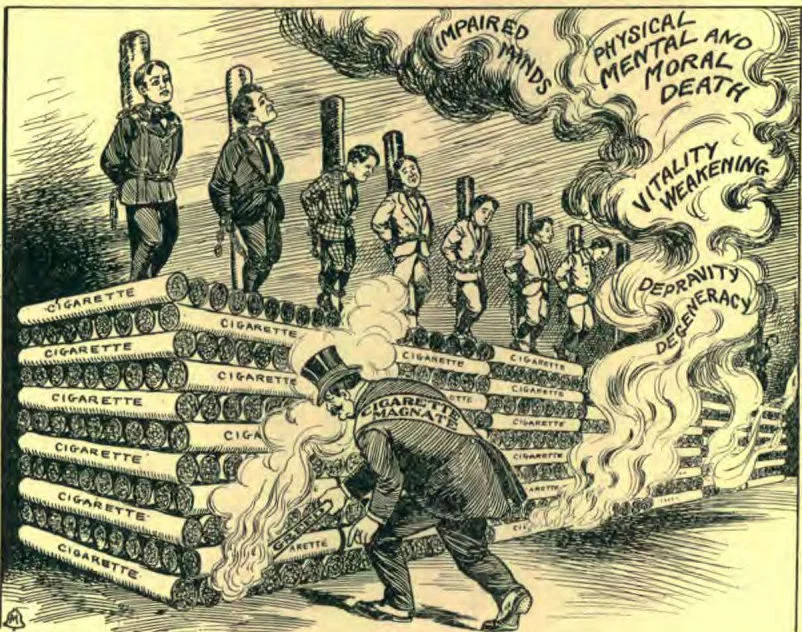
Burning the boys at the stake with “the devil’s kindling wood.”
A careful study of the effect of tobacco on high school boys at Highland Park, Illinois, is given in the School Review for 1912, pp. 623–625. Not a single graduate of the school was a habitual smoker while in school. The 45 quitters were all smokers and in poor standing in their classes, their average grades being below the passing mark. The average grade of 77 nonsmokers was 84 per cent, of 24 reformed smokers 79 per cent, of 55 smokers 76 per cent. The grades of those who had recently learned to smoke had fallen from 85 per cent to 78 per cent. One boy who was smoking heavily, quit, and his grades came up 10 per cent within six weeks. Principal R. L. Sandwick gives some excellent arguments with his statistics. We will consider more startling statistics from other sources, but none which indicate more clearly a direct relation between the tobacco habit and poor scholarship.
The United Presbyterian for April 20, 1913, published the following from statistics compiled by H. L. Smith, superintendent of the Bloomington, Indiana, schools: —

RETARDATION

Grades Average age of smokers Average age of nonsmokers Excess age of smokers
First 9.17 7.58 1.59
Second 9.66 8.51 1.15
Third 10.68 9.36 1.32
Fourth 12.6 10.55 2.05
Fifth 14.22 12.21 2.01
Sixth 13.62 12.42 1.20
Seventh 14.67 13.32 1.35
Eighth 15.12 14.65 .47
HIGH SCHOOL
Ninth 16.47 15.55 .92
Tenth 16.75 16.17 .58
Eleventh 18. 17.27 .73
Twelfth 17.55 17.22 .33

Conclusions

“1. Smokers are distinctly older than nonsmokers, having failed in their work much more frequently.
“2. Smokers are doing distinctly poorer work than nonsmokers.
“3. Smokers are disciplined much more frequently and for more serious offenses than nonsmokers.”
Professor Smith also found that nonsmokers failed in 10 per cent of their work, occasional smokers in 18.7 per cent, and habitual smokers in 29 per cent. The number of pupils involved in the investigation was 950, and the figures are so significant that they should convince every boy, every parent, and every educator. The results are doubtless in part directly due to inferior character, or to some condition of environment of the boy who takes to the tobacco habit; but in any case, no self-respecting, high-minded boy will want to be found in such company after the facts are placed before him.
An article by P. L. Lord, published in the New York School Journal, gives the results of investigations of 200 boys who smoked cigarettes, and of an equal number who did not. The reports were made by ten teachers, who observed boys from ten to seventeen years old, chosen by lot in their schools, studied them for several months, and reported to Mr. Lord impartially. Whatever the relationship between the cigarette habit and the astonishingly bad showing made by boys who had the habit, a study of the tabulation below should arouse every boy worth saving, every parent who cares for his boy, every teacher, and every man who sets the example of smoking. The following is Mr. Lord’s tabulation of the appalling relations: —
Smokers Nonsmokers
Nervous 14 1
Impaired hearing 13 1
Poor memory 12 1
Bad manners 16 2
Low deportment 13 1
Poor physical condition 12 2
Bad moral condition 14 0
Bad mental condition 18 1
Street loafers 16 0
Out nights 15 0
Careless in dress 12 4
Not neat and clean 12 1
Truants 10 0
Low rank in studies 18 3
Failed of promotion 79 times 2 times
Older than average of grade 19 2
Untruthful 9 0
Slow thinkers 19 3
Poor workers or not able to work continuously 17 0
Supt. H. D. Hervey, of Malden, Massachusetts, obtained, with the aid of his teachers, the following convincing statistics on relative physical, mental, and moral conditions of smokers and nonsmokers in his schools: —
Smokers Nonsmokers
Undersized 15 2
Weazen 12 1
Unkempt 17 0
Sallow 20 0
Weak 12 0
Often sick 10 1
Headache 14 1
Sore eyes 7 0
Lazy 34 0
Nervous 22 1
MENTAL CHARACTERISTICS
Dull 24 1
Unable to think at times 31 0
Mentally dwarfed 12 0
Incapable of sustained attention 35 0
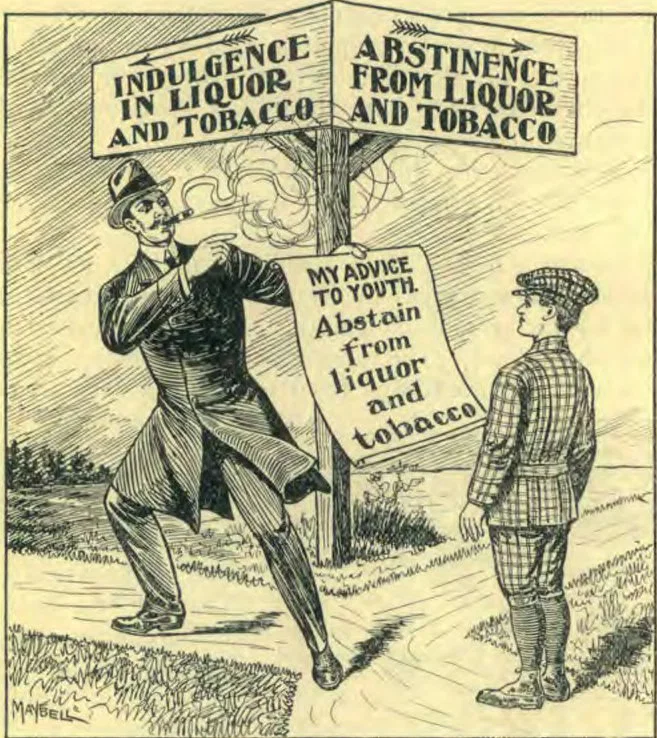
The inconsistency of teaching the right and pursuing the wrong.
Smokers Nonsmokers
Poor memory 26 0
Poor reasoning powers 29 1
MORAL CHARACTERISTICS
Weak of will 32 1
Coward 15 0
Liar 16 0
Degenerate 7 0
Vulgar 12 0
Influence bad 15 0
Disobedient 18 1
Disrespectful 11 0
Truant 16 0
We quote as follows from Mr. Hervey’s conclusion: “Boys may use tobacco because they are physically and mentally weak and morally unsound, or they may become physically, mentally, and morally impaired because they use tobacco, or each factor may be partly cause and partly effect. In any event, the results of this study would seem to indicate that a close connection exists between low mentality, physical weakness, moral delinquency, and cigarette smoking. If this be true, the cigarette, far from being the sign of manliness and of superior intelligence, should be regarded as the badge of the physical weakling, the mentally incompetent, and the morally unsound.”
Superintendent Hervey also gives the following data regarding forty smoking and forty nonsmoking pupils, chosen by lot from the grades and the high school. The statement involves items not in the table above: “The average age of the smokers was 13 years 2.9 months, and of the nonsmokers 11 years 9.37 months. From this it would appear that those who use tobacco are 1 year 5.5 months older for their grades than are those who do not use tobacco. The cause for this will appear more evident later on. The average height of the smokers was 55.87 inches, while for the nonsmokers it was 56.1 inches. That is, notwithstanding the fact that those who do not use tobacco are almost a year and a half younger, they actually average .23 of an inch taller. From a table prepared by Dr. Franz Boos, showing the average height of 45,151 boys in Boston, St. Louis, Milwaukee, Worcester, Toronto, and Oakland, the 40 smokers were 1.13 inches shorter than they should be for their age, while the nonsmokers were about 2 inches taller than the average. The average weight of the smokers was 85.45 pounds, and of the nonsmokers it was 81.92 pounds. According to the table of Dr. Boos, boys of the age of the smokers should weigh 82.8 pounds, and boys of the age of the nonsmokers should weigh 72.2 pounds. From this it would appear that, while the smokers weigh 2.62 pounds more than the average, the nonsmokers weigh 9.72 pounds more than the average, a difference of 7.1 pounds in favor of the nonsmokers. Of the smokers, 33 had normal vision and six had poor vision, while of the nonsmokers all had normal vision. Of the smokers, none stood excellent in his studies, 2 ranked as good, 12 as fair, 26 as poor. Of the nonsmokers, 15 ranked as excellent, 14 as good, 11 as fair, and not one as poor. Of the smokers, 8 had failed of promotion once, 14 had failed twice, 8 had failed three times, and 1 four times, making a total of 64 failures. In other words, 31 boys out of the 40 had failed of promotion one or more times.”
Hundreds of statements regarding the injurious effects of tobacco on boys could be quoted, but nothing could be added to the evidence contained in the data from the various studies given above. The facts stated should be sufficient to keep any boy who cares for a good, strong character from entering the ranks of smokers.—Bruce Fink, Ph. D., in “The Tobacco Habit.”