D. H. Kress, M. D.
Several years ago a man took a ten-dollar bill from his pocket and deliberately struck a match and set fire to it. He had money to burn. Fortunately I was able to snatch the bill out of his hand before it was destroyed. The man was under the influence of drink, and was therefore irresponsible and possibly excusable. He was, however, playing the fool.
There is more than one way of playing the fool. If a boy should buy ten dollars’ worth of cigarettes and carry them into an alley and just for fun set fire to them and burn them up, we would say, Young man, you are playing the fool. Suppose he should instead take them into his mouth and set fire to them, burning them up one by one, and in addition would inhale the poisonous smoke, he would assuredly be playing the fool, for not merely would he be burning up the ten dollars, but by inhaling the smoke he would sustain a physical injury.
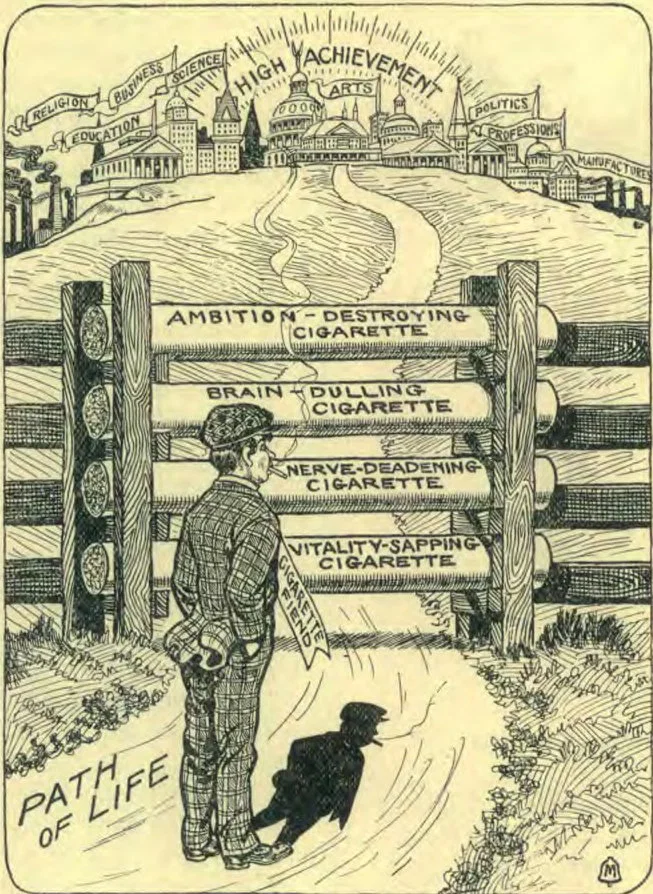
There are thousands of boys and young men in every community who are playing the fool in this way. They are burning up their money as truly as did the drunken man, and in addition are inhaling the poisonous fumes from the cigarettes.
The cigarette smoker imagines he is smoking tobacco. This would be bad enough, for the nicotine, liberated by the slow burning tobacco, is present in the smoke, and is a deadly poison. But the cigarette smoker is not merely smoking tobacco, as he supposes; he is smoking tobacco plus some other products, as glycerin, rum, licorice, etc., which are sometimes added in the manufacture of cigarettes for the purpose of keeping the tobacco moist and giving it color. Some of the products which are thus added may be harmless in themselves, but in burning them, poisons are developed which are even more injurious than nicotine.
Today cigarette making is an art, and in this probably lies the greatest evil connected with their use. The purpose is to make a cigarette which is velvety, agreeable in flavor, and which does not bite the tongue when smoked. To accomplish this, various other products are added. These products may differ slightly in different brands of cigarettes, for each cigarette manufacturer has his own secret process; but in no case are they added to improve the cigarette from a health viewpoint: they are added solely for commercial purposes. One of the products developed from smoking cigarettes containing glycerin is furfural. A few years ago one of Thomas Edison’s assistants, in conducting some experiments in the laboratory, chanced to inhale the fumes of burning glycerin, with almost fatal results. Furfural is deadly.
Yet the boy who smokes cigarettes is continuously inhaling these deadly fumes. Furfural is especially injurious to the nervous system, and when inhaled for a prolonged period will bring about a degeneracy of the brain and nerve cells of an incurable nature. The boy who smokes cigarettes becomes restless, irritable, coarse, and careless in his deportment. He develops nervous symptoms of a marked character, and in time criminal tendencies may manifest themselves. The earlier in life the habit is formed the greater the injury sustained.
The symptoms developed by the smoking of cigarettes are quite different from the symptoms associated with tobacco smoking, merely. This is generally recognized—cigarette smokers are not reliable. Many business firms refuse to employ cigarette smokers. In Chicago even a tobacco dealer rejected thirty-eight out of forty-two young applicants for a position, because they were smokers of cigarettes. The tobacco dealer said, “The boys of today are not what boys of ten years ago were, and it is due largely to the cigarette evil. They come here with their ill manners, stained fingers, dopey-eyed cigarette faces, and cigarette breaths, and they are saucy and dirty.”
Recently in passing through a department in the Cash Register Company, in Dayton, the one who conducted me said, “In this department the work is of such a delicate nature that only young women can be employed and trusted with it.” Young men could not stand the nerve tension connected with work requiring such delicacy of touch.
Mr. Burbank, of California, the plant wizard, made a similar discovery.
He says, “Men who smoke even one cigar a day cannot be trusted with some of the most delicate work. These men, while able to do the rough work of farming, call budding and other delicate work ‘puttering,’ and have to give it up, owing to an inability to concentrate their nerve force. Cigarettes are even more damaging than cigars, and their use by boys is little short of criminal, and will produce in them the same results that sand placed in a watch will produce—destruction.”
The boy who pays out his hard-earned money for cigarettes, and then burns them up by inhaling the smoke, is more certainly playing the fool than did the man who, while under the influence of drink, attempted to burn the ten-dollar bill.
The definition given of a cigarette, as “a little tobacco rolled in a piece of paper, with a fire at one end and a fool at the other,” is possibly as true a definition as could be given.