CERTAIN experiences and observations led me to take my pulse when I was smoking and when I was not smoking. I found that my heart, after thirty-six hours' abstinence from tobacco, would be beating from seventy to seventy-two times a minute. Three days' indulgence in cigarettes would raise this to about ninety when I first awoke in the morning, and to one hundred and ten or more at night.
I took occasion one day to ask a physician what the effect of this would be.
“I suppose it would not impress you,” he said, “if I were to tell you that it will tend in time to produce arteriosclerosis, or hardening of the arteries. But perhaps I can put it in a way you will appreciate more: If you had a gasoline engine which the maker had designed to run at twelve hundred revolutions a minute, and you found a way by which you could make it run at eighteen hundred, and you continued to do that, how would it affect the engine?”
“It would wear it out,” I answered, “in two thirds or less of its natural time.”
“That is what you are doing,” he said. “You are wearing yourself out.”
I began to understand why I had found it so difficult to stop smoking, now that I realized that for years I had been running my engine — my heart — about half again as fast as it was designed to go.
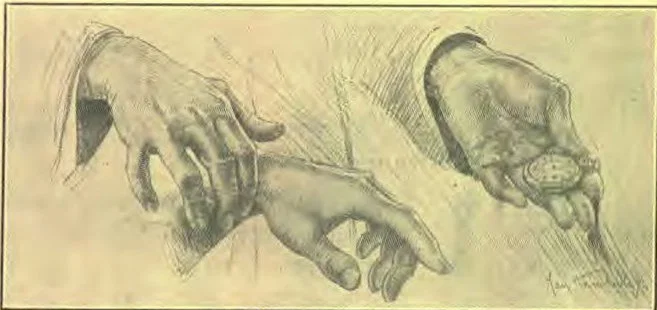
About this time my father, who had smoked cigarettes for thirty-five years, began to suffer a slowly increasing paralysis of his left side. It commenced with a stiffness of the fingers of his left hand, spread to the arm, and then to the left leg. The doctor told him at once that he must stop smoking. My father answered that he could not do that, but would try to put any limit on his smoking which the doctor decreed. The doctor made him an allowance of three cigarettes a day, and my father straightway purchased the strongest cigarettes he could find. He carried an umbrella now all the time, using it as a cane. On the street I could tell him farther than I could recognize his figure, by the dragging of his left leg.
On the day before he was to leave on a vacation, I went around to the office to get him, and we started together to the bank to cash a check. The bank was about half a dozen blocks away. In the first three blocks my father made his fight to stay in the world of active men, and failed. Moment by moment he leaned more heavily upon me. Finally he halted, helplessly, with the first look of defeat I had seen upon his face.
I found a seat for him near where we had stopped, and got a taxicab and took him home. He never went on that vacation, although he lived for many months in increasing helplessness.
Until my father's death I did not know that physicians take into account the prolonged use of tobacco in diagnosing the ills of middle age. It would have made no difference, I suspect, if I had known before; probably I should have smoked anyway, even if I had been told that Bright's disease, arteriosclerosis, derangements of heart and digestion are the common lot in middle age of those who have used tobacco through their youth.
When I gave up cigarette smoking,—and incidentally all other use of tobacco has followed naturally with me,—I found that, without realizing it, I had been tired for twenty years. It amazes me now to think how customary it was with me, on entering a room, to look around first of all for a place to sit down, and to recollect how usual it was for me, when no demand was made upon me, to pass the evening stretched upon a couch.
Since I stopped smoking, I have become more active; I am more eager to meet and mix with people. My self-confidence has returned, and with it the world has seemed to fall into a new perspective. I find that while I was a cigarette smoker, I was living a sort of dream life, in which things showed themselves in wrong proportion and in incorrect positions in the scale. Now I have changed from a pessimistic dreamer into a man who is beginning to do things. I have the pleasure of knowing that I am doing good work and receiving recognition for it.—George H. Cleveland, in Ladies' Home Journal.