WITH saddlebags across our shoulders, Elder E. L. Maxwell and I bade farewell to our wives the morning of July 29, 1917, and left for the railway station in Callao, Peru. Our train pulled out of the station at six o'clock in the morning, and by four in the afternoon we had passed through sixty-two tunnels. After passing through the last one, we crossed the great divide and began to go down on the east side of the Andes. We crossed the Andes at an altitude of about 16,000 feet above sea level. This is the greatest altitude reached by any standard-gauge railroad in the world with the exception of a branch line of this same road, which reaches up in the eternal snows of the Andes at an equal altitude. In going to the top, by circling around, and switching back and forth to get up the side of the mountain, one station is passed five times. In making the last switch we could look nearly straight down and see the town 1,500 feet below us.
Passing from sea level to so high an altitude in so short a time is physically very trying on one. I suffered with a severe headache. The faces of all on the train became very red and flushed, looking as if the blood were almost ready to burst through the skin. Some were very sick, and bled at eyes, ears, and nose.
We reached Huancayo, which is the station at the end of the line and about one hundred fifty miles over on the east side of the Andes, at eleven o'clock that night. Here we spent two days resting before going to Laraos. I felt as if I were just getting up from a long sick spell, and can assure you the two days' rest was appreciated. On the first of August two Indians with mules and burros arrived to take us over the mountain pass to their Indian village. As we did not leave Huancayo till late in the day, we made only about twelve miles, and that by traveling till nine o'clock at night. During the evening we passed through three Indian villages. We also met several companies of drunken Indians, who were dancing and yelling, thus causing considerable excitement. We spent the night in what would be called a wagon yard in the States, yet it was the best place in the town. An Indian woman made us a bowl of good hot soup. It was my first experience with Indian cooking. I got along well, as a faithful dog was near by to help me get rid of some goat cheese that was well fastened together with goat hair.
Our guide aroused us at four o'clock the next morning, so we might get an early start. It was well we did start early, for if we could have seen the road we were going over, our courage might have failed us. Now and then we came to a big rock which served as a huge stair step. Our mules would simply give a lunge and land on the top. The road was a mountain trail about two feet wide and so straight up that I was afraid my mule might upset. The day passed, and night found us following a little stream that finds its way to the great Amazon. This night we were the guests of an Indian family out in the country. This family let us make our bed in an old adobe hut with a straw roof. At one end of the bed the chickens roosted, and at the other was a large pile of Peruvian wood, “cow chips.” Above our heads were several dead chickens tied up by their feet to poles that served as a ceiling. We were, however, glad for the shelter, as6our bedding was scarce and the night was very cold. In the morning, after eating a little cancha, or parched corn, we were off for another day.
At ten o'clock we crossed one of the main ranges of the Andes at an altitude of about 16,000 feet, and very close to the eternal snow line. To our right was a great peak covered with snow. From here we could look out across the mountain tops for many, many miles, viewing now and then a great peak towering six or eight thousand feet above us. It was a beautiful morning, and the scene was impressive. During the afternoon we passed by many copper, gold, and silver mines. We could often pick up a stone filled with one of these metals. I saw an old rock fence, the rocks of which sparkled with gold. At four o'clock in the afternoon we began to descend our last large hill to the town of Laraos.
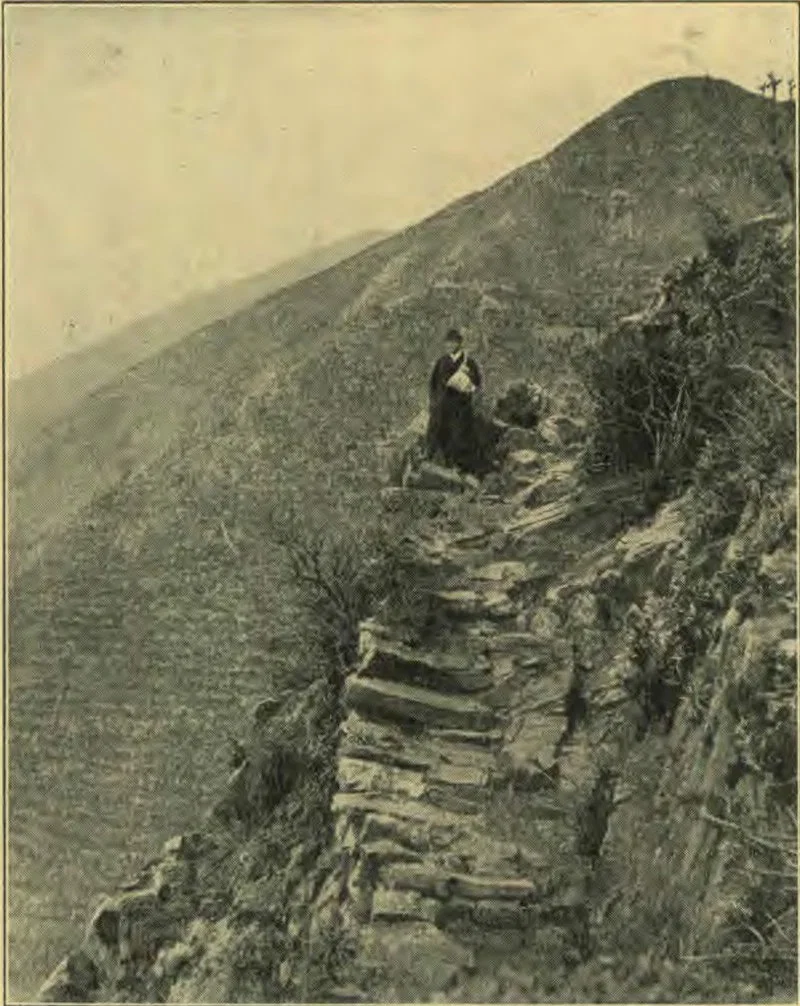
In going down three miles, we lowered ourselves six thousand feet in altitude. Our road was a narrow path ranging from one to three feet wide. To our left was a great rock wall. To our right was an immense gulch two thousand or more feet deep. A stone from under the mule's feet would frequently roll to the bottom and land in the angry waters that roared below. We arrived at Laraos that night at nine o'clock. Friends had prepared a room for us in a house of mud. There were no windows in it, but a door in the center of the side. The floor was of mother earth, which had been swept and well covered with a coat of water. The latter added much to our misery, as we were already cold and very weary from our journey.
A SECTION OF THE MAIN TRAVELED ROAD TO LARAOS
If one's horse should fall from this narrow path, he would land in the river fifteen hundred feet below. Elder Maxwell is shown coming down the steps.
This little town of Laraos is built over a mountain stream on a big mountain slide. One can see up the side of the mountain where the dirt came from that filled the gulch, making a great dam across it, about five hundred feet high. This mountain stream has succeeded in making its way through this dam. While the water sinks from sight on one side with no visible opening for its escape, it comes rushing out on the other side. This region has a wonderful system of irrigation and farming. Up either side of the mountain for two or three thousand feet, are great rows of little fields. These fields are now level, but many times the wall that was formerly erected on the low side, and which now holds the dirt to make them level, is as high as the field is wide. These fields will average about twenty feet wide and fifty to one hundred feet long. Each adult and every child has from three to four of these little fields, and each field is supplied with water for irrigation.
The message first found its way to this place through the printed page, carried by Brother Salazar in June of 1913. In the fall of the same year W. R. Pohle and R. B. Stauffer visited this place and held some meetings in the Catholic church, but trouble arose and they had to leave. In 1915 Brother Salazar again visited this place and held some meetings in the public square. On the night of April 4 a mob attacked him and he had to flee for his life. One of the brethren was crippled in the uproar that followed, and for a time much persecution followed for the believers. The first day that we were there the city authorities visited us, and later the city schoolmaster, who had vowed that a Protestant minister should never again enter the place. The night before, this schoolmaster had, in company with two or three other men, tramped the town all night, shouting “Viva Católica,” thus trying to create a mob to drive us out of the place. With the help of Him who rules above, we were able to make friends with the schoolmaster and the city authorities, and after a stay of one week we left without being molested in any way.
After visiting three other Indian villages and holding meetings in them, Sunday, August 19, people from all four places met in a central place called Tintin, for baptism. Twelve were ready for this ordinance, and twelve or fifteen more wanted to be baptized, but it was necessary that each should first be married to the woman with whom he was living. As are the priests, so are the people. The priests set a low example of morality, and when the message finds these people, they have to make things right before taking part in the ordinances of the church.
We returned to Huancayo over a different road. Our guide awakened us at three o'clock in the morning on the twentieth of August, and we started on our way over a very difficult path. We were down in a great gulch following along a stream. Our trail was dug out of the side of a great wall. Sometimes we were close to the roaring waters and again we were up so high that we could scarcely hear the roar. It was dark and we could not see the road, so we had to trust our horses and the God who rules above to take us safely over the narrow trail. Now and then we crossed the7stream over a bridge made of brush suspended across the water twenty or more feet above it. These bridges look very frail and they do not belie their looks. They are about three feet wide, and are made without banisters. In the center is a path about eighteen inches wide, for the horse to walk on. The great walls on either side of us kept getting closer and closer together all the time, till soon we could see but few stars through the opening above us. At daybreak we came to what looked like the impossible. A great perpendicular wall on either side a thousand or more feet high, and in front arose a wall nearly perpendicular, two hundred or more feet high. The gulch at this place was not more than ten or twelve feet wide.
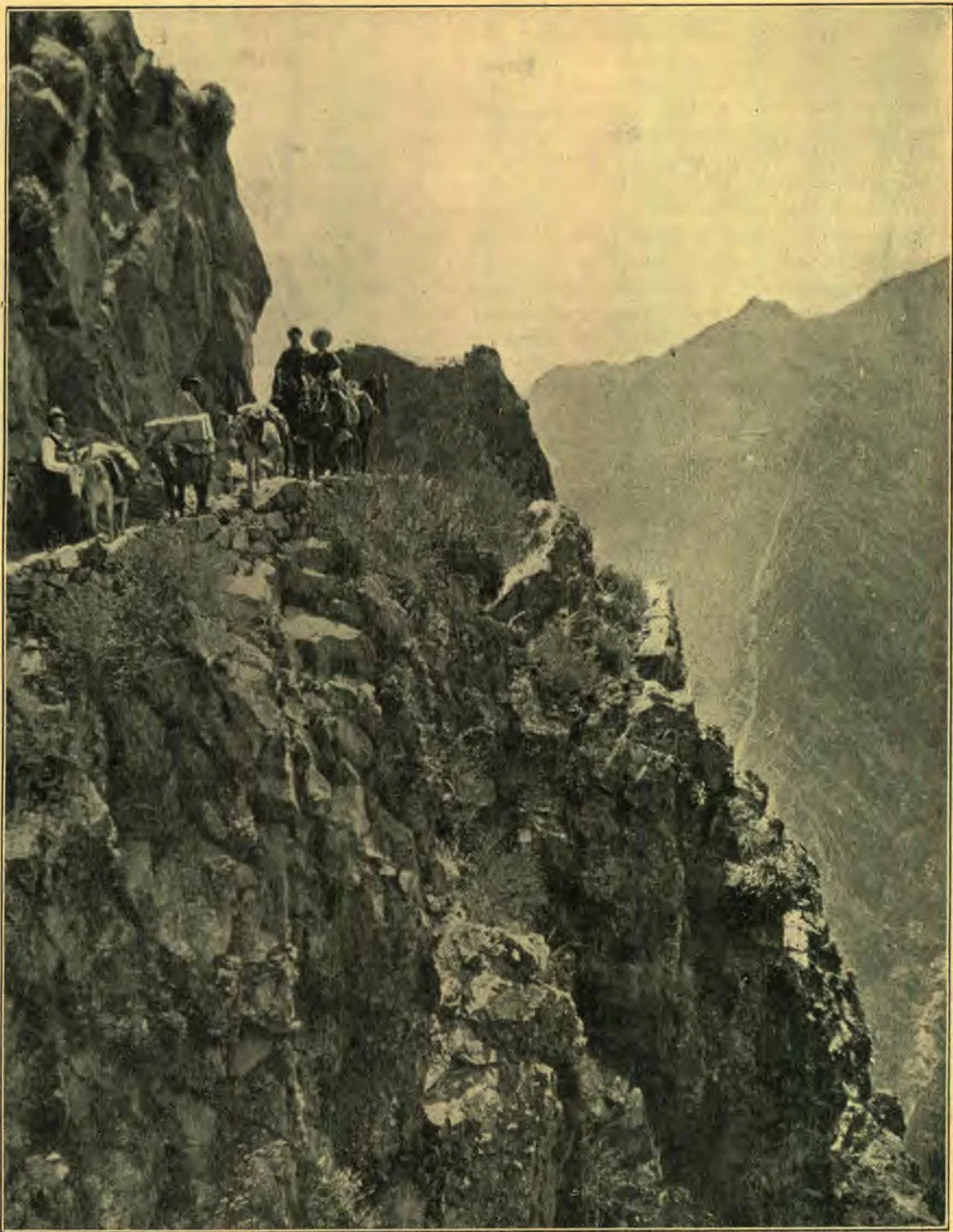
THE MISSIONARY PARTY ON THEIR WAY TO VISIT THE OUTSTATIONS
It is nearly a thousand feet straight down to the water at this place.
We began to look for a way out, and found a stairway with steps from one to two feet high up the wall in front of us. This stairway reaches from the wall on one side to the wall on the other side, and back and forth, till finally one may reach the top. At first we wondered how the horses and loaded burros would climb such a stairway, but we dismounted and got in front of our horses to keep out of the way of rolling stones, and our faithful animals followed. It is interesting to watch the burros climb with their loads. This is the main traveled road to market, and all lumber, farm tools, and everything of that kind must be taken over this road. It is no wonder that the people learn to live and do with a meager equipment. We must also remember that books for the colporteur must be taken over this road if delivered to the people of the towns below.
During the day we again crossed the same mountain pass that we crossed in going to Laraos. This time we were in a blizzard and snowstorm. As we went down on the other side, the snow turned to rain. Because the people living along the way are thieves, we were obliged to camp for rest under the shelter of a large rock.
Brother Maxwell and I tried sleeping on one cot, because our bedding was scarce and the rock was not large enough to shelter two cots. At half past twelve our guide awakened us, stating that it was time to be on our way. We were glad to hear the call, for it was little that we had slept, and we were cold and needed some spirited walking to get us warm. We arrived at Huancayo the night of August 21, at seven o'clock. Here we took some much-needed rest. Though the roads are difficult and the altitude and weather trying, we are glad to have a part in the work of soul-saving in Peru. E. H. WILCOX.