IT was a Zulu king, I believe, who, in the early days of African missions, demanded that he, the king, should be taught to read by a quicker process than his people who were attending the mission school. He came with his chiefs to be taught in royal fashion. He learned the first few letters; and the teacher advised that this was sufficient for the first lesson.
No, he, a king, must take the whole alphabet at one sitting. The result was that at the end of his first day's school he had the letters all confused in his mind, and in disgust gave up the whole plan of acquiring the art of reading.
I was reminded of this African king's idea that there ought to be some royal road to learning, by an experience related at the Australasian Union Conference. Brother J. L. Branford, of the Monamona aboriginal mission, in Queensland, told how the natives—the black aborigines—thought at first that the missionaries would be able not only to teach, but to supply the learning as well. He said:
“When we first opened our day school, the natives thought it was a great idea. A large number of men and women wanted to come and learn to read and write; but they seemed to have the idea that their teacher was going to do all the work, and that they need not put forth any effort. They did not seem to expect that they would need to use their brains. We started a night school for the men, but a few weeks convinced them that it was too hard for them, and so they gave up. The women held on a little longer, but with all the encouragement we could give them we could not persuade them to stick to their studies long enough to receive any real benefit. One by one they dropped off. The adults do not like to use their minds other than in the art of hunting and fishing.”
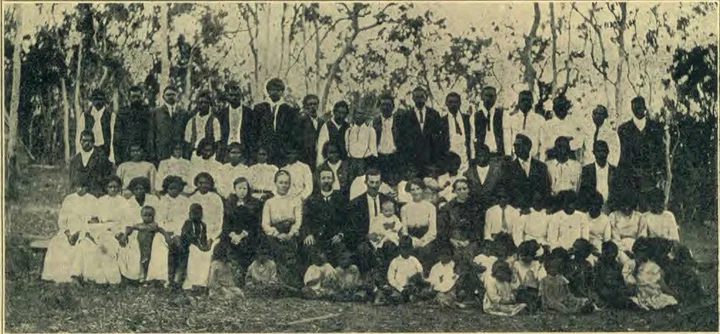
It was good, however, that Brother Branford was able to give a more encouraging report concerning the children:
“With the young people, however, it is quite different. These we have more under our control, and good results have been attained. We have found that they learn some things as quickly as white children. Reading and writing is easy to them, especially writing. But we find that they forget much more quickly. It seems hard for them to retain what they have learned. But, taking our educational work right through, our young people have made good progress, and they are becoming much more intelligent than their parents. They are exceptionally fond of singing. It is a common occurrence to hear in the evenings groups of boys and girls singing our good hymns. Most white children hail with delight the announcement of a holiday from school, but such is not the case with our black children. If anything happens that our teacher cannot hold school, they are quite disappointed. They love their school very much. The girls have made more progress than the boys. The reason for this is that we have the girls in a dormitory and Brother and Sister Mitchell live with them. This has given the girls much greater opportunity of making progress. We need a dormitory for the boys very much, and must have one in the near future.”
Thus, while still no royal road to learning has been discovered, the good old road of hard work and perseverance suffices even these children of the wilds. Many years ago the Australian aboriginals were spoken of by some as so low in the scale of human existence as to be incapable of improvement. All that is now known to be nonsense. Degraded they are in the wild bush land and deserts of the interior, but they have hearts that feel as our own, and minds capable of comprehending not only the common things of the way of salvation. Already eleven of these young knowledge, but chiefest of all, the eternal truths of not devoid of good.
S. S. “Tango Maru,” Banda Sea, East Indies.