CRATER LAKE

5%

Review and Herald Publishing Company · Battle Creek, Mich. · Apr 25, 1901

FromThe Youth’s Instructor, Vol. 49, No. 17.

Read the full edition

CRATER LAKE

Its Geological History

And God saw that the wickedness of man was great in the earth, and that every imagination of the thoughts of his heart was only evil continually. And it repented the Lord that he had made man on the earth, and it grieved him at his heart. And the Lord said, I will destroy man whom I have created from the face of the earth. . . . And God said unto Noah, The end of all flesh is come before me; for the earth is filled with violence through them. And, behold, I will destroy them with the earth. . . . And, behold, I, even I, do bring a flood of waters upon the earth, to destroy all flesh, wherein is the breath of life.”
In obedience to the commandment of God, Noah built an ark, and went out to warn the people of the destruction that was coming upon the earth. But the people would not heed him, and when it had been demonstrated to the universe that neither entreaty nor threat of punishment would turn them from their evil ways, God shut Noah and his family into the ark, and shut the rest of the world out.
Then “the fountains of the great deep were broken up.” The water that had been hidden in the bosom of the earth to feed the rivers that flowed from these great fountain-heads and went out to water the soil, rushed out upon the surface, and with the rain that fell from heaven, flooded the earth. Angels of God upheld the ark, else, stout as it was, it would never have withstood the terrible storm that swept the earth.
When the waters broke from the deep, great areas of the earth’s crust were thrown up and doubled back upon other portions of the surface. By the power of God’s word, other portions of the earth’s surface were broken up and thrown in heaps, to cover the slain, to hide the treasures of gold and silver and precious stones of which the antediluvians had made idols, and to bury the luxuriant forests that had covered the earth.
Many other changes took place, for “the world that then was, being overflowed with water, perished,” but as only the burying of the antediluvian forests has a direct bearing upon our subject, these other changes need not be mentioned here.
Years passed, and the buried forests slowly turned into vast beds of coal; for God has such a tender love for his creatures that he turns every curse into a blessing, so far as they will permit. Sometimes these coal beds became ignited by the spontaneous explosion of gases, and then great fires raged in the interior of the earth, until the surrounding rocks became a swollen, molten mass, that finally burst through the crust of the earth, and began the formation of a volcanic mountain.
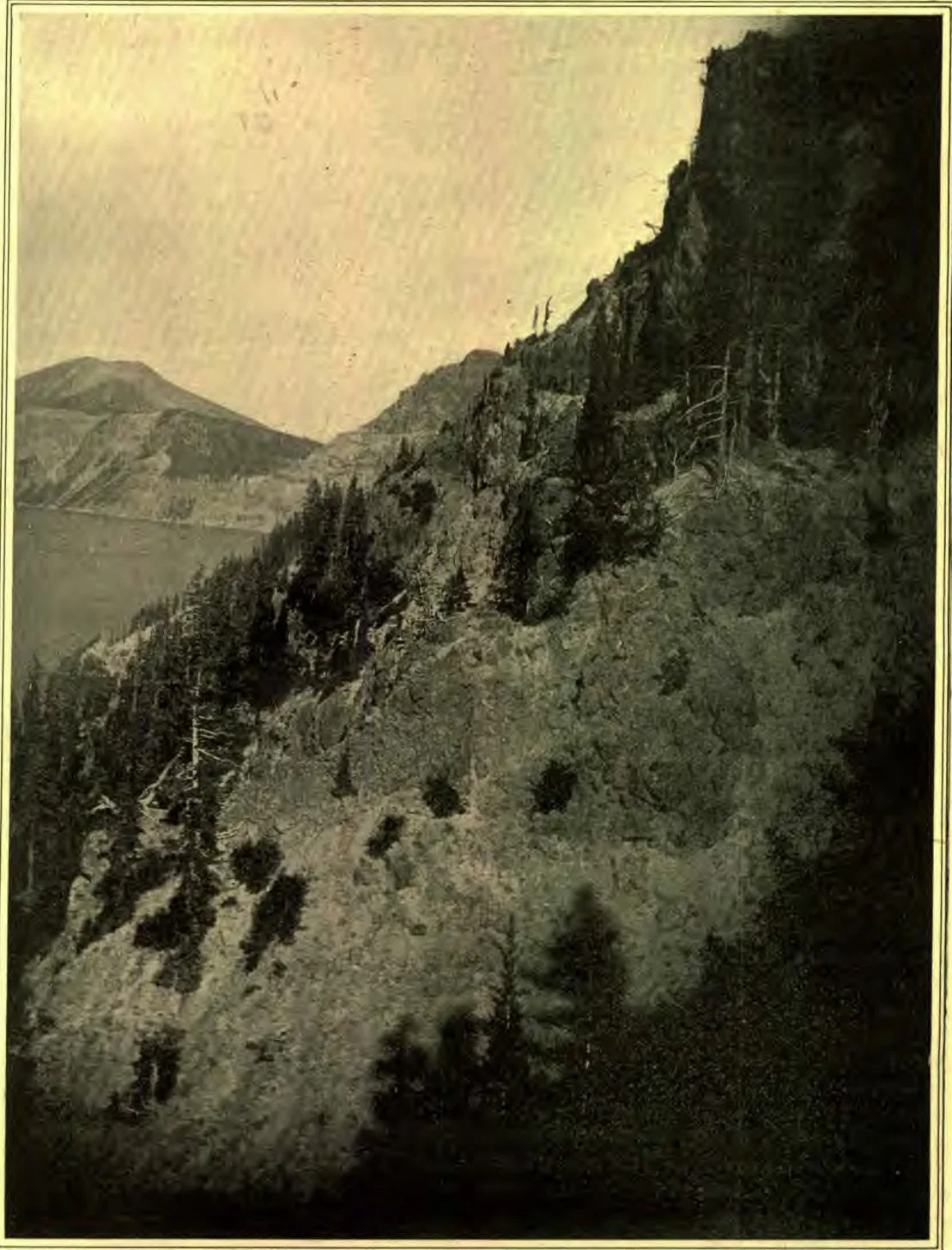
ALONG THE SOUTHEAST SHORE. CASTLE CREST TO THE RIGHT, AND MOUNT SCOTT TO THE LEFT.
Soon after the flood, one of these mountains began to form in what is now southern Oregon. It is quite impossible to estimate geological periods in years, so we can not tell how long it was forming, but it was probably among the first volcanoes the world had seen. The coal bed that fed the fires of this volcano was a large one, and was situated near the surface of the earth.
Years passed, and the fires raged with unabated fury. Mt. Mazama, as it is now called, grew higher and higher, until it overtopped all the peaks in the Cascade Range. But the fires burned back from beneath the mountain, and the lake of molten lava found lower outlets. Then Mt. Mazama became a semi-active volcano, whose crater emitted smoke and sulphurous gas, but no lava. Under the mountain was a vast cavity, at the bottom of which still surged the molten sea.
Snow fell upon the mountain top, and glaciers began to wear away the rough rocks of its sides.
Then the time was ripe for another act in this great drama.
The fuel near Mt. Mazama was well-nigh exhausted, but the fire, following one isolated vein of coal, suddenly burst into an underground lake, and let in a flood of water upon the molten sea. Then there was a terrific explosion, accompanied by an earthquake that could have been felt for hundreds of miles around. Mt. Mazama, or that part of it that lay over the principal cavity, was lifted bodily, just as you may have seen the lid of a kettle lifted to permit the escape of steam when the water boils furiously. The steam escaped, and the débris of Mt. Mazama fell back upon the seething mass below, leaving an elliptical hole more than six miles long, five miles wide, and fully a mile deep.
The molten lava burst through the débris, and another mountain began to grow up from the bottom of this great pit. But before it reached a height equal to the perpendicular walls that surrounded it, the pressure upon the lava below was relieved, the last fire burned out, and Mt. Mazama became a dead volcano.
The snow of winter and the rain of summer fell in this great basin in the mountain, and it gradually filled with water. Along some portions of the basin’s rim, where the conditions were favorable, the winter frosts and the summer thaws loosened the rocks, and they went tumbling down, grinding themselves and their fellows into powder, and forming soil upon the now sloping sides of the wall. Each year the soil in these spots became deeper; each year the water within the basin crept higher; each year the forests upon the mountain side grew denser. Then the wind, the birds, and the squirrels carried within the basin seeds of forest tree, shrub, and wild flower. Wherever they could find soil to take root, these seeds sprang up and grew, covering some portions of the crater’s wall with verdure.
And now the last act of this great drama has been played, and Crater Lake is ready to delight the eye, inspire the imagination, and thrill the very soul of all who gaze upon its deep-blue waters.
Many geological histories of Crater Lake have been written by far more learned men than the writer of this one, but all that I have read disagree with God’s word, and are consequently untrue. This objection can not be urged against the above, and in all probability it is a true history of the formation of Crater Lake.
J. EDGAR ROSS.