THE PLANET MARS

8%

Review and Herald Publishing Company · Battle Creek, Mich. · Apr 25, 1901

FromThe Youth’s Instructor, Vol. 49, No. 17.

Read the full edition

THE PLANET MARS

No one who has been at all observant of our evening skies during the past few months, but has noticed that beautiful, ruddy star that has been apparently moving westward among the other stars, following nearly in the pathway of the sun. That star is the planet Mars. Mars is the fourth world in order, counting from the sun, being the next beyond us. We are better acquainted with this little world than with any of the others; for although Venus comes nearer to us than does Mars, yet when she approaches that part of the heavens where we chance to be, she always keeps her dark side toward us, while Mars always shows us his full illuminated face whenever we come near to each other.
Mars is a much smaller world than ours, having only two sevenths of the surface that our world has. Its diameter is only 4,230 miles. An object weighing here one hundred pounds would there weigh only thirty-eight pounds.
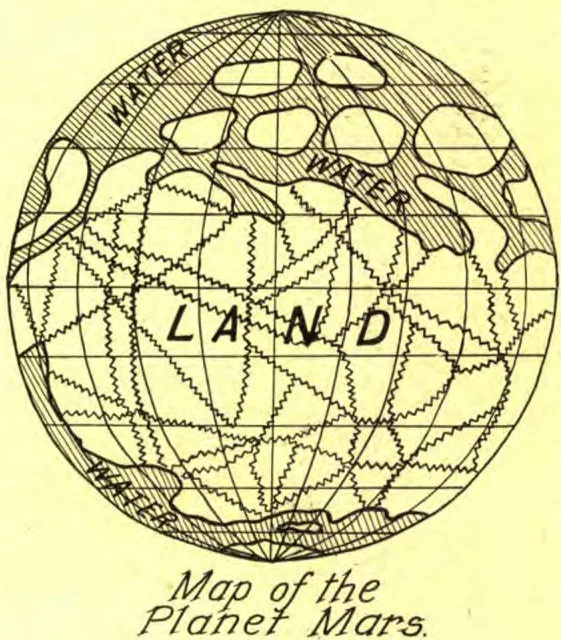
Map of the Planet Mars.
As we have already said, Mars has been for some months apparently moving westward among the stars; this movement has, however, been only apparent, and has been growing slower and slower, until on April 4 it seemed to stand still. It will seemingly remain in this position for a short time, when it will again resume its eastward journey around the sun. Study carefully the diagrams given in our last study, and see if you can not tell why this is so. Some evening we will study more fully this interesting phenomenon. Because of these changes, the ancients named the planets “wandering stars.” As we leave Mars behind in our rapid race around the sun, we shall find him growing dimmer and dimmer until at last we shall lose him behind the sun. When we again see him regaining his brightness, he will be a morning star, and will be found on the other side of the sun.
Mars reflects to us two distinct colors, red and green, the former reflected from the islands and continents; the latter from the oceans, lakes, gulfs, and bays. The greater portion of our earth has, since the flood, been covered with water; but with Mars this is not so; its surface being about five-eighths land and three-fourths water, more as we understand our earth was before the curse of the flood rested upon it. We present with this a drawing showing one of the hemispheres of Mars. One peculiarity of this planet, as will be seen, is the network of lines running in different directions across the continents. What they are we do not know. They were, for some time, supposed to be canals or artificial water-ways; but this can not be true, for they are from forty to fifty miles wide; besides, they change their position at times. Frequently a single one will spread out, and finally become double, the two lines running parallel for hundreds of miles, as will be seen on the map. Similar markings have lately been observed on Venus as well. Some have suggested that these markings may be the lines dividing the land among the different families, similarly to the dividing of the land of Palestine among the tribes of Israel. At times large portions of land become flooded with water, as Egypt is flooded by the River Nile. In 1902 the Earth and Mars will approach unusually near each other, and it is hoped that then, with our improved facilities for observation, we shall learn many new facts regarding this near neighbor of ours.
The climate of Mars seems to be, in the northern hemisphere, quite like that upon our earth, only more mild and even, the winters not being so cold and stormy as ours; but in the southern hemisphere the extremes of heat in summer and cold in winter are very marked. This is caused from the fact that the planet is fully 27,000,000 miles farther from the sun in the winter of the southern hemisphere than during the summer. During the winter time the poles of Mars are covered with a thick blanket of ice and snow, which as summer approaches gives way to green fields and sun-lit hills and dales.
Were it true that the amount of heat and light of a planet is dependent upon, and regulated solely by, its distance from the sun, then we would have to suppose that Mars was a much colder and darker world than the one on which we live; for according to this hypothesis, it would receive some less than one-half the light and heat that we receive; but since it has been proved that Mars has a much more dense atmosphere than we, we can readily understand why we find it to have even more light and heat than we enjoy.
Their seasons are nearly twice as long as ours. Swinging at the rate of 54,000 miles an hour, it accomplishes its yearly journey in 687 days of our time. Its day is known to be exactly 24 hours, 37 minutes, and 22.67 seconds long. The exactness of this data is calculated from observations that reach as far back as the days of Dr. Robert Hooke, 1666.
Another interesting feature of Mars is its moons. Until as recently as 1877 it was supposed to have no satellites; but in that year Professor Hall of the Naval Observatory discovered two, one being about six miles in diameter and the other about seven miles. The outer moon, which he named Deimos, is about 14,600 miles from Mars, and makes its monthly journey around its primary in thirty hours and eighteen minutes. The inner moon, which he named Phobo, is only 5,800 miles from the planet, and revolves about it in seven hours and thirty-nine minutes. Now think what a strange sight that must be: the planet itself revolves from west to east in a little more than twenty-four hours, which would cause the sun to rise in the east and set in the west, the same as with us; but this little moon travels so much faster than the planet revolves that he actually rises in the west and sets in the east, and does it so quickly that he passes through all the phases of new, full, quarter, old, and back to new moon again all in one single evening.
To give you some idea as to how carefully Professor Hall must have searched, even with his mammoth telescope, before finding these two moons, we will say that it would be the same as asking an astronomer in Chicago to turn his telescope upon the Tabernacle in Battle Creek, and determine whether some lady had not lost her gold watch upon the pavement that surrounds that building.
The landscape of Mars is supposed to be beautifully undulating, with hills and valleys, brooks and flowers, no ragged rocks having ever been torn from its bosom, as was the case with our earth at the time of the flood. Its heavy clouds refresh and gladden its hills and vales with dew and rain; while its snow-capped poles tell of its invigorating winters that come and go with its ever-varying seasons. Dew and sunshine, cloud and rain, all speak of the bow of God’s covenant promise of peace to them. We see, in the bow that has since the deluge spanned our heavens, the promise of God’s care and love to us; and while sin has never entered their beautiful world, while it has never felt the terrible curse that thrice has rested so heavily upon us, yet they certainly must look forward to that glad time when the accuser of their brethren shall have been destroyed; when sin with all its sad results shall have been forever wiped away, and Christ proclaimed forever King of kings and Lord of lords. They, with us, will some day join in that song of redemption that John records in Rev. 5: 13, where he says, “Every creature which is in heaven, and on the earth, and under the earth, and such as are in the sea, and all that are in them,”—showing that the worlds themselves, as well as their inhabitants, are represented as joining in this anthem,—“heard I saying, Blessing, and honor, and glory, and power, be unto him that sitteth upon the throne, and unto the Lamb for ever and ever.”
The storm-clouds that we see hanging over these unfallen worlds tell us too plainly that if one member suffers, all the members suffer with it; if one member is honored, all the members rejoice with it. 1 Cor. 12: 26. It is no wonder Paul says, “The creature was made subject to vanity, not willingly, but by reason of him who hath subjected the same in hope, because the creature [the created worlds] itself also shall be delivered from the bondage of corruption into the glorious liberty of the children of God. For we know that the whole creation groaneth and travaileth in pain together until now.” Rom. 8: 20–22. God grant that the time may soon come when his whole universe shall be forever free from the curse and mildew of sin and iniquity. OTHO C. GODSMARK.