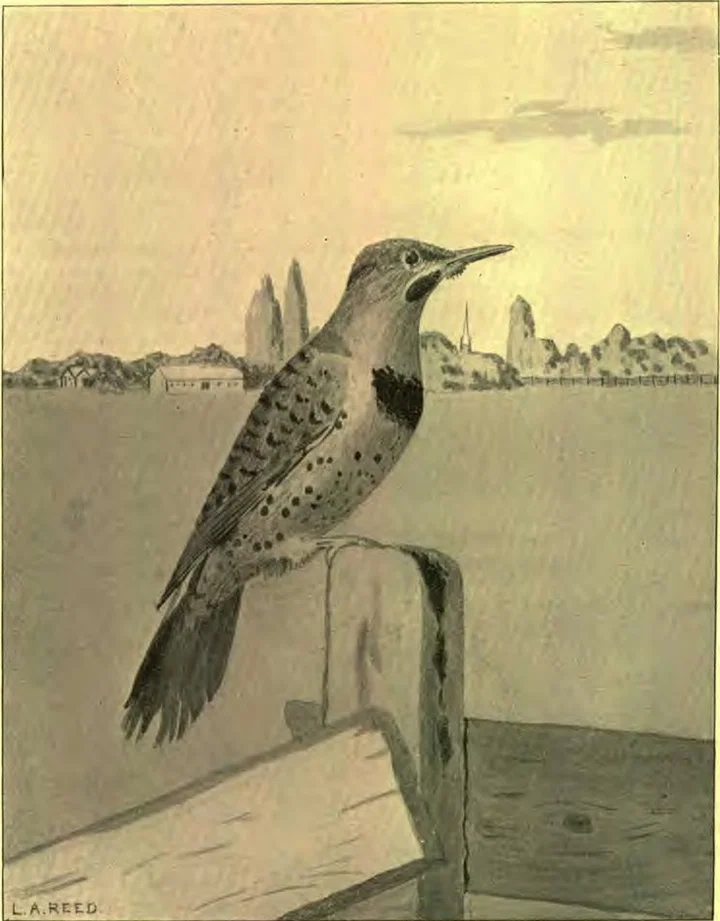
Another noisy bird is the flicker, or yellow-winged woodpecker. This bird has at least thirty-six different names. He is frequently called yellow-hammer, yellow flicker, high-holder, and clape. He is a large bird. The sides of his head, throat, and breast are lilac-brown, with black patches on the cheeks and a large black half-moon on the breast. His back is brown, barred with black; belly ashy with black spots; rump white; scarlet crescent on nape; wings lined with golden; tail black above, golden beneath, feathers pointed.
The only other bird that might be mistaken for him from the descriptions is the meadow lark. The white spot on the rump of the flicker, its call notes, and the woodpecker-use of its bill, will easily distinguish it from the lark.
The flicker is with us all through the winter, but in the spring the numbers increase, and the woods ring with their cries and drummings. I have seen a flicker light on a hole in a fence post, and if he could find a good drumhead made by a loose piece of bark, or better a piece of tin tacked to the wood, he instantly gave it most vigorous hammering with his strong sharp bill. The first time I observed this, I supposed it only an accident, that the bird was striking in an attempt to pierce the wood for the purpose of extracting insects, but I soon learned my mistake. There is no question about it, the flicker often drums for the mere love of the noise.
Last summer one came frequently to the rear of our home, lighted on the tin roof, and battered away with as much enjoyment as a small boy at a drum. When eating, it is true, he uses his long bill, and long sticky tongue. But his most common food is ants, and these he finds in rotten wood and upon the ground. As a usual thing he makes no noise while feeding.
As to his love for creating a racket, I quote the words of another:—
“Our ‘yellow-hammer’ has a genius for noise. I saw two of these flickers clinging to the trunk of a shell-bark tree; which, by the way, is a tree after the woodpecker’s own heart. One was perhaps fifteen feet above the other, and before each was a strip of loose bark, a sort of natural drumhead . First, the lower one beat his music out, rather softly. Then, as he ceased, and held his head back to listen, the other answered him; and so the dialogue went on.”
“They belong to the tribe of Jubal. Hearing [one day] somebody drumming on tin, I peeped over the wall, and saw one of these pigeon woodpeckers hammering an old tin pan lying in the middle of the pasture. Rather small sport, I thought, for so large a bird. But that was a matter of opinion merely, and evidently the performerp. 134 himself had no such scruples. . . . True, the pan was battered and rusty, but it was resonant, for all that, and day after day he pleased himself with beating the reveille upon it. One morning I found him sitting in a tree, screaming lustily in response to another bird in an adjacent field. After a while, waxing ardent, he dropped to the ground, and stationing himself before his drum, proceeded to answer each cry of his rival with a vigorous rubadub, varying the program with an occasional halloo. How long this would have lasted there is no telling, but he caught sight of me, skulking behind a tree-trunk, and flew back to his lofty perch, where he was still shouting when I came away.”—Birds in the Bush.
Another marked characteristic of the bird is his manner of courtship. Several pay attentions to the same female at the same time, each trying to outdo the other in his kind attentions. “The apparent shyness of the suitors, as they sidle up to her and as quickly retreat, the sly glances given as one peeps from behind a limb, watching the other, playing bo-peep, seems very human. . . . The defeated suitor takes his rejection quite philosophically, and retreats in a dignified manner.” In courting, the male “spreads his tail, he puffs out his breast, he throws back his head, and then bends his body to the right and to the left, uttering all the while a curious musical hiccough.” One or the other, in time, is sure to win the lady with so much flattering attention.
As has been said, ants are the chief article of food. Three thousand ants have several times been found in the stomach of the flicker. In case of the grasshopper plague, he is very useful in killing off the pests, but at ordinary times he feeds upon ants. He has been accused of stealing corn, but he really eats but very little.
L. A. REED.