“Why that forlorn expression on your face, Jack?” asked Uncle Henry, as he saw how puzzled the boy was in his effort to divide accurately a 9¾-inch board into four equal parts.
“This looks easy enough,” said Jack, “but every time I try to divide it one division or another is larger than the rest. I am sure I shall never be enough of a mathematician to make a first-class carpenter; guess I shall have to be a doctor.”
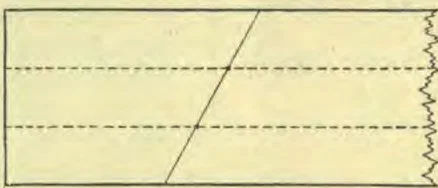
“Aren’t you drawing conclusions too early?” said his uncle. “You have not yet learned the secrets of the trade. Now if you will make your ruler measure obliquely just 10 inches across your board, and then will make a dot on your board on every 2½ inches (one fourth of ten is two and a half), you will have the divisions indicated accurately. Or, if you have a 10½-inch board, and wish to divide it into three equal parts, place the ruler across the board so that the oblique measurement will be just 12 inches, which is a multiple of the number of parts into which it is to be divided. Then at every fourth inch mark, place a dot on your board. Now mark your divisions through these dots.”
“That is worth a box of candy, Uncle Henry. I wonder if all my troubles could be solved as easily if I only knew more.”
“Very likely; knowledge is a wonderful dissolver of troubles. Now let us make sure you have the idea so clear that no trouble of this kind will ever again hinder your work or ruffle your good nature.”
“Well, let me see,” said Jack, thinking up a problem. “I can divide a board 11 inches wide into seven equal parts by placing a ruler across it so that the oblique measurement is 14 inches, and then mark off every 2 inches; or mark off every 3 inches on an oblique line measuring 21 inches.”
“I will trust you after this to waste neither energy nor time puzzling over such a simple proposition as the accurate division of a board,” said Jack’s uncle.
“Now I am anxious, uncle, to learn more of the carpenter’s short cuts, and I believe I shall after this give more attention to my arithmetic too.”
Germany’s Substitutes
ACCORDING to the Associated Press, since the war Germany has been very successful in manufacturing for herself or in finding substitutes for imported articles, such as,—
Saltpeter, Aluminum, Oils, Rosin, Graphite
“Before the war she imported annually over $40,000,000 worth of saltpeter for agricultural and ammunition purposes, mainly from Chile. Today factories are manufacturing saltpeter, so that Germany is now able to supply the amount necessary for ammunition and for fertilizers.”
“Before the war the supply of bauxite for the manufacture of aluminum had been imported from France, and the cutting off of this supply led German scientists to discover a process of aluminum manufacture by electricity from ordinary clay.”
“Chemical experts in the German coal fields have discovered new ways of extracting oils from their coal, partly relieving the serious condition resulting from the cutting off of mineral oil products, which, in 1913, amounted to no less than $277,000,000.”
“Germany lost practically all of her imports of rubber, and to offset this shortage she has substituted steel for rubber in innumerable cases. Further, the perfection of the submarine merchantman made it possible to bring in considerable new rubber to mix with the old in the creation of a regenerated or synthetic rubber. The supply of this has been developed, until now it is said to be sufficient for another eight months.”
“Ceylon was the exclusive source of supply of graphite used in Germany before the war. Since then Germany has been dependent entirely upon the inferior Bavarian graphite; but German chemists have been able to find a process by which the Bavarian article can be purified to a 97-per-cent standard.”
“Supplies of rosin had come exclusively from America and France, but German chemists have now become able to produce all that is needed from the German forests, or are able to use as a substitute the by-products of wood and coal.”
“Paper has been adapted in innumerable instances to serve for cloth. By using protoxide of sodium, sulphite cellulose, and paper, a very durable and satisfactory thread has been evolved, which, in turn, lends itself to the creation of sacks and bags, girdles, doilies, aprons, working garments, wrapping cloth, and thread and string. The inventors have discovered a way to give the ‘paper-cloth’ great resistance to dampness.”
“Almost the only ‘unsubstitutable’ substance has been copper, but there has been found to be plenty of that on hand in German industrial plants elsewhere. In place of the copper thus taken by the government there have been installed aluminum and zinc, out of which wires and utensils of various sorts have been fashioned. In addition, zinc has been found to do just as well as copper in the manufacture of a score of articles in everyday use, and is a good substitute also for brass and bronze. Iron and steel also substitute satisfactorily in dozens of other cases. Zinc and aluminum and zincked iron find their use now in switchboards and the like, in place of marble or slate.”
Substitutes for Foods
“Imitations have played almost if not quite as large a part as substitutes for foodstuffs, of which a shortagep. 9 has been created by the war. Many of the imitations are of doubtful nutritious value. The grain supply of the empire, originally not near enough for the consumption of 70,000,000 of people, has been ‘stretched’ by potato flour. And now that the potato crop is almost a failure, potato flour will itself be substituted by barley during the first half of the present year.”