Copyrighted by author. Used by permission.
BY EX-GOVERNOR J. FRANK HANLY
We have thrown the sanction and the nominal protection of the church and the state over the institution of the home, and for a few paltry dollars have licensed the activities of a monster whose success is measured directly by the amount of ruin and sorrow he can crowd into the homes of the people.
—C. M. Snow.
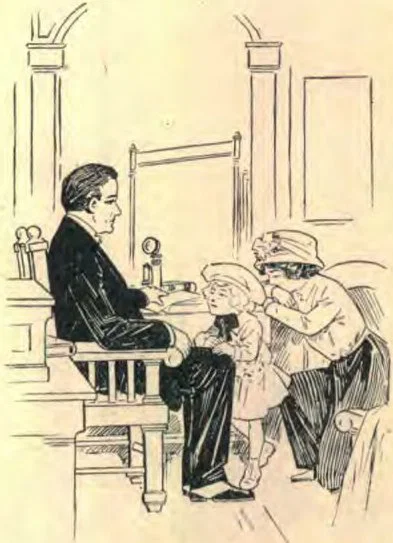
One afternoon there came into the governor’s office in Indianapolis a little woman. She was plainly clad, her shoes were coarse, her hands were toil-calloused. She led by the hand a little boy, scarcely three years old, round-faced, big-eyed, with sun-lit curls,—a vision of impelling beauty. Strangely attracted by the sight of him, and made gentle by the memories his presence stirred within me, I said to his mother,—
“Madam, what may I do for you this afternoon?”
“Governor, I have come to ask you to give me back my husband.”
“Give you back your husband? Why, madam, I haven’t your husband.”
“Oh, yes, you have, Governor! You’ve had him ever since last September—five long, weary months—down at Jeffersonville, at the State reformatory; and I’ve come to beg you to give him back to me.”
“At Jeffersonville, in the State reformatory! Then your husband is a criminal, madam, and I can’t give him back to you.”
“No, no, he isn’t, Governor! I know he committed a grave crime,—highway robbery in the nighttime,—but he isn’t a criminal; and when you know him as I know him, you will know he is not.”
“Not a criminal, and guilty of highway robbery! Why, woman, it is the gravest crime but one the law knows. Whoever commits it takes the hazard of taking human life. No, your husband must be a bad man, a criminal. He is where he ought to be. I can’t give him back to you. My duty to the State and to society, whose servant I am, precludes my giving him back to you.”
Then, summoning her courage and her strength for the final assault, she said: “Governor Hanly, I’m surprised, disappointed, and grieved at you. I thought you were a just man. People told me you were. I came here believing you were. But you’re not, you’re not! If I were able to employ counsel and could bring them here, you’d hear them by the hour, and you would not judge until you had heard. But I’m poor, so pitifully poor that I cannot bring counsel. I can only tell my story in my own feeble way, and you’ve judged me before you’ve heard me. You’re not just! You’re not just! I’m entitled to better treatment than this from the governor of my State.”
Rebuked, I bowed my head in assent; and then she said:—
“We were born out here in an Indiana village, my husband and I. We were boy and girl together. We grew to manhood and womanhood together. Finally we came to love each other and, four years ago, we stood at the altar and plighted ourselves in the solemn contract of marriage. We turned from the holy ceremony and went out into this great city to find a home. We were poor—yes, I know. But we were young, and strong, and brave. We went out into the city with high purpose. We found a home, a modest little one, only two rooms; but small as it was, we could not buy it; we were too poor. We could only rent it. But we did rent it, and moved into it; erected in it a family altar, and put about the altar household gods, humble, but dear to us. And we were happy. Then three years ago the baby came,—this little boy,—and, Governor, I haven’t language to explain to you how his little fingers drew our hearts together; how love for him melted and fused our purposes into one. There was no cloud upon our sky until last September, on Labor Day, my husband went with a party of friends down to Shelbyville, twenty miles away, to attend a Labor Day celebration. Down there, for the first time in his life he indulged in intoxicants. By evening he was maudlin drunk; and on the way home, in the nighttime, with his drunken companions, he met a stranger in the highway. They stopped him in the darkness and robbed him, and then drove on. But sobered by the consciousness of the awful crime in which he had participated, my husband soon climbed out of the carriage, walked back to Shelbyville, reached there in the gray dawn of the early morning, hunted up the sheriff, told him the whole pitiful story, and surrendered himself into custody. Then they sent for me. I took the little boy and went down to Shelbyville. Arriving there, and walking the streets of the strange little city and inquiring for my husband, I was told I should find him up in Judge Sparks’s courtroom. I made my way up there, stepped inside the door, and there, sure enough, beyond the bar, surrounded by the officers of the law and of the court, sat my husband. For a moment I waited in fear and silence, then I saw the prosecuting attorney arise, and heard him read to my husband an indictment charging him with the crime of highway robbery, and then I heard the court kindly but solemnly say to him:—
“Prisoner at the bar, stand up. You are charged with a grievous crime. You have heard the indictment read. How do you plead to it? Answer. Are you guilty or not guilty?”
“And then, God help me! Governor, my heart stood still, as I heard him confess his guilt. Frightened and half frenziedp. 2 by what I had seen and heard, I made my way to the bar. I intervened. I told the court the story of our lives, and asked the judge for the love of the little boy to give me back my husband. And Judge Sparks, through his tears, said to me:—
“Madam, I would to God I could, and if I could I would. But I have no choice. The law of Indiana gives me no discretion. Your husband is charged with a grievous crime. He admits his guilt. I can only pronounce the judgment of the law, in such case made and provided, five to twenty-one years in the State reformatory.”
“And then they led him away. After he was gone, I took the little boy and made my way back to Indianapolis; back to our desolate home; back to our desecrated family altar; back to our broken household gods. And standing there that night, in the darkness, amid my crushed and fallen hopes, and the wreck and ruin of my home, my heart grew big with hate. I hated the State of Indiana, I hated the law. I hated the judge who had pronounced its judgment. I hated my husband, until I remembered that it was the drink and not he, and that only four years before I had so proudly and confidently said, ‘Will, it’s for better or for worse, until death does us part.’ Remembering that, I said,
‘If God will help me, I’ll keep the faith and fill the bond; some way I’ll keep the little home; some way I’ll pay the rent; some way I’ll care for the little boy.’ And, Governor, for five long, inclement, dreary winter months I’ve kept that pledge. I’ve washed, and ironed, and scrubbed. I’ve done everything that an honest woman could do,—look at my toil-calloused hands,—and I’ve asked no man for help; I’ve been too proud for that. And I should not ask you now, but I face a crisis. I can’t keep my feet any longer. There’s to be a new baby any day, and I’ve got to go to a hospital and my little boy to an orphans’ home, unless you give me back my husband.’ Then, throwing herself upon her knees, putting her face in her hands and laying her head on my table, she cried with the abandon of a child. And as she wept and sobbed, the little boy slipped from the high chair from which his feet had dangled, came over to me, and with the artlessness of a baby put his little hand pleadingly on my knee, looked up through streaming eyes into my face, and cried in childish treble: “Mister, you’ve got my papa. I want my papa. Why don’t you give me back my papa?” I looked down into the tear-dimmed face, and caught there a vision of my own little boy, his age, that I had loved and lost but a while before, and the tugging at the heartstrings of the father became too much for the governor. Reaching down and gathering him in my arms, I said to him: ‘God bless you, little man. You’ve won! I’ll give you back your papa.’”
The mother sprang to her feet, and cried: “Governor, did I hear aright? Are you going to give him back to us?”
I answered, “Yes, and now.”
And ringing for my secretary, I said: “Colonel Gemmer, wire Warden Whittaker, of the State reformatory, that the governor is paroling William Wolverton, a convict down there, doing an indeterminate sentence of five to twenty-one years for highway robbery. Say to him that it is my direction that on tomorrow he clothe Wolverton in a decent suit of clothes, take him to the railway station, buy him a ticket, and put him aboard the noon train for Indianapolis.” Then turning to the wife I said: “He will reach the union station tomorrow evening at seven o’clock. Go meet him and bring him here. I want a word with him in your presence.”
But, all consideration for me, she answered, “Seven o’clock? Why, Governor, isn’t that after office hours?”
I said, “Yes.”
Then she said: “Then I can’t ask you to wait. The train, you know, may be late. I can’t ask you to wait.”
I said to her: “No matter if it is late, I will wait. Your business will be the biggest business the governor of Indiana will have tomorrow, and I will wait until you come.”
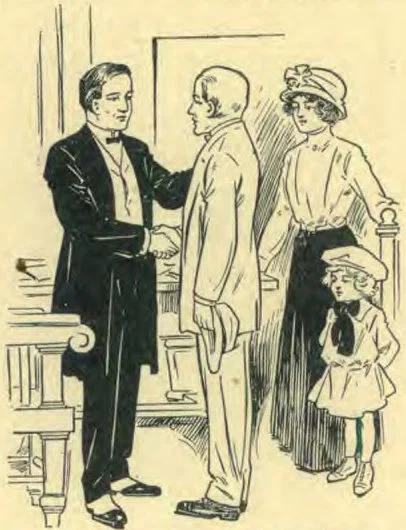
And the next evening I did wait—waited after all had gone from the big office; waited in silence and in solitude as the shadows lengthened and the twilight deepened, until finally there came through the gloaming this man and woman and little boy. As they approached my desk, I stood up, took the man by the hand, looked him in the eyes, and said to him:—
“William Wolverton, you’ve sinned against a State that was good to you. You’ve pulled down the pillars of your own house upon your own flesh and blood. You’ve betrayed this woman, whom only four years ago you promised man and God that you would love, cherish, and defend with your life. You’ve forgotten the obligation you owe to this little boy, the child of your own loins. Wolverton, you are a bad man, I guess, and yet I’m going to give you a chance to earn your freedom. I’m going to parole you, on your good behavior; not for you; no, I’m not doing it for you. I’m afraid you’re not worth it. I’m doing it for the sake of this woman here, your wife, who has been as faithful to you as a Magdalene at the cross. I’m doing it for the sake of this little boy, your child, who won my heart yesterday. I’m doing it for the sake of your unborn baby and in memory of my own dear dead. Wolverton, won’t you let your unborn baby and my dead baby be a covenant between us? Won’t you? Here’s a letter. Take it to the man to whom it is addressed. I saw him this morning. He promised me that he would take you, give you employment at good wage, and help you find yourself again. Take the letter to him and stay with him until I discharge you; but come back here next month and bring your wife and child, for I must know that you keep faith with me, Wolverton; and if you betray me, I’ll have the power and I’ll send you back to prison for the limit of your term, twenty-one years. You may go; but don’t forget that you carry your freedom in your own hands.” Then I watched them, as with bowed heads they madep. 3 their way out into the darkness.
The next month, true to direction, they came back, only there were four of them, the father, the mother, the little boy, and the new baby,—the baby born the night of the father’s return. What a tragedy!
They came once a month for eighteen months. And they never came that the governor did not see them; for the standing order was that no matter what the business or who was there, the Wolverton family was to have precedence—the right of way. And in those eighteen months I saw a wonderful thing. I saw a man fight his way back to manhood. I saw a man who, through drink, had made shipwreck of his life, find himself anew. I saw the evolution of a human soul. And on the last Christmas Eve I spent in the great office, I stood again in the gloaming as the shadows lengthened and the twilight deepened, and about me sat this family.
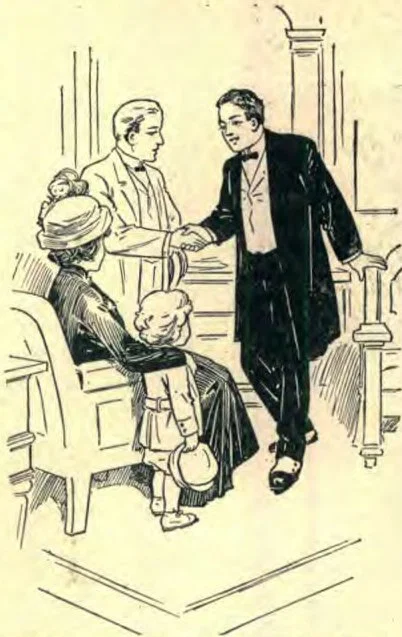
And again I stood up, took the man by the hand, and looking into his face, said to him, with a voice that would tremble with grateful emotion in spite of myself:—
“Wolverton, you’re a man again. You’ve found yourself anew. You’ve fought a good fight. You’ve kept the faith. You’ve filled the bond. I’m proud of you. And on this glad Christmas Eve, so fragrant with the memory of Him who died to atone for human sin, I’m going to make you a Christmas gift worth while. Here it is! Your unconditional pardon!—written in my own hand. Take it, Wolverton, take it, and go and sin no more.”
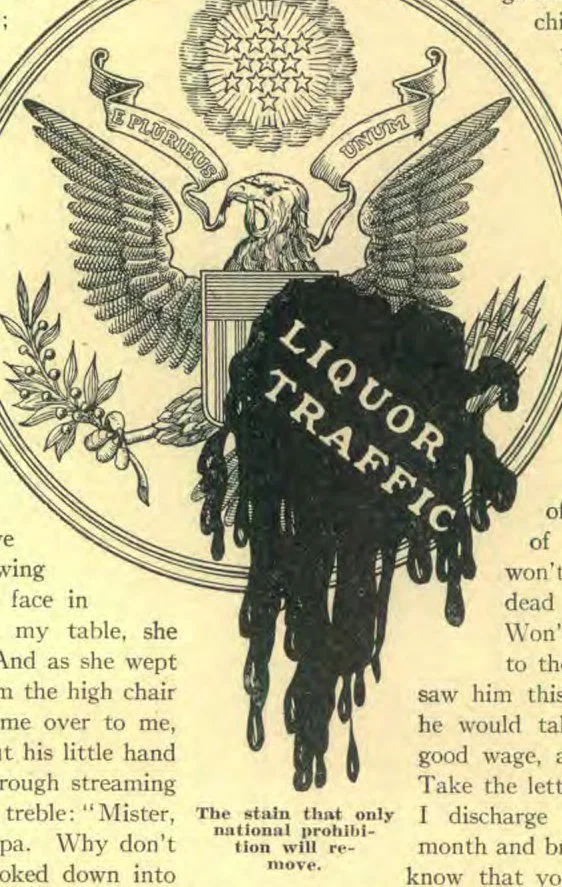
My friends, do you know what I was trying to do that Christmas Eve? I wonder if you do! Do you? I was trying as best I knew to undo the work of a licensed and legalized American saloon. I was trying to give back to abandoned wifehood a husband. I was trying to restore to disinherited childhood a father. I was trying to right the wrong the rum traffic had done an unborn baby. And, somehow, as I look back to it, through the years, it seems to me the blessedest work in which I was ever permitted to engage.
I sat there long that night, after this family had gone—alone with my soul and my God. And in the silence and solitude of the blessed Christmas evening, I was born again. I found a new and holier altar than I had ever known. I saw a new heaven and a new earth. I caught the vision of a saloonless land, a sober nation, a stainless flag, and found a cause big enough to put my life upon. And it is a great matter when a man finds a cause big enough to put his life upon.
I was governor of my State—a great commonwealth of three million people—at forty-one. My friends were kind enough to say that I might justly expect further political preferment, but that night I put my ambition on the great altar I had found. I knew the price. I paid it gladly. I went to my home with the promise welling up from the deeps of my soul to my Heavenly Father that if he would help me discharge to the end the duties of the great office I then held, when they were finished I’d go to the American people and tell them the inexpressible, infinite wrong the legalized liquor traffic of this nation is doing the childhood of my country. From then till now I’ve kept that pledge as best I could.
There is no American commonwealth into which I have not gone on this high mission; no great American city whose streets I have not walked, to whose people I have not appealed in this behalf. And that I might keep the vow I made that Christmas Eve, in a greater, bigger, more effective way than I otherwise could, I have called about me these consecrated men and women who constitute the Flying Squadron of America, and am leading them to and fro across the continent in this great nation-wide campaign. We seek to raise in this land a new banner,—one to which the wise and good of every party, sect, and creed may repair. The event is in the hands of God. As for me,—
“I ask not to see the distant scene; One step’s enough for me.”