MARY ELIZABETH was a little girl with a long name. She was poor, she was sick, she was ragged, she was dirty, she was cold, she was hungry, she was frightened. She had no home, she had no mother, she had no father, she had no sister, she had no grandmother, she had no kitten. She had no supper, she had no dinner, she had no breakfast. She had no shoes, she had no hood, she had no mittens, she had no flannels. She had no place to go to, and nobody to care whether she went or not. In fact, Mary Elizabeth had not much of anything but a short, pink calico dress, a little red cotton-and-wool shawl, and her long name. Besides these, she had a pair of old rubbers, too large for her. They flopped on the pavement as she walked.
She was walking up Washington Street in Boston. It was late in the afternoon of a bitter January day. Already the lamplighters were coming with their long poles, and gas-lights began to flash upon the grayness,—neither day nor night,—through which the child watched the people moving dimly, with a wonder in her heart. This wonder was as confused as the half light in which the crowd hurried by.
“God made so many people!” thought Mary Elizabeth. “He must have made as many suppers. Seems as if there ought to been one for one extra girl.”
But she thought this in a gentle way, very gentle for a girl who had no shoes, no flannels, no hood, no home, no mother, no dinner, no bed, no supper. She was a very gentle little girl. All girls who hadn’t anything were not like Mary Elizabeth. She roomed with a girl out toward Charlestown, who was different. That girl’s name was Jo. They slept in a box that an Irish woman let them have in an old shed. The shed was too cold for her cow, and she couldn’t use it, so she told Jo and Mary Elizabeth that they might have it as well as not. Mary Elizabeth thought her very kind. There was this difference between Jo and Mary Elizabeth: when Jo was hungry, she stole; when Mary Elizabeth was hungry, she begged.
One night, of which I speak, she begged hard. It is very wrong to beg, we all know. It is wrong to give to beggars, we all know, too; we have been told so a great many times. Still, if I had been as hungry as Mary Elizabeth, I presume I should have begged, too. Whether I should have given her anything if I had been on Washington Street that January night, how can I tell? At any rate, nobody did.
Some told her to go to the orphans’ home. Some said, “Ask the police.” Some people shook their heads, and more did nothing at all. One lady told her to go to the St. Priscilla and Aquila Society, and Mary Elizabeth said, “Thank you, ma’am,” politely. She had never heard of Aquila and Priscilla. She thought they must be policemen. Another lady bade her go to an office and be registered, and Mary Elizabeth said, “Ma’am?”
So now she was shuffling up Washington Street—I might say flopping up Washington Street—in the old rubbers and the pink dress and red shawl, not knowing exactly what to do next, peeping into people’s faces, timidly looking away from them, hesitating, heartsick,—for a very little girl can be very heartsick,—colder, she thought, every minute, and hungrier each hour than she was the hour before. Poor Mary Elizabeth!
Poor Mary Elizabeth left Washington Street at last, where everybody had homes and suppers without one extra one to spare for a little girl, and turned into a short, bright, showy street, where stood a great hotel. Everybody in Boston knows, and a great many people know, that hotel. In fact, they know it so well that I will not mention the name of it, because it was against the rule of the house for beggars to be admitted, and perhaps the proprietor would not like it if I told how this one especially little beggar got into his well-conducted house. Indeed, precisely how she got in, nobody knows. Whether the doorkeeper was away, or busy, or sick, or careless, or whether the head waiter at the dining room door was so tall that he couldn’t see so short a beggar, or whether the clerk at the desk was so noisy that he couldn’t see so still a beggar, or however it was, Mary Elizabeth did get in,—by the doorkeeper, past the head waiter, under the shadow of the clerk, over the smooth, slippery floor. The child crept on. She came to the office door, and stood still. She looked around her with wide eyes. She had never seen a place like that. Lights flashed over it, many and bright. Gentlemen sat in it, smoking and reading. They were all warm. Not one of them looked as if he had had no dinner and no breakfast and no supper.
“How many extra suppers,” thought the little girl, “it must have taken to feed ’em all!” She pronounced it “extry.” “How many extry suppers! I guess maybe there’ll be one for me in here.”
There was a little noise, a very little one, strange to the warm, bright, well-ordered room. It was not the rattling of the Boston Advertiser, or the Transcript, or the Post; it was not the slight rapping of a cigar stump, as the ashes fell from some one’s white hand; nobody coughed, nobody swore. It was a different sound. It was the sound of an old rubber, much too large, flopping on the marble floor. Several gentlemen glanced at their own well-shod and well-brushed feet, then up and around the room.
Mary Elizabeth stood in the middle of it, in her pink calico dress, and the red plaid shawl tied over her head and about her neck with a ragged tippet. She looked very funny and round behind, like the wooden woman in Noah’s ark. Her bare feet showed in the rubbers. She began to shuffle about the room, holding out one purple little hand.
One or two of the gentlemen laughed; some frowned; more did nothing at all; most did not notice, or did not seem to notice, the child. One said, “What is the matter here?”
Mary Elizabeth flopped on. She went from one to another less timidly; a kind of desperation had taken possession of her. The tempting odors of the dining room came in. Mary Elizabeth thought of Jo. It seemed to her she was so hungry that, if she could not get a supper, she should jump up and run, and rush about and snatch something, and steal like Jo. She held out her hand, but only said, “I’m hungry.”
A gentleman called her. He was the gentleman who had asked, “What is the matter here?” He called her in behind his New York Times, which was big enough to hide three like Mary Elizabeth; and, when he saw that nobody was looking, he gave her a five-cent piece in a hurry, as if he had done a sin, and quickly said, “There, there, child! go, now, go!” Then he began to read the Times quite hard and fast, and to look severe, as one does who never gives anything to beggars, as a matter of principle.
But nobody gave anything else to Mary Elizabeth. She shuffled from one to another hopelessly. Every gentleman shook his head. One called for a waiter to put her out. This frightened her, and she stood still.
Over by the window, in a lonely corner of the great room, a young man was sitting, apart from the others. Mary Elizabeth had seen that young man when she first came in, but he had not seen her. He had not seen her nor anybody. He sat with his elbows on the table, and his face buried in his arms. He was a well-dressed young man, with brown, curling hair. Mary Elizabeth wondered why he looked so miserable, and why he sat alone. She thought, perhaps, if he weren’t so happy as the other gentlemen, he would be more sorrowful for cold and hungry girls. She hesitated, and then flopped along and directly up to him. One or two gentlemen laid down their papers and watchedp. 23 this; they smiled and nodded to each other. The child did not see them, to wonder why. She went up and put her hand on the young man’s arm.
He started. His curly brown head lifted itself from the shelter of his arms; a young face looked sharply at the beggar girl,—a beautiful young face it might have been. It was haggard now, and dreadful to look at, bloated and badly marked with the unmistakable signs of a wicked week’s debauch.
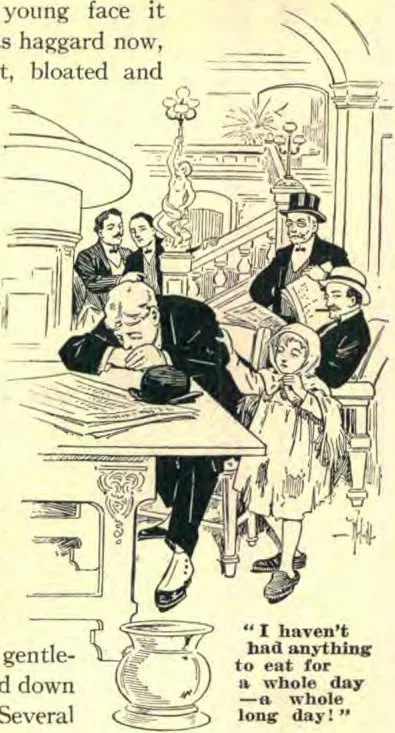
He roughly said,—“What do you want?” “I’m hungry,” said Mary Elizabeth. “I can’t help that. Go away.” “I haven’t had anything to eat for a whole day—a whole long day!” repeated the child. Her lips quivered, but she spoke distinctly. Her voice sounded through the room. One gentleman after another had laid down his paper or his pipe. Several were watching this little scene. “Go away!” repeated the young man, irritably. “Don’t bother me. I haven’t had anything to eat for three days!”
His face went down into his arms again. Mary Elizabeth stood staring at the brown, curling hair. She stood perfectly still for some moments. She evidently was greatly puzzled. She walked away a little distance, then stopped, and thought it over.
And now paper after paper, pipe after cigar, went down. Every gentleman in the room began to look on. The young man with the beautiful brown curls and the dissipated, disgraced, and hidden face, was not stiller than the rest. The little figure in the pink calico and the red shawl and big rubbers stood for a moment silent among them all. The waiter came to take her out, but the gentlemen motioned him away.
Mary Elizabeth turned her five-cent piece over and over slowly in her purple hand. Her hand shook. The tears came. The smell of the dining room grew savory and strong. The child put the piece of money to her lips as if she could have eaten it, then turned, and, without further hesitation, went back. She touched the young man—on the bright curls, this time—with her trembling little hand.
The room was so still now that what she said rang out to the corridor, where the waiters stood, with the clerk behind looking over the desk to see.
“I’m sorry you are so hungry. If you haven’t had anything for three days, you must be hungrier than me. I’ve got five cents. A gentleman gave it to me. I wish you would take it. I’ve only gone one day. You can get some supper with it, and—maybe—I—can get some somewheres. I wish you’d please take it.”
Mary Elizabeth stood quite still, holding out her five-cent piece. She did not understand the stir that went all over the bright room. She did not see that some of the gentlemen coughed and wiped their spectacles. She did not know why the brown curls before her came up with such a start, nor why the young man’s wasted face flushed red and hot with noble shame.
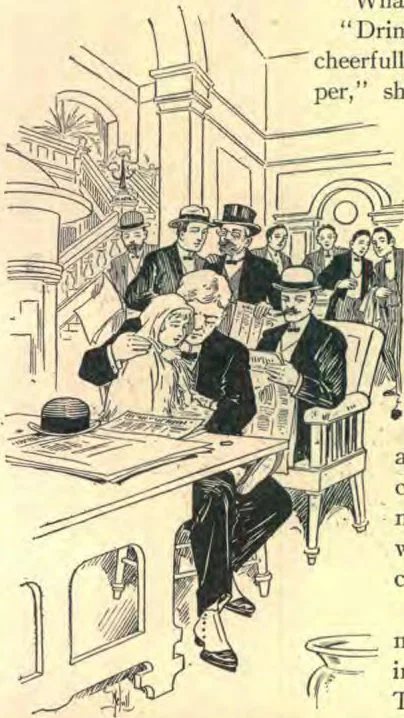
She did not in the least understand why he flung the five-cent piece on the table, and, snatching her in his arms, held her fast, and hid his face in her plaid shawl and sobbed. Nor did she know what could be the reason that nobody seemed amused to see this gentleman who had given her the money came up, and some more came up, and they gathered round, and she in the midst of them, and they all spoke kindly, and the young man with the bad face that might have been so beautiful stood up, still clinging to her, and said aloud:—“She’s shamed me before you all, and she’s shamed me to myself. I’ll learn a lesson from this beggar, so help me God.”
He then took the child upon his knee, and the gentlemen came up to listen, and the young man asked what was her name.
“Mary Elizabeth, sir.”
“Names used to mean things in the Bible, when I was as little as you. I read the Bible then. Does Mary Elizabeth mean Angel of Rebuke?”
“Sir?”
“Where do you live, Mary Elizabeth?”
“Nowhere, sir.”
“Where do you sleep?”
“In Mrs. O’Flynn’s shed, sir. It’s too cold for the cow. She’s so kind she lets us stay.”
“Whom do you stay with?”
“Nobody, only Jo.”
“Is Jo your brother?”
“No, sir. Jo is a girl. I haven’t got only Jo.”
“What does Jo do for a living?”
“She—gets it, sir.”
“And what do you do?”
“I beg. It’s better than to—get it, sir, I think.”
“Where’s your mother?”
“Dead.”
“What did she die of?”
“Drink, sir,” said Mary Elizabeth, in her distinct and gentle tone.
“Ah—well. And your father?”
“He is dead. He died in prison.”
“What sent him to prison?”
“Drink, sir.”
“Oh!”
“I had a brother once,” continued Mary Elizabeth, who grew quite eloquent with so large and attentive an audience, “but he died, too.”
“What did he die of?” “Drink, sir,” said the child, cheerfully. “I do want my supper,” she added, after a pause, speaking into a whisper, as if to Jo or to herself; “and Jo’ll be wondering for me.”
“Wait, then,” said the young man: “I’ll see if I can’t beg you enough to get your supper.”
“I thought there must be an extry one among so many folks!” cried Mary Elizabeth; for now she thought she would get back her five cents.
Sure enough: the young man put the five cents into his hat, to begin with. Then he took out his purse, and put in something that made less noise than the five-cent piece; and something more, and more, and more. Then he passed around the great room, walking still unsteadily; and the gentleman who gave the five cents, and all the gentlemen, put something into the young man’s hat. So, when he came back to the table, he emptied the hatp. 24 and counted the money; and, truly, it was forty dollars.
“Forty dollars!”
Mary Elizabeth looked frightened. She did not understand.
“It’s yours,” said the young man. “Now come to supper. But see! this gentleman who gave you the five-cent piece will take care of the money for you. You can trust him. He’s got a wife, too. But we’ll come to supper, now.”
“Yes, yes,” said the gentleman, coming up. “She knows all about every orphan in this city, I believe. She’ll know what ought to be done with you. She’ll take care of you.” “But Jo will wonder,” said Mary Elizabeth, loyally. “I can’t leave Jo. And I must go back and thank Mrs. O’Flynn for the shed.” “Oh, yes, yes; we’ll fix all that,” said the gentleman, “and Jo, too. A little girl with $40 needn’t sleep in a woodshed. But don’t you want your supper?”
“Why, yes,” said Mary Elizabeth, “I do.”
So the young man took her by the hand, and the gentleman whose wife knew all about what to do with orphans took her by the hand; and they all went out into the dining room, and put Mary Elizabeth in a chair at a marble table, and asked her what she wanted for her supper.
Mary Elizabeth said that a little dry toast and a cup of milk would do. So all the gentlemen laughed, and she wondered why.
And the young man with the brown curls laughed, too, and began to look quite happy. But he ordered chicken and cranberry sauce, mashed potato, celery, rolls and butter, tomatoes, ice cream, nuts and raisins, cake and custard, and apples and grapes. And Mary Elizabeth sat in her pink dress and red shawl, and ate the whole; and why it didn’t kill her nobody knows, but it didn’t.
The young man with the face that might have been beautiful—that might yet be, one would have thought who had seen him then—stood watching the little girl.
“She’s preached me a better sermon,” he said, below his breath, “better than all the ministers I ever heard in all churches. May God bless her! I wish there were a thousand like her in this selfish world!”
And when I heard about it, I wished so, too.
And this is the end of Mary Elizabeth’s true temperance story.—Elizabeth Stuart Phelps, in St. Nicholas, and published in pamphlet form by the Unitarian Temperance Society, Boston.