E. R. NUMBERS
Years ago in an Ohio town there lived a bright, energetic young man with pleasing manners and an attractive personality, whom we shall call Charles.
He was the pride of his mother, and a general favorite in the great store where he was employed, and the country folk for miles around would call for him when they came to attend to their shopping at the end of the week. His employers placed every confidence in him, and few young men have had brighter prospects than did Charles. But the cigarette habit early began to fasten itself upon him.
This habit, once begun, grew upon him rapidly. In a short time he seemed to be completely under the control of the deceptive narcotic, and a great change came over him. Finally, becoming restless and dissatisfied, he gave up his position and went to driving a hack, where he was thrown among companions who were only too ready to aid him in his downward course.
In time he left his old home town, and for years I lost all trace of him. However, one day in a great city we met on the street car; and what a sight! He was not at all the Charles I had known in our boyhood days. At that time he was an example of neatness, and diligence in business; now he was slovenly in appearance, careless in manner, profane in speech, and the inevitable cigarette was ever between his lips. In his dealings he was shiftless and unreliable, and was constantly harassed by his many creditors in their vain attempts to collect honest bills.
This complete change in one upon whom I had once looked with admiration deeply impressed me with the baneful effects of the cigarette; but the worst was yet to come.
We were again separated for years, and I heard nothing of him. Eventually I returned to the old home town, and I learned that Charles also had returned. I longed to do something to win him to the right, so I appointed a day to visit him. I found the home, if such it might be called, in one of the poorest sections of the town. His wife met me at the door. She wore a look of sadness and despair such as I had seldom seen. As I listened to her heart-rending story, I learned that the cigarette had led to drink and to all the miseries of a drunkard's home. His old friends and acquaintances had forsaken him, and he could not secure steady employment. If he obtained work for a few days, it was only to spend on drink what he had earned. His wife pleaded with me to do what I could to help him, for she could not endure the burden of living with him longer if he did not reform. His onlyp. 7 child, a girl of eleven years, came in during the visit. Neglect was evident, as might be expected with a drunkard for a father. Charles was not at home, but I found him loafing at the corner hotel, where such characters congregate. I returned to my home, and my heart was heavy as my thoughts ran back to brighter days, and then over the downward steps which had culminated in what I had just witnessed.
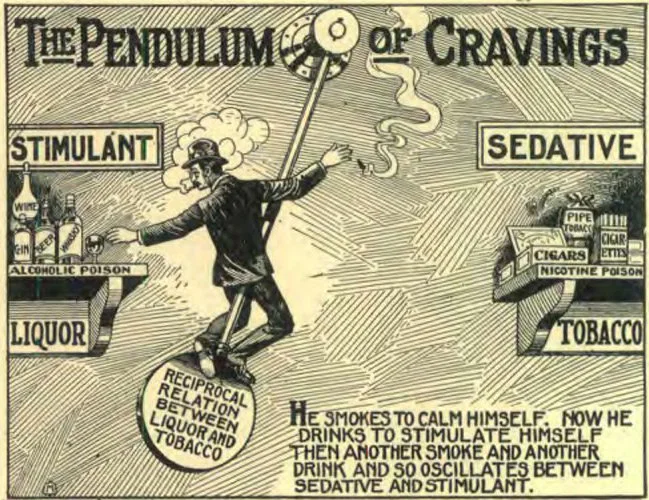
Boys, this is a true story, and it is not an isolated or exaggerated case. Evidences of blasted hopes and ruined prospects are on every hand. Therefore I hope that any boy or young man who reads this life sketch, if he is ever tempted to take his first smoke, will give no place to the “little white slaver,” lest his life be a repetition of the sad story of Charles.