An Island Visit

9%

Review and Herald Publishing Assn. · Takoma Park Station, Washington, D. C. · Oct 9, 1917

FromThe Youth’s Instructor, Vol. 65, No. 41.

Read the full edition

An Island Visit

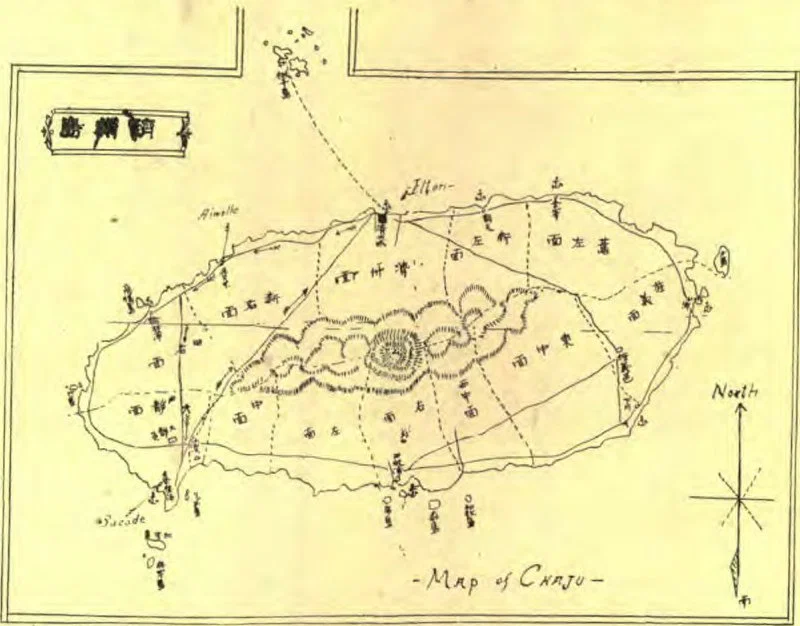
MORE than one hundred miles to the south of the mainland of Korea, in the Yellow Sea, lies Chaju (Quelpart on American charts), the mysterious; an island of volcanic origin about twenty-five miles wide by fifty-five miles long, with a regular unbroken coast line. The central figure of the island is the great extinct volcano rising several thousand feet above the level of the sea. Its top is usually lost in the clouds and its crater is filled with water.
The great stone slabs set up along the highways and bypaths in memory of the illustrious dead, with evidences of great highways that have fallen into disuse and the great walls around the cities, proclaim an ancient civilization much superior to that of today, a civilization which no doubt was at its height when Rome was but an infant.
The reclamation of the island from its original waste was an undertaking so gigantic as to make it one of the wonders of a wonderful East. It is evident that when the first settlers arrived here the ground was completely covered with bowlders of lava formation weighing from pounds to tons, because today every lot, the majority of them no larger than one fourth of a city block, is surrounded with a cobblestone wall. Some of these walls are six feet thick and eight feet high, so constructed as to make use of the rocks from the ground. Aside from the walls great monuments of stones are thrown up over the lots. One may walk from one end of the island to the other, and be between stone walls all the way. However, the island possesses some redeeming features. Among these are its many springs of water rivaling the ice-cold ones of the Rocky Mountains. We saw several of these pouring a volume of water the size of a man's body out of the solid rock. Aside from frequent high winds the island also has a desirable climate, the north side receiving an abundance of sunshine and the south side much rain. The mountains furnish an endless supply of wood and lumber, the waters of the sea supply fish, while the long summers insure two crops of cereals annually.
The ancient capital, Iltori, was at one time a walled city, and part of the wall even today is in a comparatively good state of preservation. The two arches where this wall spanned the little creek that flows through the city are still there, one of them being used as a bridge. The old south gate is also preserved. We passed out through it over a street paved with lava rock. As we passed through the gate we came upon groups of images by the street side, sitting as solemnly on their pedestals as when they were placed there in the dark ages of the past, as the gods of the island. When almost a mile from the city, we came to a circular stone wall inclosing perhaps five acres of ground. Within this outer inclosure was a smaller square one. Both of these are too sacred for the plow, the inner one bearing only grass, while the outer one is almost filled with large pine trees, making a splendid park. In the center of the inner inclosure is a hole in the ground about ten feet deep by twenty in diameter, with three smaller holes in the bottom of it. In front of this hole is a square platform of cut rock with a huge rock slab resting upon it, declaring in Chinese characters that from these three holes issued the first parents of the human race who went forth from here and peopled the world. This tradition is credited by most of the people today, they believing that their little island is the first of nations and the mother of the world.
In walking from Sacade on the southern coast of Chaju to Iltori on the north, one must cross the lower levels of the mountains. After journeying for several miles in a six-foot lane with a stone wall on either side, one comes to an old highway with a twelve-foot bed and a twenty-foot lane. In past ages much effort and work were spent upon this road in the way of cuts and fills to make it suitable for carts or wagons. Doubtless this road was once used extensively by the populace, the resources and the products of the island being distributed over it. But today I hardly think there is a wheeled vehicle on the island. As one mounts higher and higher up the side of the mountain, one comes to a place beyond the bounds of reclamation. For a time the rock wall is on only one side, while the upper side is a wilderness, and finally the wall disappears altogether. These higher levels are almost free from the bowlders that characterize the lowlands. There are thousands of acres of natural meadow but waiting as it would seem, for the farmer's plow. We asked the natives why this land lay thus unused, and they replied: “Snow falls up there, and the wind blows too hard.” However, we believe that it is simply a case of following the paths of the fathers. The lanes in the higher districts are the most beautiful, being slightly traveled. The grass grows within them and the walls are so covered with shrubbery that they look like hedges of living green spread with beautiful wild flowers.
This little island for ages maintained an independent kingdom, but was annexed by conquest to Korea about eight hundred years ago. During the years of Korean ownership it has been used extensively as a place of banishment for offenders of the state.
We found the customs of the people much different from those of the mainland, while the people themselves are a larger and stronger race. There are about three women on the island to every man, and as it is unlawful for a woman to go through life unmarried, it means that almost every man has from two to five wives. Very few of the men work, as the women are the burden bearers. Many of them gain a livelihood by diving into the ocean for shellfish and seaweed. On good days they go out by hundreds from the shore, taking with them meshed bags made of twine, with the open end secured to a stick bent in a circle, in which to carry their catch. These are tied to large gourds which keep them floating. The gourds also serve as supports to the divers when resting on the surface of the water. The women frequently remain in the water for half a day at a time, being as fearless and as much at home in the sea as the fabled mermaids.
We have found Chaju one of the hardest places in the Korean field for our work; yet a slight foothold has been gained. We have two native workers, with a baptized membership aside from them of eleven: also several others are keeping the Sabbath, and a score of interested ones are studying the truth. Brother Smith and I spent five days on the island, visiting and baptizing believers. While the gods of stone by the roadside were responsible for the decay in the civilization of the island, we are confident that the Lord has a people on Chaju who will welcome him with rejoicing at his appearing.
E. J. URQUHART.