(February 23)
LESSON SCRIPTURE: Gen. 12: 1-10; 13.
MEMORY VERSE: “I will make of thee a great nation, and I will bless thee, and make thy name great; and thou shalt be a blessing.” Gen. 12: 2.
STUDY HELPS: “Patriarchs and Prophets,” pp. 125-133; “Bible Lessons,” McKibbin, Book One, pp. 69-72.
“I know not the way I am going, But well do I know my Guide.”
Questions
1. Who was Abram’s father? From what place did they remove? To what place did they go? Who are named as members of the company? Gen. 11: 31.
2. What command had the Lord given to Abram? What promise was made to him? Gen. 12: 1-3. Note 1.
3. After his father’s death in Haran, what did Abram do? How old was he at this time? Whom did he take with him? Verses 4, 5. Note 2.
4. As he journeyed, who appeared unto Abram? What did the Lord say? What did Abram build? Verses 6, 7.
5. Where did he again build an altar? Verse 8.
6. What caused Abram to leave the land of Canaan for a time? Verse 10.
7. Who went with Abram when he returned to Egypt? To what part of Canaan did he go? What is said of Abram’s wealth? Gen. 13: 1-4.
8. What is said of Lot’s possessions? Why could not he and Abram live together? Verses 5-7.
9. What did Abram say to Lot concerning the trouble? What plan did he propose? Verses 8, 9. Note 3.
10. What portion of land did Lot choose? What did he consider in making his choice? What did he not consider? Verses 10-13. Note 4.
11. What lessons should we learn from the experience of Lot? Note 5.
12. What did the Lord say to Abram after Lot was separated from him? Verses 14-17.
13. To what place did Abram then move his tent? What did he build there? Verse 18.
Things to Do
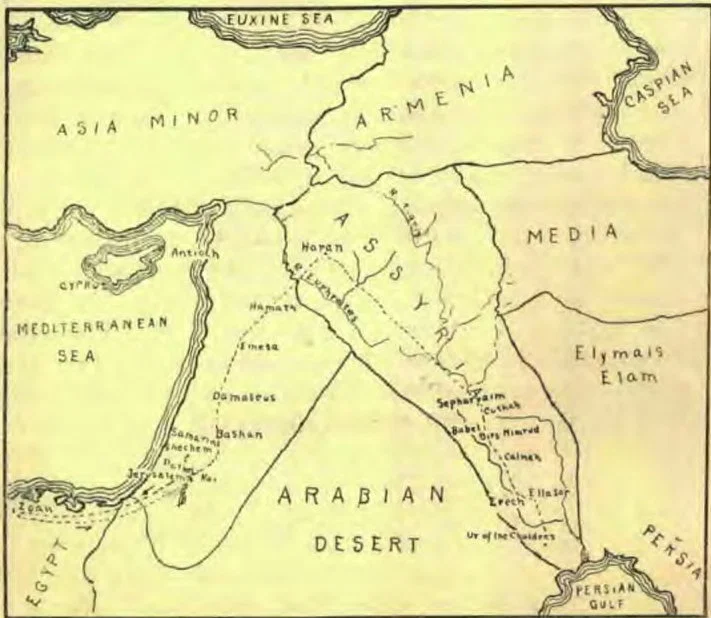
Locate on the map all places mentioned in this lesson. Trace Abram’s journey from Ur to Bethel.
Notes
1. It is written of Abram’s father, Terah, that he “served other gods” (Joshua 24: 2), and Abram, dwelling at Ur of the Chaldees, had grown up in the midst of heathenism. Abram, however, remained faithful to God and steadfastly worshiped him. But the influence of kindred and friends would interfere with the work which the Lord had set apart Abram to do, so he was called to separate himself from the associations of early life to go to a land—he knew not where.
2. Dean Stanley, a writer of ancient customs, gives this picture of the scene: “All the substance that they had gotten is heaped high on the backs of kneeling camels. The slaves that they bought in Haran run along by their sides. Round them are the flocks of sheep and goats, and the asses, moving beneath the towering forms of camels. The chief is there, amid the stir of movement, or resting at noon within his black tent, marked out from the rest by his cloak of brilliant scarlet. . . . The chief’s wife, the princess of the tribe, is there in her own tent, to make the cakes, and prepare the usual meal of milk and butter; the slave or the child is ready to bring in the red lentil soup for the weary hunter, or to kill the calf for the unexpected guest.”
3. Abram and Lot were both rich. Their possessions now brought them into trouble. Though Abram should by every right have had first choice of the land, yet he waived the rights which God himself had given (Gen. 12: 7), and courteously offered first choice to his nephew. Lot willingly accepted the favor, although he owed all his prosperity to his connection with Abram.
4. At first Lot pitched his tent “toward Sodom;” later he moved into a house in the city. “The dwellers in Sodom were corrupt; vile conversation greeted his ears daily, and his righteous soul was vexed by the violence and crime he was powerless to prevent. His children were becoming like these wicked people; for association with them had perverted their morals. Taking all these things into consideration, the worldly riches he had gained seemed small and not worth the price he had paid for them. His family connections were extensive, his children having married among the Sodomites.”—“Testimonies for the Church,” Vol. IV, p. 110.
5. “PITCHING ONE’S TENT TOWARD SODOM.—(1) Any wrong or selfish act, unforsaken, will naturally draw us toward evil. (2) There are great outward attractions to many sins. They are like Oriental cities, shining with marble and gold in the distance, but within they are full of all manner of vileness. (3) The approach to great sins is gradual. The innocent never rush into them at once, but are gradually drawn on; their repulsion is overcome little by little. ‘They first endure, then pity, then embrace.’ (4) He who keeps bad company pitches his tent toward Sodom. (5) He who indulges in doubtful pleasures pitches his tent toward Sodom. (6) He who pitches his tent toward Sodom will probably soon find himself in the city. (7) The only safe way is to keep as far from sin and as near to God as possible.”—Peloubet, 1913, p. 82.