The Relief of Leyden

4%

Review and Herald Publishing Assn. · Takoma Park Station, Washington, D. C. · Jan 8, 1918

FromThe Youth’s Instructor, Vol. 66, No. 2.

Read the full edition

The Relief of Leyden

Holland is such a tiny country, tucked away in the corner of northwestern Europe, that it does not seem very important. No one would ever guess what thrilling chapters of history have been written in this little triangle of delta land bounded by Germany, Belgium, and the sea. But time was when the eyes of all Europe were turned to the Netherlands; when the sturdy, thrifty, resolute Dutch proved the despair of queens and kings and emperors.
Holland is a land reclaimed from the sea. Dikes hold back the tides from the lowlands and keep the fertile fields, as well as farm homes, villages, and cities, in comparative security. For centuries these people have waged a constant war against their one relentless enemy—the ocean.
In time our story goes back about three hundred years. The Netherlands were under the rule of Catholic Spain, and the Inquisition was in power. Persecution and broken promises of political as well as religious freedom, finally aroused the Hollanders, who were stanch Protestants, to action, and the Dutch Republic was born, Prince William of Orange, sometimes called William the Silent, being chosen as leader. The struggle with Spain which followed centers about the siege of Leyden.
This was perhaps the most beautiful city in Holland. “On every side were broad green fields, reclaimed by tireless industry from the very sea itself, smiling villages, gay gardens, and fruitful orchards. The city was interlaced with many small streams, and these watery streets were shaded by lime trees, poplars, and willows, and crossed by one hundred forty-five bridges of hammered stone.” There were comfortable homes and substantial public buildings, and in the center of the city rose the Tower of Hengist, an ancient ruin which afforded an excellent view of the surrounding country.
The besieging army, under the Spanish commander Valdez, and numbering about eight thousand men, closed Leyden on May 26, 1574. Inside there was no defending army—only a small corps of “freebooters” and five companies of burgher guard. The main reliance of the city for its defense “was the stout hearts of the inhabitants within the walls, and the sleepless energy of William the Silent without.” The prince encouraged them to remember that not only their own fate, but the future of their country, depended upon their bravery, and the people vowed, “As long as there is a living man left we will contend for our liberty and our religion.”
Early in the siege an account was taken of all foodstuffs, and every one in the city placed on a strict allowance. Half a pound of meat and half a pound of bread were allotted to a full-grown man, and the rest a due proportion. The only communication they had with their friends outside was by the use of carrier pigeons.
The Prince of Orange, in spite of the efforts of the Spaniards, held the important cities of Delft and Rotterdam, and the keys to the relief of the suffering city, for while Leyden was not on the sea, he could send the sea to Leyden by breaking the dikes along the Meuse and Yssel and opening the great sluices at Rotterdam, Schiedam, and Delfshaven. This he determined to do. He realized that “the damage to the fields, villages, and growing crops would be great, but he felt that no other course could rescue Leyden, and with it the whole of Holland, from destruction” at the hand of covetous Spain. His loyal people rallied to his aid with the cry, “Better a drowned land than a lost land,” and on the third of August, 1574, the dikes were broken and the sluice gates opened.
Meanwhile the people inside the city had become very much discouraged, for their bread was gone and other provisions were low indeed. When word came from the prince that the water was rising upon the “Landscheiding,” the great outer barrier which separated the city from the sea, the burgomaster ordered the bands to play, and the starving city celebrated a holiday, much to the astonishment of the Spaniards outside.
Soon the besieging army found itself in turn besieged, and by a power stronger than man’s. It was no trifling danger which threatened them—“to be attacked by the waves of the ocean which seemed about to obey with docility the command of William the Silent.”
The incoming waters spread slowly over the wide fields, and the Spanish forces were obliged to retreat inward, but day after day the starving people of Leyden climbed to the Tower of Hengist, “with heavy heart, and anxious eye, watching, hoping, praying, fearing, and at last almost despairing of relief by God or man.” It is hard to trust when one is hungry. Just at this time came assurance from their brethren outside: “Rather will we see our whole land and all our possessions perish in the waves than forsake thee, Leyden.”
The prince was ill in Rotterdam, but from his sick bed he directed the assembling of a relief fleet under Admiral Boisot, and by the first of September, three months after the siege began, more than two hundred ships were slowly advancing over the broken dikes. These were manned by twenty-five hundred veteran soldiers and sailors, experienced on land as well as water. The distance from Leyden to the outer dike was fifteen miles, and the relief vessels made their way easily enough to a strong dike within five miles of the city. The approach was surrounded by sixty-two strong forts, one within the other, and it was necessary to break through this series of defenses, held by Valdez, with a force four times as strong as that coming to the rescue.
The prince gave orders that the large dike, still one and one-half feet above water, should be taken at any cost. By mere chance it was left weakly guarded, and on the night of September 10, the patriots fortified themselves there without the loss of a man. When morning came, the astonished Spaniards rushed out to recover what they had lost, but were completely defeated, and the work of breaking the dike was done under their very eyes.
Another long dike three fourths of a mile nearer Leyden next stopped the rescue fleet. General Boisot seized it before the enemy realized its importance, leveled it in many places, and brought his ships in triumph over the ruins. Now he found that entrance to a large mere, called Freshwater Lake, into which he expected immediately to have floated, could be had only by passage through one deep canal. “The sea which had thus far borne him on, now diffusing itself over a wide surface, and under contrary winds, had become too shallow for his ships. The canal alone was deep enough to afford passage, but it led directly to a bridge strongly occupied by the Spaniards.” With a few of his strongest ships and bravest soldiers, Admiral Boisot attempted to open the way, but met with defeat.
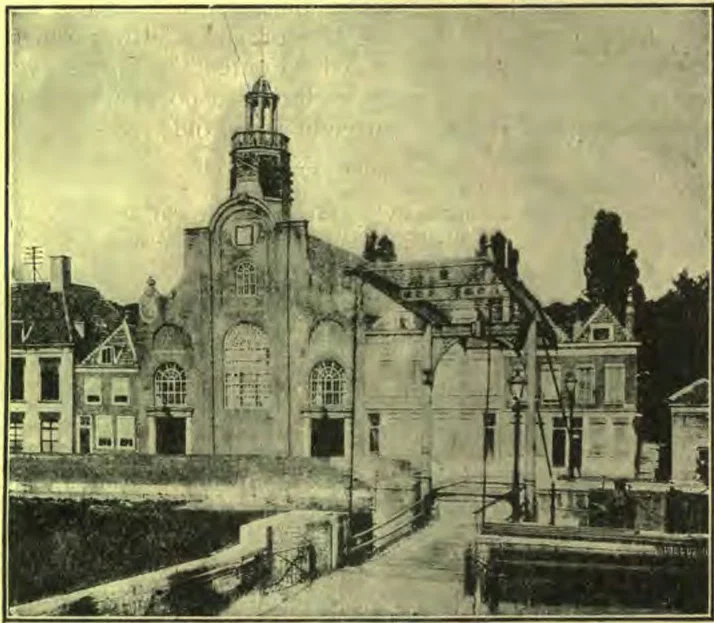
CHURCH AT DELFSHAVEN, HOLLAND
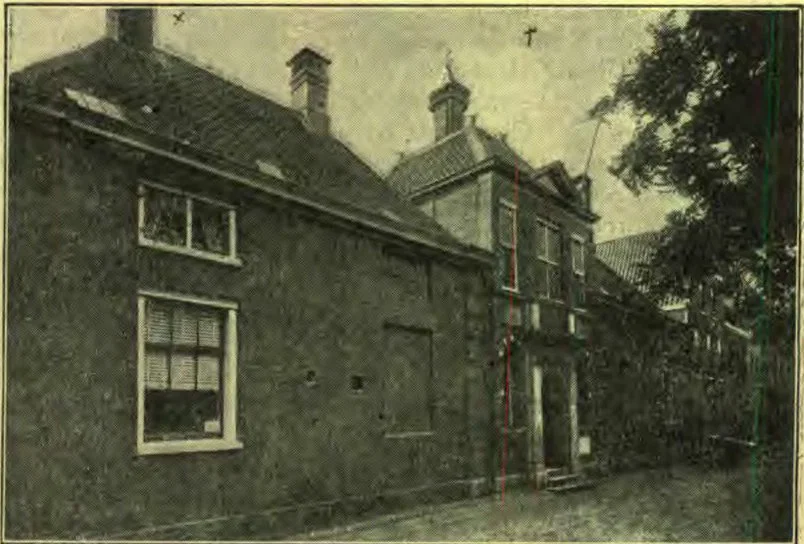
THE JOHN ROBINSON HOME AT LEYDEN
A week passed, and still the relief ships lay motionless in the shallow water. But on September 18 the wind shifted, and the following day the vessels were again afloat. A fugitive from one of the villages guided the ships over a low dike, and the terrified Spaniards fled toward Leyden. Brave as they were on land, they lost their courage in the presence of the sea. Reaching Zottermeer, the rescuers, after a short delay to allow the escape of the villagers, set this fortress as well as Benthuyzen, on fire and abandoned it. The blaze, seen from Leyden, was hailed as a beacon of hope.
But the relief ships were now delayed at north Aa by another barrier called the “Kirk-way,” and again contrary winds left them stranded in shallow water. The Prince of Orange arose from a sick bed and came to look over the situation. He at once gave orders for the destruction of the “Kirk-way,” the last important barrier between the fleet and Leyden. Meanwhile the besieged city was almost at its last gasp. “Bread, malt cake, and horseflesh had entirely disappeared; dogs, cats, rats and other vermin, were regarded as luxuries. A few cows remained, kept as long as possible for their milk, but a few were killed each day and distributed in small portions, hardly enough to keep the famishing people alive. Green leaves were stripped from the trees and eaten, and still many died. Mothers dropped dead in the streets, with their dead children in their arms, and in many a house the watchmen in their rounds found a whole family of corpses, for pestilence stalked at noonday in the streets.
Some, faint-hearted at delayed relief, favored surrender, but the heroic burgomaster, surrounded by a clamoring crowd, waved his hat for silence and cried: “Here is my sword. Plunge it into my breast, and divide my flesh among you. Take my body to appease your hunger, but expect no surrender as long as I remain alive.” Thus heartened by their magistrate, they renewed their vows of fidelity. “Ye are rat eaters and dog eaters,” shouted the Spaniards. “It is true,” replied the heroic citizens, “but so long as ye hear a dog bark or a cat mew within the walls ye may know that the city holds out.” “As well,” derided the Spaniards, “can the Prince of Orange pluck the stars from the sky as bring the ocean to the walls of Leyden for your relief.” But boasting is vain.
On the twenty-eighth of September the equinoctial winds came on, and in twenty-four hours the waves were breaking with unrestrained power over the ruined land. At midnight the fleet sailed across the “Kirk-way” in the storm and darkness. A fierce naval battle followed, resulting in victory for Admiral Boisot.
Two strong forts still stood, but hardly was the fleet in sight of the first when the panic-stricken Spaniards fled along the narrow path that was rapidly vanishing in the waves, toward their last refuge, Lammen, about two hundred fifty yards from Leyden.
“This obstacle rose formidable and frowning, directly across the path of the rescuers. Swarming as it was with soldiers, and bristling with artillery, it seemed to defy the armada either to carry it by storm or to pass under its guns into the city.” Admiral Boisot was discouraged, for it appeared to him that the relief plan must after all fail in sight of success. He “anchored his fleet within a respectful distance,” and spent what remained of the day in carefully laying his plans. At last he announced his intention of carrying the fort, if possible, on the following morning, but if obliged to retreat, he observed with something like despair, that there would be nothing for it but to wait for another gale of wind.”
Meanwhile Leyden was wild with expectation. A dove had brought a message informing them of the exact location of the fleet. “Yonder,” cried the burgomaster, “yonder behind that fort are bread and meat, and brethren in thousands. Shall all this be destroyed by the Spanish guns, or shall we rush to the rescue of our friends?” They resolved to attack their enemies in conjunction with the fleet at daybreak.
“Night descended upon the scene, a pitch-dark night, full of anxiety to the Spaniards, to the relief fleet, to Leyden. Strange sights and sounds occurred at different moments to bewilder the anxious sentinels. A long procession of lights issuing from the fort was seen to flit across the black face of the waters, in the dead of night, and the whole of the city wall, between the Cow-gate and the Tower of Bergundy, fell with a loud crash. The horror-stricken citizens thought that the Spaniards were upon them at last; the Spaniards imagined the noise to indicate a desperate attack.”
“Day dawned at length, ending a feverish night, and the admiral prepared for the attack. Within the fortress reigned a deathlike stillness. . . . Suddenly a man was seen wading breast-high through the water from Lammen toward the fleet, while at the same time one solitary boy was seen to wave his cap from the summit of the fort. After a moment of doubt the happy mystery was solved. The Spaniards had fled panic-stricken during the darkness. Their position would still have enabled them to frustrate the enterprise of the patriots, but the hand of God, which had sent the ocean and the tempest to the deliverance of Leyden, had struck her enemies with terror likewise. The lights which had been seen moving during the night were the lanterns of the retreating Spaniards, and the boy who was now waving his triumphant signal from the battlements had alone witnessed the spectacle. So confident was he in the conclusion to which it had led him that he had volunteered at daybreak to go thither all alone. . . . All obstacles being now removed, the fleet of Boisot swept by Lammen and entered the city on the morning of the third of October. Leyden was relieved.”
“The starving and heroic city, which had been so firm in its resistance to an earthly king, now bent itself in humble gratitude before the King of kings. After prayers the whole vast congregation joined in the thanksgiving hymn. Thousands of voices raised the song, but few were able to carry it to its conclusion. The hymn was abruptly suspended, while the multitude wept like children.” Lora Clement.