It was in Northumbria, at the beginning of the seventh century, that the first portions of the Bible were rendered in the Anglo-Saxon tongue, by an ignorant farmer named Cædmon. This man had a genius for translating into verse, in the form of a paraphrase, the stories of the Old Testament, which the monks read from the Latin Vulgate. His work is among the early beginnings of English literature. Another writer of this same time was Aldhelm, later bishop of Sherborne, who translated the Psalms and helped to put the Gospels into Anglo-Saxon.
These were the earliest parts of the Bible in English. But the best-known work of this period was the translation of the Gospel of John by the venerable scholar Bede, who died in 735. There is a beautiful story told of how he finished this work on his deathbed, because, as he said, “I do not want my boys [his monks] to read a lie, or to work to no purpose after I am gone.”
On the morning of his last day there was only one chapter left untranslated. He was very near death, when his faithful scribe said, “Dear master, there is one chapter yet to do.” “Take thy pen and write quickly,” said Bede. All day he wrote, being interrupted many times to say farewell to the friends who came in. Just as night was coming on, his scribe leaned over and whispered, “Master, there is just one sentence more.” And he said, “Write quickly.” The monk wrote on, and then said, “See, dear master, it is done now.” “Yes, you speak truly; it is finished now.” Then they laid him on the pavement of his cell, at his request, and he died praising God, whom he had so faithfully served. His translation was destroyed some years later when the Danes devastated the towns of Northumbria.
Besides these early translations, Alfred the Great is known to have had the Psalms and parts of the Old Testament put into Anglo-Saxon, and distributed in his kingdom. After this we have to skip to the beginning of the thirteenth century, when a monk by the name of Orm made a metrical version of parts of the Gospels, and the Acts, for use in church services. This is known as the “Ormulum.” It was not a translation, but a paraphrase, with explanatory notes. These early attempts are but steps toward the light that was to break forth in the fourteenth century under John Wycliffe.
Wycliffe was a great scholar and a teacher at Oxford. He was a reformer who spoke out boldly against the abuses and corruptions of the clergy of his time. He laid great stress on the Scriptures as the basis of religious life, and he saw that the English people needed to have the Bible in their own tongue. He was nearly fifty years old when he began his work of translating the Bible from Latin into language which the simplest English peasant might understand. As rector of Lutterworth, a center of learning, he had all the help he needed, and his influence with the upper classes was a protection against his enemies who wished to stop the work. As soon as it was completed, he organized a band of lay preachers, called Lollards, who went about the country preaching and distributing the Scriptures. They became so numerous that it was reported that of every two men one was a Lollard.
Two years after he had completed his work, Wycliffe died from a stroke of paralysis caused by continuous study and heavy work. His Bibles were sold for about one hundred and fifty dollars, and Foxe reports that at that time it was common for a load of hay to be given for the loan of a New Testament for one day.
But in 1414 a law was passed saying that “all persons found reading the Scriptures in their mother tongue should forfeit land, cattle, life, and goods from their heirs forever.” The Book continued to hold its place, however, until the next century, when Tyndale’s version appeared.
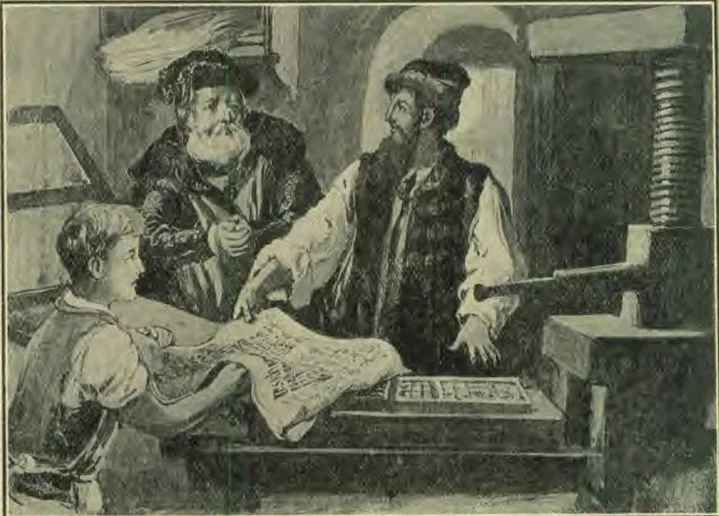
Tyndale lived in an age of enlightenment, when the shackles of the Dark Ages were swept aside, and men began to think and act for themselves. The first complete Bible was printed by Gutenberg, from movable types, in 1455.
William Tyndale was born in 1484, and became, as Foxe says, “singularly addicted to the study of the Scriptures.” He was a Greek and Hebrew scholar, and was well fitted to translate the Bible from the original tongues. While in college, he got into an argument with a churchman, to whom he said, “If God spare my life, I will, ere many years, cause a boy that driveth the plow to know more of the Scriptures than thou dost.” This he started to do, but found his way hedged with difficulties. After a long search for funds, and a place free from monks and politicians, he located at Cologne, where he got his New Testament printed.
The first edition of three thousand copies was just off the press when his enemies came, and he was barely able to escape by boat up the Rhine, with his printed sheets. At Worms he found a friend and printer in Cochleus, who helped him to get out two editions of three thousand copies, and ship them to England concealed in packages of merchandise. The people of England were very eager to get the Testaments at almost any price. A rush was made for them by both bishops and people, the bishops that they might burn them, and the people that they might read. Whole editions were bought up by the bishops and burned. Of eighteen thousand copies printed we have only a fragment of thirty-six pages in existence today.
Tyndale had to move from place to place to keep out of the hands of his enemies. He dared not return to England, and finally he was caught and burned at the stake, his last words being, “Lord, open the king of England’s eyes.” His prayer was answered, and his work forms the basis of the Authorized Version as we have it today.p. 9
Although King Henry VIII had opposed the work of Tyndale, he realized that the demands of the English people for the Bible could not be silenced. Before Tyndale’s death, he appointed Miles Coverdale to make a translation based on the German and Latin. Coverdale was not a scholar like Tyndale, but he was a quiet, shrewd editor, who had the favor of the king, and was thus able to get all the help he needed from other scholars. His was the first complete Bible in English. It was called the Great Bible, and was gladly received, being “sent forth with the king’s most gracious license.”
England now had the open Bible, only twelve years after Tyndale’s Testaments were publicly burned. This version held its place until the time of Queen Mary, when many Protestants had to flee to Geneva. While there, a scholar named William Whittingham, with others, began a version of the whole Bible. This was completed in 1560. Eight years later there was given to the world the so-called Bishops’ Bible, since not less than eight of these dignitaries took part in the revision. This translation was designed to be an improvement over the Great Bible, “and in this way to challenge the ever-growing popularity of the Calvinistic Genevan Bible.”
Bible study was further stimulated when James the First came to the throne in 1603. He had a natural liking for its study, and soon appointed fifty-four learned men to work on a translation that would suit the needs of all his people, and would be the best rendering in English of the original. This was the Authorized Version, sometimes called the King James Version, which was completed in 1611. The translators worked in groups at different places, on the different books of the Bible, and whenever a book was completed it was sent to each of the other groups for suggestions and revisions. There were Anglicans, Puritans, and laymen among those chosen, and they were permitted to call in outside help when it was thought desirable. The work was so arranged that each man read and passed on the work of every other man in the company. The result was that this translation has stood the test of time, and has been the bulwark of Christianity in the English-speaking world for more than three hundred years. This is but a brief sketch of how we got our Bible. The full story with its many interesting items reveals God’s guiding hand, and is a great source of help and inspiration to his children. ARTHUR GIBBS.