THE Malaysian Mission comprises an area about equal in extent to that of the United States. It includes the Straits Settlements, the Federated Malay States, British North Borneo and Sarawak (under British rule or influence), and the Dutch East Indies (except New Guinea), which are under Dutch control. About fifty million persons, most of whom are Malay Mohammedans, live in this mission field. No fewer than thirty European nationalities are represented, with twenty-two Malay races, ten Indian dialects, and twelve Chinese dialects.
A little further study of this interesting territory will be profitable.
1. The Straits Settlements.— This territory is under British control. It takes its name from the fact that it is “made up of detached blocks of land along the Straits of Malacca.” It includes,—
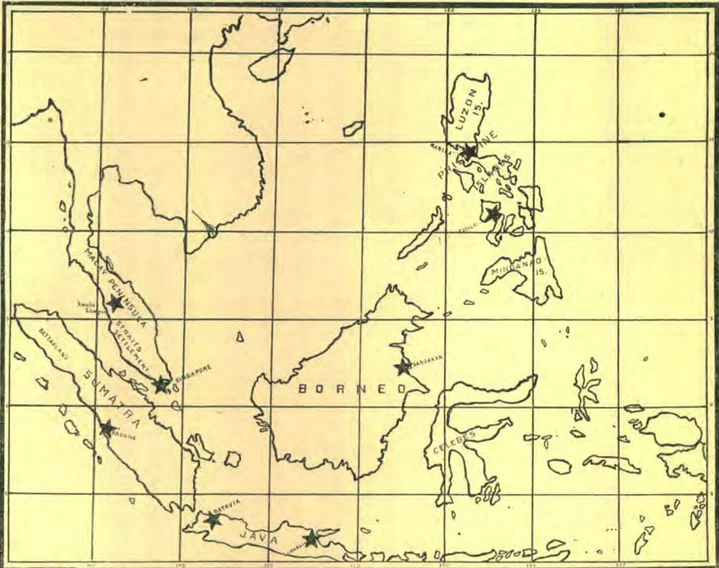
“a. The island of Singapore, at the extreme south end of the peninsula.
“b. Malacca, a strip of land on the west coast of the peninsula about one hundred miles north of Singapore.
“c. The Dindings, a piece of the mainland and a number of islands 350 miles north of Singapore.
“d. The island of Penang and Province Wellesley, a strip of territory opposite Penang on the mainland, 480 miles north of Singapore.”
2. The Federated Malay States.— “The remaining territory of the Malay peninsula is divided into nine states, all under British protection. Four of these have united under a federation by which they are known as the Federated Malay States. By special arrangement Great Britain administers the governmental affairs of these federated states. The other five states are separate and independent. They have placed themselves under British protection, but each administers its state affairs, under the advice of British counselors.”
3. British North Borneo.— This is a territory comprising 31,106 square miles in the island of Borneo. The capital is Sandakan.
4. Sarawak.— A British protectorate comprising 55,000 square miles in Borneo. The capital city is called by the same name.
5. Dutch East Indies.— This territory includes parts of Java, Sumatra, Borneo, the Celebes, and other islands.
Our work in the Malaysian Mission field is operated in six divisions,— the Straits Settlements, the Federated Malay States, Sumatra, West Java, East Java, and British North Borneo. From the first it has been carried forward under very adverse conditions and often against open opposition. The health of the workers has failed, some have had to leave, and others have struggled on faithfully when they were sorely in need of rest. While the results are comparatively small for the time and effort and money expended, it is good to know that in this distant field there are hearts that thrill with the same joy that a knowledge of this truth brings to us. During the last few years the work has been better established and organized, and advance is being made.
In the fall of 1913 the believers used the Harvest Ingathering Review, and obtained over $400 gold from 1000 papers. The membership has nearly doubled in the past two years. The leaders are seeking to awaken the true missionary spirit among the members, realizing that often the natives can reach their friends where a foreigner would be powerless. In Singapore a Missionary Volunteer Society has been organized, both young and old taking the Reading Course and studying the Standard of Attainment subjects. Some begin to pay tithes before they become members. One man who was baptized at Kuala Lumpur sent Brother Detamore a money order for $16 (Straits money), of which $11 was tithe, the first he had paid, and $5 was an offering for the opening up of the work in the Solomon Islands.
The Philippine Islands
This field was first entered in 1906, by Brother R. A. Caldwell, who came to sell books. Evangelical work was begun in 1907, by Pastor J. L. McElhany, but for only the English-speaking residents. In December, 1908, Pastor and Mrs. L. V. Finster entered the field, and began work for the native people. The blessing of God has attended the efforts made, and the workers are full of courage. The following description of the mission stations under which work is now being carried forward is abridged from the report given by Brother Finster to the delegates at the general meeting of the Asiatic Division, held in Shanghai in the spring of 1915:—p. 6
“Until the latter part of 1913, our work had been confined to the Tagalog provinces, in and around Manila, but with the arrival of new missionaries at this time, we were able to open up work in three new languages.
“The Ilocano Mission
“This mission includes the provinces of Ilocos Norte, Ilocos Sur, Abra, and Union. Pastor Roy Hay and family went to Vigan, Ilocos Sur, to study the language and find an opening for our work there. They have been very busy on their language work and in preparing several tracts in the native language. The Lord has also blessed them with three converts, and many others are earnest listeners. The Ilocano people are among the brightest and most stable of the Filipino tribes. Pastor Hay reports many openings for work. In one of his recent letters he reports a man who, having heard that Pastor Hay kept the Sabbath, walked twenty-five miles to his home to study more of the truth.
“The Cebuan Mission
“The islands of Cebu, Bohol, Occidental Negros, Leyte, and Oriental Negros are included in this mission. The languages of the different islands vary but little. Dr. and Mrs. Carlos Fattebert, assisted by Robert Stewart and his wife as colporteurs, are working among the 2,000,000 people of these islands. Dr. Fattebert is located at Argao, and Brother Stewart at Cebu. The doctor's medical work has been well received in Argao, and his dispensary receipts have paid about forty per cent of his salary and expense. His knowledge of Spanish has been a great help to him in his work and in learning the native dialect. He is now able to hold services in the native language. A large number of tracts have been prepared, and our press is now finishing an abridged edition of ‘Thoughts on Daniel.’ There are now eight or nine Sabbath keepers here, and many inquirers.
“Brother Robert Stewart has devoted his time to placing our medical books in the homes of the people. The Lord has richly blessed him in this seed sowing, and he has found interested persons in many parts of the islands.
“The Iloilo Mission
“The people of the islands of Panay and Occidental Negros form this mission. The language is quite similar to the Cebuan. Brother Floyd Ashbaugh first entered this field in 1912 with our literature, and placed many of our books in the homes of the people. These books created many openings, and helped to prepare the field for the arrival of Pastor E. M. Adams and his family in 1914. They have located in Iloilo, in the southern part of Panay. Pastor Adams has had as helpers Fausto Jarnadal and Wenceslao Rodriguez. Just before coming to this meeting, Pastor Adams baptized eleven and organized a church of sixteen members. We are very glad to receive the report of this our first church among the Visayan people. They havep. 7 prepared several tracts in the native language, and have an abridged edition of ‘Thoughts on Daniel’ about ready for the press. Pastor Adams reports the field more than ripe for the harvest, and many more calls for help than they are able to fill.
“The Tagalog Mission
“This is the oldest mission and the headquarters of our work. The working force consists of Brother and Sister W. E. Lanier, the writer and his wife, four Filipino evangelists, one Bible worker, and two Filipino Bible women. Nurse Blodgett has also been able to render much help to the sick.
“We have started a small printing plant for publishing native tracts, papers, and books, and during the past year have printed the following: 50,800 pages in Ilocano tracts; 51,200 pages in Cebuan tracts; 44,000 pages in Panayan tracts; 240,000 pages in Tagalog tracts; 468,000 pages in monthly papers; 60,660 pages in Sabbath school lessons; and 780,000 pages in Tagalog new book. We have also bound about two thousand books in our bindery. Brother W. E. Lanier has charge of the printing work.
“Our first mission home was completed in July. Our first church was erected in Malolos last January. There have been more than one hundred baptisms during the year, and the present membership is about two hundred eighty-five. Our literature sales will reach $5,000, and the tithes about $1,400, as compared with $557.76 last year.”
A missionary society has been organized, and an active interest in this work is being taken by the church. The believers are faithful in tithe paying, and at present the native tithe pays sixty per cent of the native wages and expenses. The Sabbath school work has been well organized, and the offering increased from $75.57 gold in 1913, to $189 gold in 1914.
The table on page six may lack a few details, but we have used the latest and most accurate information at hand, and believe it will be a help in fixing in mind the points at which work has been done, the location of the workers, and something of results accomplished. It is well to remember, however, that results are not always to be measured or counted or weighed. Eternity alone will show them as they really are.
A. B. E.